
Skip to content
Briefings are running a touch slower this week while we rebuild the foundations.See roadmap
Iran Conflict 2026
5MAR

Day 6: $1.1bn radar destroyed; warships named

7 min read
09:10UTC

CENTCOM confirmed three Iranian warships destroyed by name or class — the first independently verified losses from a claimed 20. Qatar disclosed the destruction of a $1.1 billion US early warning radar at Al Udeid, and satellite imagery revealed extensive damage at the Fifth Fleet headquarters in Bahrain. Both chambers of Congress rejected war powers constraints, removing the last domestic political check on the conflict.

Key takeaway

Both sides are sustaining verified losses to irreplaceable military infrastructure while every domestic and international mechanism that might constrain the conflict has been defeated, deferred, or remains without a formal process.

This briefing mapped
Loading map…
Military
Legal
Diplomatic

CENTCOM video confirms two Iranian warships destroyed at Chah Bahar berths. Combined with the torpedoed IRIS Dena, three of the Pentagon's claimed twenty sinkings are now independently verified.

Sources profile:This story draws on neutral-leaning sources from Netherlands and United States
NetherlandsUnited States

CENTCOM released video confirming two Iranian warships destroyed at their berths in Chah Bahar: the IRIS Shahid Sayyad Shirazi (Soleimani-class corvette), filmed ablaze and sinking at pier, and an unnamed Jamaran-class corvette, also struck and sunk dockside. Combined with the previously confirmed IRIS Dena, three Iranian naval vessels have now been independently verified by name or class out of the Pentagon's claimed 20.

The first independently verified warship destructions provide a concrete floor for Iran's naval losses while leaving the vast majority of Pentagon claims unverifiable under Iran's communications blackout — a gap that shapes credibility assessments for both sides. 

Briefing analysis

The AN/FPS-132 destroyed at Al Udeid belongs to the upgraded PAVE PAWS family of radars forming the outer detection layer of US ballistic missile defence. No component of this network has previously been destroyed by enemy action; the system was designed during the Cold War to detect Soviet ICBM launches and has since been adapted for theatre missile warning. Its loss in combat has no precedent in the network's operational history.

The congressional war powers votes extend a pattern from Korea through Vietnam, the 1991 Gulf War, and the 2001 AUMF: legislatures consistently decline to restrain military operations already underway. The War Powers Resolution of 1973, passed in response to Vietnam, has never successfully compelled a president to withdraw forces. The procedural technique deployed here — a competing weaker resolution to fracture a bipartisan coalition — adds a new mechanism to the established pattern of congressional deference during active hostilities.

Iran's foreign minister does not dispute the Dena's sinking — he promises America will 'bitterly regret' the precedent, framing the loss as justification for escalation rather than a defeat requiring explanation.

Sources profile:This story draws on mixed-leaning sources from United Kingdom and Qatar
United KingdomQatar

Iranian Foreign Minister Abbas Araghchi acknowledged the loss of the IRIS Dena for the first time, framing the sinking as a precedent that invites retaliation rather than a defeat requiring acknowledgment. This is Iran's first public confirmation of any named warship loss in the conflict.

Iran's first public acknowledgement of a named warship loss reframes the sinking as an American precedent warranting retaliation rather than an Iranian military setback — establishing the rhetorical foundation for escalatory responses while conceding the underlying fact. 

Qatar's defence ministry confirms an Iranian strike destroyed a $1.1 billion US early warning radar at Al Udeid — the first officially acknowledged destruction of specific US military hardware by a host government in this conflict.

Sources profile:This story draws on mixed-leaning sources from United States
United States
LeftRight

Qatar's Defence Ministry confirmed that an Iranian strike on Al Udeid Air Base destroyed a US AN/FPS-132 early warning radar system valued at approximately $1.1 billion. This is the first specific piece of US military hardware whose destruction has been officially acknowledged by a host government. The AN/FPS-132 is a long-range Ballistic missile early warning radar feeding data into the US-wide missile defence network; its destruction degrades early warning coverage far beyond Al Udeid itself.

The confirmed destruction of a long-range Ballistic missile early warning radar degrades US missile defence coverage far beyond Qatar, and Doha's decision to publicly confirm the loss narrows the space between neutral host and war participant. 

Commercial satellite imagery shows the Fifth Fleet's Bahrain headquarters lost its encrypted communications backbone during the war's most demanding week.

Sources profile:This story draws on mixed-leaning sources from United States
United States
LeftRight

New York Times analysis of Planet Labs and Airbus Defence & Space satellite imagery of Naval Support Activity Manama — the Fifth Fleet's Bahrain headquarters — shows several buildings completely destroyed. Two AN/GSC-52B secure wideband satellite communications terminals (approximately $20 million each) and an AN/TPS-59 radar unit were confirmed destroyed. The comms terminals handle encrypted satellite links for Fifth Fleet coordination across the Arabian Gulf, Red Sea, and western Indian Ocean; their loss forced a shift to backup communications during the conflict's most intensive phase. No US personnel casualties reported.

Iran destroyed the Fifth Fleet's primary encrypted satellite communications terminals at Naval Support Activity Manama, forcing a shift to backup systems during peak operational tempo. The Pentagon did not disclose the damage; commercial satellites and The New York Times did. 

A procedural manoeuvre split the bipartisan coalition behind war powers restraint. Both chambers have now declined to limit presidential authority over the Iran conflict.

Sources profile:This story draws on centre-left-leaning sources from United States
United States

The Massie-Khanna war powers resolution (H.Con.Res.38) was defeated in the House of Representatives on Thursday. The Intercept reported that Representative Josh Gottheimer (D-NJ) introduced a competing weaker alternative resolution designed to provide moderate pro-Israel Democrats cover to vote against the binding measure — a deliberate, coordinated strategy to split the bipartisan Coalition. Combined with the Senate's 47-53 rejection on Wednesday, both chambers have now declined to constrain executive authority over the Iran conflict.

Both chambers have declined to constrain executive authority over the Iran conflict. The House defeat was engineered through a procedural spoiler resolution that split the bipartisan Massie-Khanna Coalition

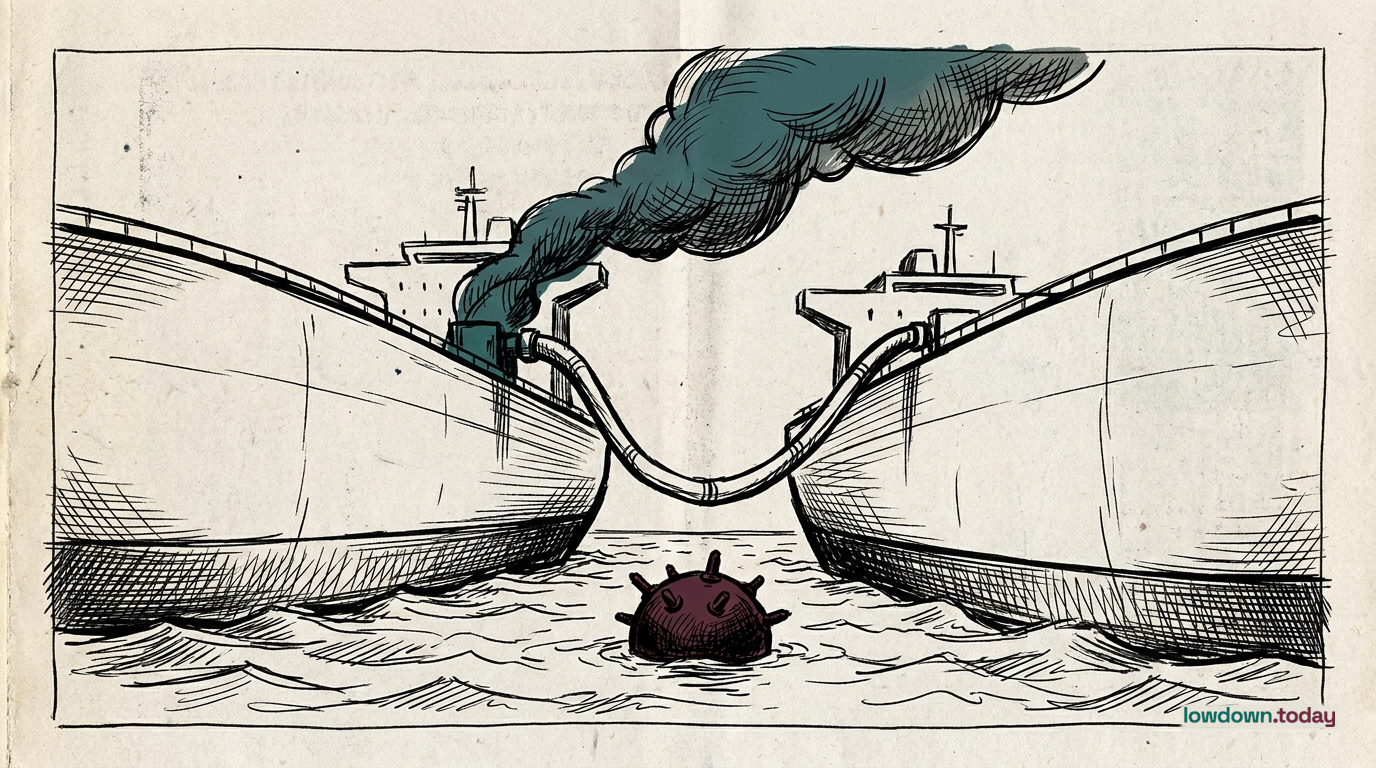
The IRGC claimed it struck a US oil tanker. The Sonangol Namibe is owned by Angola's state oil company and carries no American connection.

Sources profile:This story draws on mixed-leaning sources from Türkiye and United States
TürkiyeUnited States
LeftRight

A drone or missile struck the Sonangol Namibe — a Bahamas-flagged crude tanker operated by Angola's state oil company Sonangol — approximately 30 nautical miles southeast of Kuwait. UKMTO confirmed an explosion on the port side causing a cargo tank oil leak. The IRGC claimed it had struck a 'US oil tanker'; the vessel is Angolan state-owned. This is the first confirmed cargo damage and oil spill from a named commercial vessel in the conflict.

The first confirmed cargo damage and oil spill from a named commercial vessel in the conflict struck a non-aligned OPEC member's tanker — either misidentified or deliberately mislabelled by the IRGC. Both explanations carry consequences for every commercial vessel remaining in Gulf waters. 

Mohammad Pakpour, who commanded IRGC ground operations across Syria and Iraq, is reported killed in the war's opening strikes. His death has not been confirmed by either side.

Sources profile:This story draws on neutral-leaning sources from Iran
Iran

IRGC Ground Forces commander Mohammad Pakpour was reported killed in the opening strikes of 28 February, according to Kurdish human rights monitor Hengaw. Neither the Pentagon nor the IRGC has confirmed his death. Pakpour had led IRGC ground operations in Syria and Iraq and publicly threatened to 'burn down' Tel Aviv in 2024. The IRGC has now lost Pakpour alongside broader institutional disruption from Ali Khamenei's death and the Assembly of Experts strike in Qom.

If confirmed, Pakpour's death removes the operational head of the IRGC's largest branch — responsible for both ground combat and internal security — at a moment when the organisation has simultaneously lost its Supreme Leader, suffered strikes on its political oversight body, and cannot publicly install a successor. 

Sources:Hengaw

Mojtaba Khamenei's formal announcement as Supreme Leader is delayed until next week. Israel's defence minister has publicly promised to assassinate whoever takes the title. Iran is fighting its largest war without a functioning head of state.

Sources profile:This story draws on mixed-leaning sources from United Kingdom and Qatar
United KingdomQatar

Iran International reports the formal public announcement of Mojtaba Khamenei as Supreme Leader may be delayed until next week. Ali Khamenei's burial has been postponed, and Iran does not typically announce a successor before interment. Any public ceremony during active strike operations would present a targeting opportunity. Iran is operating without a formally announced head of state during the most serious military confrontation in the Islamic Republic's 47-year history.

The Islamic Republic's succession process has been tested only once before — in 1989, in peacetime. The delay in formally installing Mojtaba Khamenei means Iran lacks a publicly functioning commander-in-chief during the most intense military confrontation in its 47-year history, with direct consequences for command authority, diplomatic capacity, and internal legitimacy. 

The IRIS Dena attended India's naval review days before the war. A US submarine destroyed it 40 nautical miles from Sri Lanka, in waters India considers its strategic domain. New Delhi's silence has an expiry date.

Sources profile:This story draws on mixed-leaning sources from United States and Japan
United StatesJapan
LeftRight

Bloomberg reported on 5 March that the sinking of the IRIS Dena has created direct political pressure on Indian Prime Minister Modi. The warship had participated in India's International Fleet Review and Exercise MILAN at Visakhapatnam days before the war began and was transiting home through waters India regards as its strategic sphere when destroyed by a US submarine 40 nautical miles from Sri Lankan waters. India has the world's fourth-largest navy and an explicit doctrine of Indian Ocean primacy; the incident poses unresolved questions about whether India's rules for the Indian Ocean apply to all navies equally.

The sinking forces India to confront whether its doctrine of Indian Ocean primacy applies to all navies or only to those it finds convenient to challenge — a question with consequences for India's credibility as the region's self-declared security guarantor and its relationships with both Washington and the non-aligned world. 

Closing comments

Three indicators point toward continued escalation rather than plateau. First, Iran's rhetorical framing of the Dena's sinking as a 'precedent' requiring retaliation, paired with the unconfirmed destroyer claim, signals intent to demonstrate retaliatory naval capability. Second, the first oil spill from a commercial vessel crossed a threshold that had held through earlier strikes — cargo damage raises environmental and legal stakes and may accelerate the withdrawal of remaining P&I coverage. Third, the congressional votes removed the one institutional check that could have imposed a timeline on the executive. No countervailing de-escalation signal appeared on Day 6: no ceasefire proposal, no diplomatic process producing results, no channel moving beyond general statements of concern.

Emerging patterns

  • Incremental independent verification of Pentagon warship claims: 3 confirmed out of 20 claimed
  • Iran framing military losses as precedent-setting grievances justifying escalation rather than defeats
  • Host governments transitioning from neutral hosting to publicly acknowledging war damage, narrowing gap between neutrality and belligerency
  • Systematic degradation of US C4ISR infrastructure in the Gulf from Iranian strikes
  • Congressional inability to constrain executive war-making through procedural coalition-splitting tactics
  • IRGC indiscriminate targeting at range with inflated attribution claims; conflict spillover to non-aligned commercial shipping
  • Systematic decapitation of IRGC command structure; unknown status of command continuity through deputies or autonomous unit commanders
  • Succession crisis compounded by active military operations; leadership vacuum during wartime
  • Third-party powers facing questions about rules of engagement within their declared spheres of influence
Different Perspectives
Iranian Foreign Minister Araghchi
Acknowledged the loss of the IRIS Dena for the first time — Iran's first public confirmation of any named warship sinking — while framing the torpedo kill as a precedent inviting retaliation rather than a military defeat.
CENTCOM
CENTCOM
Issued a firm, specific denial that the USS Abraham Lincoln was struck — 'The Lincoln was not hit. The missiles launched didn't even come close' — but maintained silence on the separate IRGC claim of hitting a US destroyer in the Indian Ocean, an asymmetry consistent with prior patterns of detailed denials when claims are false.
Defence Minister Israel Katz
Publicly stated that any Supreme Leader successor 'will be a certain target for assassination' — an explicit threat to target Iran's incoming head of state during a constitutional succession process.
Qatar Defence Ministry
Publicly confirmed the destruction of the US AN/FPS-132 radar at Al Udeid — the first time a host government has officially acknowledged specific US military hardware losses in this conflict. Qatar had previously maintained its hosting role was separate from the US-Israeli campaign.