Skip to content
Briefings are running a touch slower this week while we rebuild the foundations.See roadmap
Iran Conflict 2026
4JUN

Iran fires ballistic missile at Kuwait

5 min read
11:25UTC

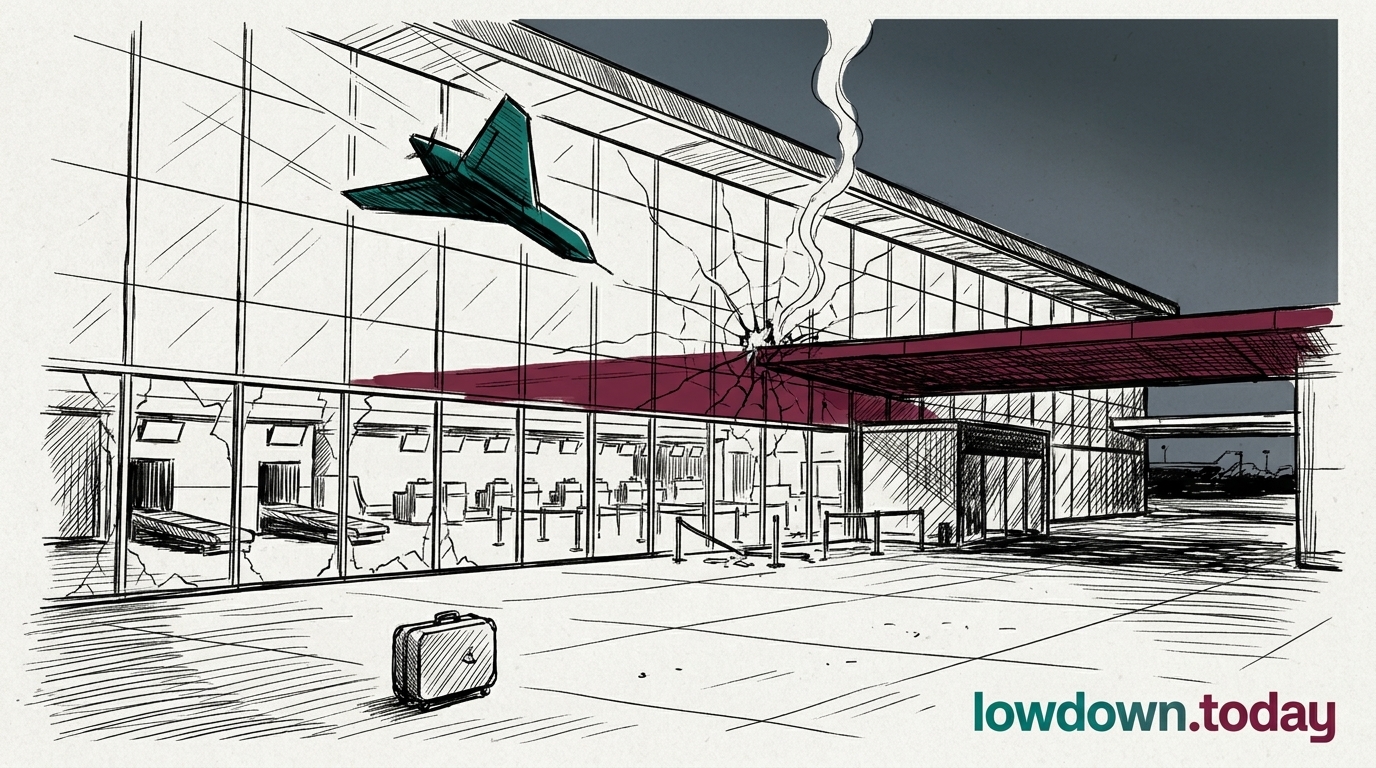
At about 10:17pm Eastern on Wednesday 27 May, Iran fired a ballistic missile toward Kuwait; Kuwaiti forces intercepted it with no casualties. CENTCOM called the night an egregious ceasefire violation.

ConflictDeveloping
Key takeaway

Iran's first missile on Gulf Arab soil widened the war geographically even as the paper track moved toward a deal.

At about 10:17pm Eastern on Wednesday 27 May, Iran fired a ballistic missile toward Kuwait; Kuwaiti forces intercepted it, and no casualties were reported 1. Kuwait is a small, oil-rich Gulf emirate and a long-standing US ally that hosts Camp Arifjan and the Ali Al Salem Air Base. Its foreign ministry condemned the "criminal Iranian attacks" on its territory 2. This is the first ballistic missile to reach the soil of a Gulf Arab state in the conflict, rather than a US base or a ship.

In the same window, US forces intercepted four to five Iranian one-way attack drones near the Strait of Hormuz and struck a ground-control site at Bandar Abbas, Iran's largest port and the operational hub of its Islamic Revolutionary Guard Corps (IRGC, Iran's ideological military branch), that was preparing a further launch 34. CENTCOM (US Central Command, the US military command for the Middle East) called the night an "egregious ceasefire violation", the first time it has reached for that phrase 5. The IRGC framed the missile as retaliation for CENTCOM's 25 May strikes on Bandar Abbas, which destroyed two mine-laying boats and a surface-to-air missile site .

A missile aimed at Kuwait City rather than a US base widens the war's target envelope from American assets to allied sovereign territory, which is why CENTCOM framed it as a violation against a top Gulf ally. Other Gulf capitals must now treat their own ground as inside Iran's reach, and CENTCOM's choice of "egregious" sets a higher bar for the US response if the pattern recurs.

The market repriced faster than the diplomats. Brent Crude had fallen to about $94 per barrel on 27 May as traders read the Hormuz memorandum as genuine de-escalation; it then rebounded roughly 2.6% to $96.57 on 28 May once the Kuwait strike priced kinetic risk back in . Lloyd's of London underwriters, who need a signed instrument rather than a headline, held the Hormuz war-risk designation unchanged, which keeps the war-risk premium embedded in fuel and freight for ordinary consumers.

Deep Analysis

In plain English

Iran fired a ballistic missile at Kuwait on the night of 27 May 2026. Kuwait's Patriot batteries shot it down at altitude, intercepting the missile before it reached the ground, and all 4.5 million Kuwaiti residents were unharmed. But the fact that the launch happened matters more than how it ended. Kuwait is not officially fighting Iran. It is a small Gulf country that hosts US military bases, specifically Camp Arifjan and Ali Al Salem Air Base, from which American forces operate in the region. By firing at Kuwait, Iran sent a message to every other Gulf country that hosts American forces: you are not a bystander just because you have not declared war. Saudi Arabia, the UAE, and Qatar all host large US military facilities. All three have been trying to stay out of the direct conflict while it unfolds. Iran's missile tells them that hosting American soldiers who are striking Iranian targets may make their own territory a target. CENTCOM, the US military command for the Middle East, described the night as an 'egregious ceasefire violation'. US forces also shot down four or five Iranian drones near the Strait of Hormuz the same night and struck an Iranian ground-control site at Bandar Abbas that was preparing further launches.

Deep Analysis
Root Causes

Kuwait hosts Camp Arifjan, CENTCOM's primary ground logistics base in the Gulf region, and Ali Al Salem Air Base, from which US air operations over the Strait of Hormuz are staged. CENTCOM's 25 May Bandar Abbas strike destroyed mine-laying boats and a SAM site; that strike originated partly from assets based in Kuwait. The ballistic missile on 27 May was the IRGC's attempt to make the cost of Kuwaiti basing explicit.

The IRGC's Decentralised Mosaic Defence doctrine, activated since 28 February, devolves launch authority to 31 autonomous provincial units. This reduces the central command's ability to impose escalation discipline: a provincial commander who judges a CENTCOM strike on Bandar Abbas to constitute a local threat can authorise a retaliatory launch without waiting for Tehran.

The 22:17 ET timing suggests the Kuwait strike was ordered within hours of the Bandar Abbas damage assessment, consistent with decentralised authority rather than a deliberate Khamenei-level strategic decision.

Kuwait's air-defence system, Patriot PAC-3 batteries backed by US Aegis coverage, intercepted the missile. The IRGC's strategic calculation may be that repeated intercepts degrade Kuwaiti domestic political tolerance for hosting US forces even when the physical damage is zero.

Escalation

The Kuwait strike marks a qualitative escalation: for the first time in the 2026 conflict, Iran has targeted a Gulf Arab sovereign state with a ballistic missile rather than limiting strikes to US naval assets, tankers, or Israeli-linked targets.

CENTCOM's description of the night as an 'egregious ceasefire violation', the first use of that specific phrase, signals that Washington views this as a threshold crossing. The prior pattern of CENTCOM-Iran exchanges had been framed as defensive actions; the Kuwait strike introduces third-party sovereign targeting that the ceasefire framework had not explicitly addressed.

What could happen next?
  • Risk

    Saudi Arabia, Qatar, and the UAE may begin conditioning their US basing agreements on receiving formal US Article 5-equivalent security guarantees, constraining CENTCOM's operational flexibility in the region.

    Short term · Assessed
  • Consequence

    Kuwait's foreign ministry condemnation as 'criminal Iranian attacks' on its territory constitutes its first formal declaration of adversarial status toward Iran, which may require Kuwait to formally invoke its bilateral defence agreement with the United States.

    Immediate · Reported
  • Precedent

    By striking Kuwait's sovereign territory with a ballistic missile, Iran has established that Gulf states hosting US forces are legitimate retaliatory targets under the IRGC's decentralised escalation doctrine, regardless of those states' own declared neutrality.

    Medium term · Assessed
First Reported In

Update #111 · US sanctions the strait its deal reopens

PBS NewsHour· 29 May 2026
Read original
Different Perspectives
China
China
Beijing's MOFCOM Blocking Rules constrain OFAC enforcement on the mainland; China has not corroborated Trump's verbal account of any bilateral summit, and the rial's failure to hold its Rubio bounce, combined with the IRGC's stablecoin rail closure, increases Chinese yuan-denominated oil-payment exposure through Hormuz.
Israel
Israel
IDF Chief Zamir said on 3 June there is no ceasefire for his forces even as Israel signed the Washington Lebanon framework requiring Hezbollah withdrawal south of the Litani; a UNIFIL peacekeeper was killed by mortar near Marjayoun on the same day, exposing the gap between the diplomatic framework and a ground advance that has not stopped.
Bahrain
Bahrain
The IRGC struck Bahrain on 3 June as its sirens sounded and its PAC-3 magazine neared exhaustion; excluded from Rubio's 2 May emergency resupply, Bahrain received a 50-round Federal Register notice on 1 June on an 18-month delivery timeline, meaning it is defending the US Fifth Fleet headquarters on the last rounds it has.
Qatar
Qatar
Qatar offered $6bn under OFAC Licence L-2 restrictions and sent Ghalibaf's delegation home empty-handed; the $6bn ceiling is a legal constraint, not a negotiating floor, and Rubio's no-sanctions-relief testimony means Qatar cannot revise it without White House action that has not been requested.
Kuwait
Kuwait
Kuwait expelled two Iranian diplomats within 24 hours of the airport strike, the strongest and fastest Kuwaiti diplomatic move of the conflict, while keeping the full mission in place to preserve a communication channel; it has now invoked Article 51 self-defence, filed a formal protest, and expelled diplomats, exhausting its formal toolkit short of full rupture.
United States
United States
Trump narrated a weekend deal while the channel Rubio described under oath, Khamenei's written-only couriers with a 3-to-5-day lag, cannot answer at that speed; CENTCOM called the airport strike deliberate, calculated and unjustified. The House 215-208 vote gave Congress its first on-record war-powers position against the deployment Trump has run without a signed instrument for 96 days.