
Skip to content
Briefings are running a touch slower this week while we rebuild the foundations.See roadmap
Iran Conflict 2026
29MAY

Day 91: US sanctions the strait its deal reopens

1 min read
08:47UTC

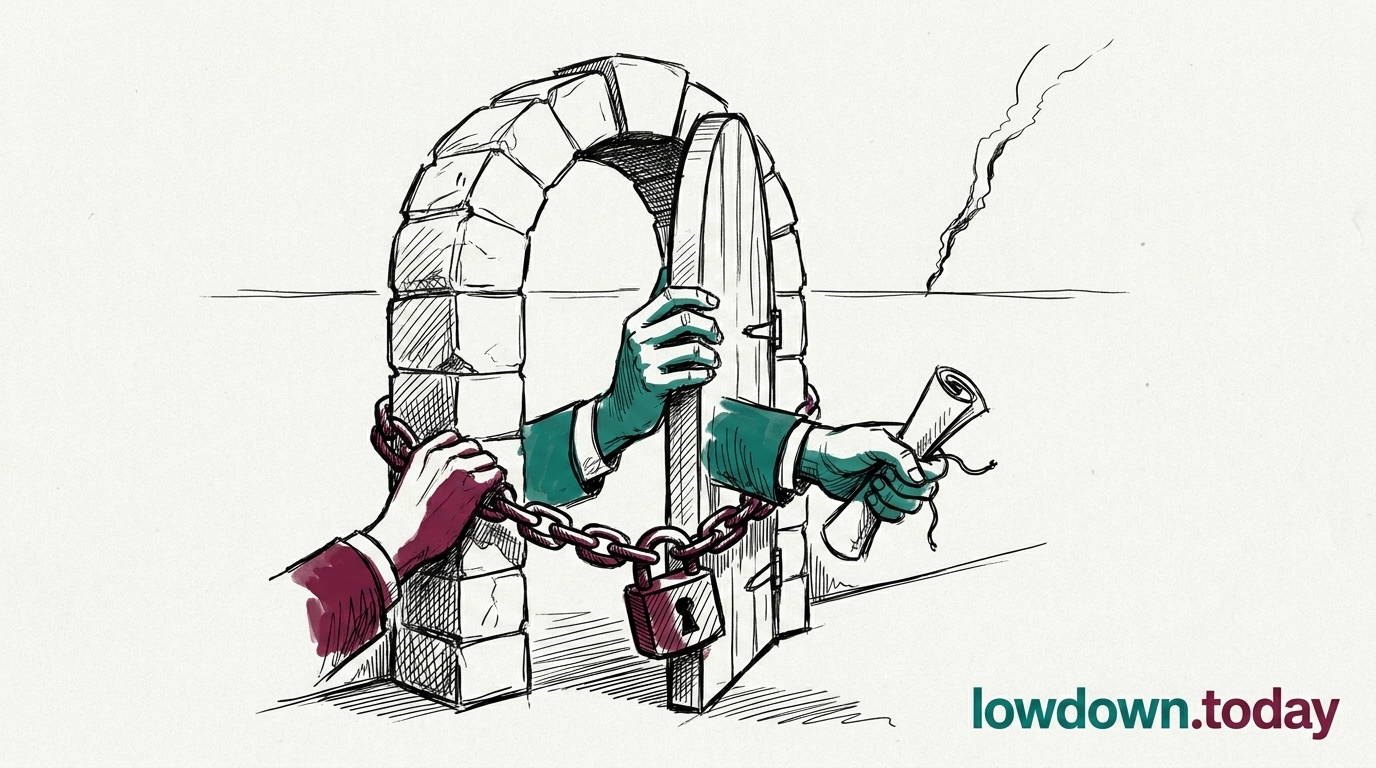
On 28 May, US and Iranian negotiators reached a tentative 60-day memorandum promising a Strait of Hormuz reopened with no tolls. The same day, the US Treasury sanctioned the very Iranian authority that would run that shipping, and Iran fired a ballistic missile at Kuwait. The words point one way; the signed actions point the other.

Key takeaway

The same structural logic is sabotaging both the diplomatic and military tracks simultaneously.

This briefing mapped
Loading map…
Regulatory
Military
Humanitarian

On 28 May the US Treasury sanctioned Iran's Persian Gulf Strait Authority hours after negotiators reached a 60-day memorandum promising a toll-free Hormuz. The signed order took effect; the deal sat unsigned.

Sources profile:This story draws on mixed-leaning sources from United States, Qatar and 1 more
United StatesQatarIsrael
LeftRight

On 28 May, US and Iranian negotiators reached a tentative 60-day deal to reopen the strait of Hormuz toll-free. Neither Trump nor Khamenei signed. The same day, the US Treasury added Iran's Persian Gulf Strait Authority, the toll-collection body, to a terrorism blacklist.

That blacklisting means no bank or insurer can process Hormuz transit payments without risking US sanctions. The Treasury's sanctions office blocks commercial reopening until a presidential order removes the Persian Gulf Strait Authority from the banned list. 

At about 10:17pm Eastern on Wednesday 27 May, Iran fired a ballistic missile toward Kuwait; Kuwaiti forces intercepted it with no casualties. CENTCOM called the night an egregious ceasefire violation.

Sources profile:This story draws on mixed-leaning sources from United States
United States
LeftRight

Iran fired a ballistic missile at Kuwait on 27 May, the first Gulf Arab state struck in the 2026 conflict. Kuwait's Patriot batteries intercepted it. US forces downed four or five Iranian drones near Hormuz and struck a Bandar Abbas launch site the same night.

Kuwait hosts Camp Arifjan and Ali Al Salem Air Base, from which American forces strike Iranian targets. The attack signals that any Gulf state hosting US forces may now be a target. 

Amnesty International documented at least 39 political executions and more than 6,000 arbitrary arrests in Iran since the war began on 28 February, in a report dated 28 May. The repression kept wartime tempo throughout the Doha talks.

Sources profile:This story draws on centre-leaning sources from United Kingdom
United Kingdom
LeftRight

Amnesty International published its first full wartime tally on 28 May: at least 39 political executions and 6,000-plus arrests since the conflict began on 28 February. The 39 executions include 16 protesters, nine dissidents, and ten people convicted of spying for the US or Israel.

The pace did not slow during the diplomatic talks in Doha. Iran's security apparatus and its negotiating team ran on separate tracks throughout, and Amnesty's 28 May report put that divergence on the record. 

Closing comments

Sideways to up. The January 2020 precedent, when EO 13224 designations of NIOC subsidiaries outlasted concurrent JCPOA-revival diplomacy by 14 months, is the base case for how long the PGSA designation can coexist with a live MOU track. The 28 May Kuwait ballistic missile strike introduces an additional vector: CENTCOM's use of the phrase 'egregious ceasefire violation' for the first time marks a threshold. If IRGC provincial units launch a second ballistic missile at GCC sovereign territory, Kuwait's bilateral US defence agreement and similar frameworks covering Saudi Arabia, the UAE, and Qatar will face a formal invocation test. The 1 June WPR wind-down lapse removes Congress as a domestic check on the same week. Specific decision hinge: whether OFAC issues a wind-down general licence for PGSA-adjacent transit before Trump and Khamenei are both asked to sign the MOU text.

Different Perspectives
US Treasury / Trump administration
Treasury Secretary Bessent framed the PGSA designation as a strike against 'extortion', while Trump declined to sign the MOU and told negotiators to take more time. The administration is using an EO 13224 counterterrorism designation as pre-signature leverage, but that instrument cannot be suspended by diplomatic agreement without a presidential revocation.
Iran (Tasnim / Foreign Ministry)
Tasnim called any Western claim that the MOU was finalised 'not valid', and Khamenei had not approved the text. Iran's Foreign Ministry positions the deal as an ongoing process with sovereignty over the PGSA and Hormuz as non-negotiable, while its IRGC adviser simultaneously called Trump's nuclear demands a 'fantasy'.
Kuwait (Ministry of Foreign Affairs)
Kuwait's foreign ministry condemned the 'criminal Iranian attacks' on its sovereign territory and is the first Gulf Arab state to be formally struck by an Iranian ballistic missile in the 2026 conflict. The condemnation may require Kuwait to invoke its bilateral US defence agreement.
Qatar (Emir's office / Doha mediators)
Qatar hosted Iran's war cabinet across late May and holds roughly $12 billion in frozen Iranian assets that Tehran named as the Hormuz reopening precondition. With the MOU unsigned and the PGSA now on the SDN list, Doha remains the financial hinge of any deal architecture, but cannot release the assets without OFAC clearance it does not have.
Amnesty International / Iran Human Rights
Amnesty's 28 May report documents 39 confirmed political executions in 90 days, a pace exceeding any sustained wartime rate since the 1988 prison massacres. IHR director Mahmood Amiry-Moghaddam notes the 88-day internet blackout is structurally functional for execution concealment, not incidental to it.