Skip to content
Briefings are running a touch slower this week while we rebuild the foundations.See roadmap
Iran Conflict 2026
4JUN

Pezeshkian cites IRGC takeover in letter

3 min read
11:25UTC

President Masoud Pezeshkian sent Supreme Leader Mojtaba Khamenei a letter on 1 June accusing the IRGC of cutting the presidency out of war decisions; the government denied he had quit.

ConflictDeveloping
Key takeaway

Pezeshkian sent a letter accusing the IRGC of sidelining him; the government denies he resigned and disputes the leak.

President Masoud Pezeshkian sent Supreme Leader Mojtaba Khamenei a letter on 1 June accusing the Islamic Revolutionary Guard Corps (IRGC) of cutting the presidency out of war decisions and leaving him unable to run the government, according to reports that surfaced on 3 to 4 June 1. Pezeshkian is Iran's elected civilian president, a reformist who holds no command authority over the IRGC.

The government moved quickly to contain it. Officials denied that Pezeshkian had quit, and his own office put out a statement reaffirming his determination to stay in post. What is verifiable is that a letter citing IRGC interference was sent and then leaked; whether it amounted to a resignation is exactly what Tehran is now disputing in public.

Khamenei addressed the affair himself. On 3 to 4 June he issued a public warning that any action causing public frustration or distrust would amount to helping Iran's adversaries, framing the leak as an enemy operation rather than an internal rift. The episode fits the factional pattern that has run through the conflict, in which the IRGC overrides the civilian government . Ghalibaf's parliamentary bloc pre-refused Majlis ratification of any deal on the same 1 June , the IRGC-aligned camp consolidating against civilian institutions as the war ground on.

Deep Analysis

In plain English

Iran has two competing power structures that have been in tension throughout this conflict. President Masoud Pezeshkian is the elected civilian leader, but his government's authority is severely limited by the IRGC, Iran's ideological military force, which reports to the Supreme Leader rather than the civilian government. On 1 June 2026, Pezeshkian reportedly sent a letter to Supreme Leader Mojtaba Khamenei complaining that the IRGC had cut the presidency out of all major war decisions, leaving him unable to run the country. News of the letter became public on 3-4 June. The government quickly denied that Pezeshkian had resigned. Pezeshkian's own office issued a statement saying he remained committed to serving. Separately, Khamenei issued a public warning that anyone causing 'public frustration or distrust' was helping Iran's enemies, which many observers read as framing the leak of the letter as an attack by foreign adversaries. Whether the letter was a private complaint, a political manoeuvre, or a genuine resignation attempt remains contested. Iran's government denied any resignation; Pezeshkian's office confirmed he remains in post.

Deep Analysis
Root Causes

Pezeshkian's position became structurally untenable through a sequence that built across the conflict. IRGC Major General Vahidi consolidated control of both military and diplomatic tracks by 22 April, reversing Araghchi's Hormuz reopening announcement within hours of its publication.

Ghalibaf's Majlis pre-refusal of any MOU on 1 June, issued on the same day as Pezeshkian's letter, represents the IRGC bloc's simultaneous constitutional capture of the legislature and military command. With an IRGC-controlled Majlis and an IRGC-installed Supreme Leader, Pezeshkian's presidency occupies a triangle that has no vertex for civilian authority.

Khamenei's public warning on 3-4 June against actions causing 'public frustration or distrust' frames the letter's leak as an enemy operation while implicitly acknowledging the letter's existence. The warning was addressed to the population, not to Pezeshkian, which is the mechanism Khamenei uses to signal that a factional actor crossed a line without publicly naming the actor.

Escalation

Khamenei's public warning on 3-4 June is the clearest signal yet that the factional conflict between the civilian presidency and the IRGC bloc has breached the internal-management threshold. Prior disputes (the April Hormuz-opening reversal, the April Pezeshkian-unable-to-reach-Khamenei episode) were managed through back-channel correction.

A public warning from the Supreme Leader framing an internal complaint as an enemy operation means the conflict is now being contested in the public information space, which the IRGC controls through Tasnim and other outlets.

First Reported In

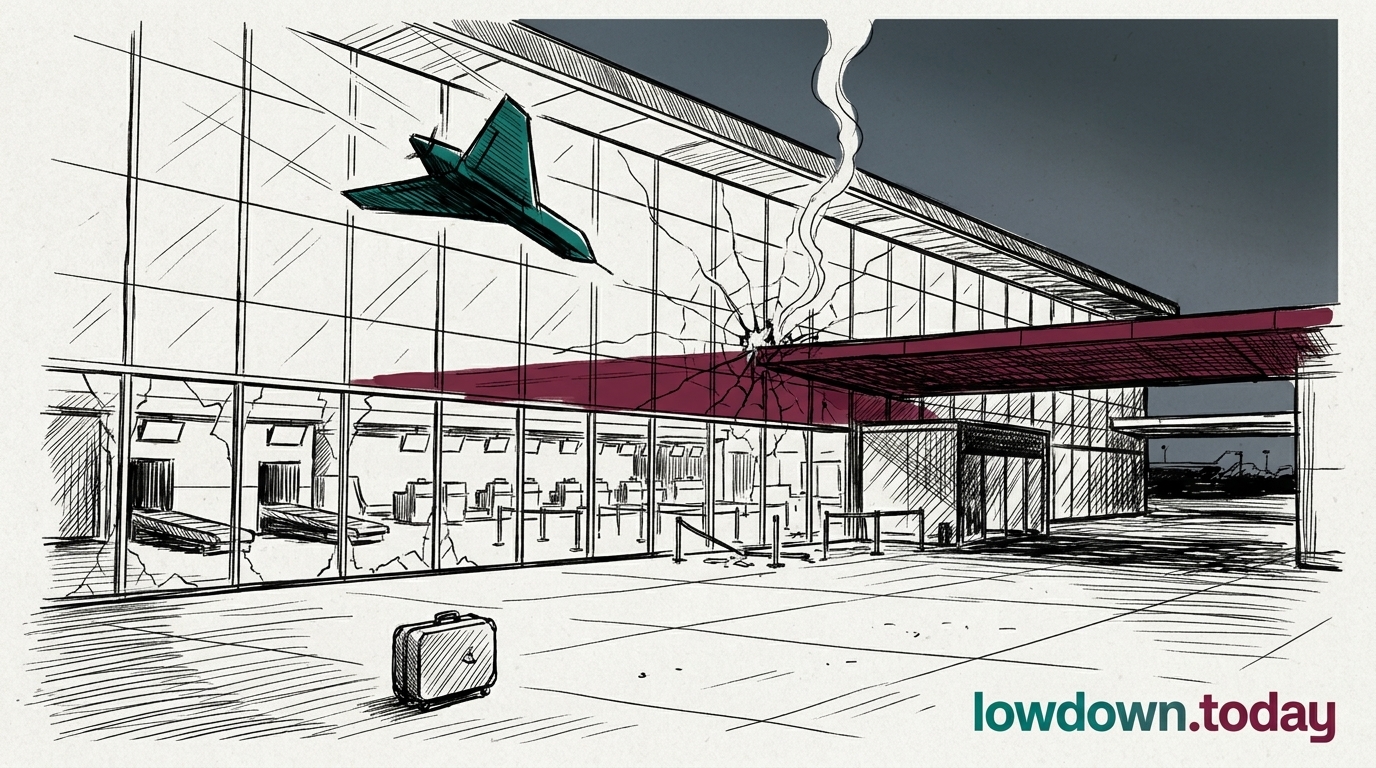
Update #117 · Iran's drone finds Kuwait's arrivals hall

Al Jazeera· 4 Jun 2026
Read original
Different Perspectives
China
China
Beijing's MOFCOM Blocking Rules constrain OFAC enforcement on the mainland; China has not corroborated Trump's verbal account of any bilateral summit, and the rial's failure to hold its Rubio bounce, combined with the IRGC's stablecoin rail closure, increases Chinese yuan-denominated oil-payment exposure through Hormuz.
Israel
Israel
IDF Chief Zamir said on 3 June there is no ceasefire for his forces even as Israel signed the Washington Lebanon framework requiring Hezbollah withdrawal south of the Litani; a UNIFIL peacekeeper was killed by mortar near Marjayoun on the same day, exposing the gap between the diplomatic framework and a ground advance that has not stopped.
Bahrain
Bahrain
The IRGC struck Bahrain on 3 June as its sirens sounded and its PAC-3 magazine neared exhaustion; excluded from Rubio's 2 May emergency resupply, Bahrain received a 50-round Federal Register notice on 1 June on an 18-month delivery timeline, meaning it is defending the US Fifth Fleet headquarters on the last rounds it has.
Qatar
Qatar
Qatar offered $6bn under OFAC Licence L-2 restrictions and sent Ghalibaf's delegation home empty-handed; the $6bn ceiling is a legal constraint, not a negotiating floor, and Rubio's no-sanctions-relief testimony means Qatar cannot revise it without White House action that has not been requested.
Kuwait
Kuwait
Kuwait expelled two Iranian diplomats within 24 hours of the airport strike, the strongest and fastest Kuwaiti diplomatic move of the conflict, while keeping the full mission in place to preserve a communication channel; it has now invoked Article 51 self-defence, filed a formal protest, and expelled diplomats, exhausting its formal toolkit short of full rupture.
United States
United States
Trump narrated a weekend deal while the channel Rubio described under oath, Khamenei's written-only couriers with a 3-to-5-day lag, cannot answer at that speed; CENTCOM called the airport strike deliberate, calculated and unjustified. The House 215-208 vote gave Congress its first on-record war-powers position against the deployment Trump has run without a signed instrument for 96 days.