
Skip to content
Briefings are running a touch slower this week while we rebuild the foundations.See roadmap
Iran Conflict 2026
17MAY

Day 79: Tehran prints the toll book; Delhi joins the queue

4 min read
10:45UTC

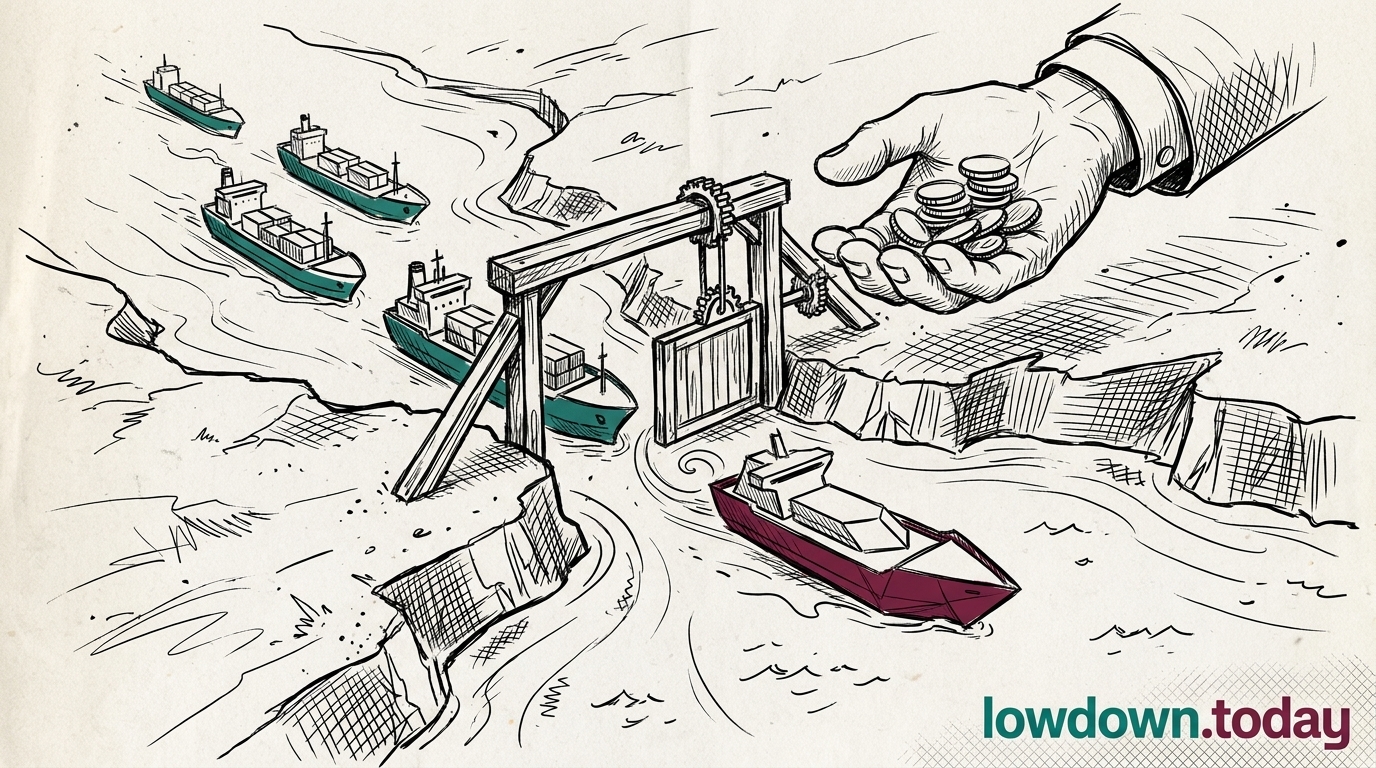
Iran's parliamentary security chief declared Hormuz a managed toll route on Saturday, naming Trump's Project Freedom vessels as the one excluded class. Within 24 hours, Foreign Minister Araghchi told India's Jaishankar that Iranian forces were already guiding Indian ships through, and the Pentagon was weighing a new operation name to reset the War Powers clock.

Key takeaway

Iran's Majlis put four institutions behind the Hormuz toll; Washington produced 79 days of unsigned paper.

This briefing mapped
Loading map…
Regulatory
Diplomatic
Legal
Military
Humanitarian
Domestic

Ebrahim Azizi, who chairs Iran's parliamentary security committee, posted on Saturday that Iran has a 'professional mechanism' for Hormuz traffic with fees on cooperating vessels and Project Freedom barred from the route.

Sources profile:This story draws on neutral-leaning sources from United States and United Kingdom
United StatesUnited Kingdom
LeftRight

Iran's parliamentary security committee chairman Ebrahim Azizi posted on 16 May that Tehran has a 'professional mechanism' to collect fees from ships transiting the strait of Hormuz, explicitly excluding vessels linked to the US Operation Project Freedom.

This is the first time Iran's parliament has formally backed the toll system the military has been running since 6 May, combining legislative authority with an operational exclusion list that directly contradicts the international right of free passage through international straits. 

Iranian Foreign Minister Abbas Araghchi told Indian counterpart S. Jaishankar in New Delhi on Friday that roughly 13 Indian-flagged vessels are queued for Hormuz transit while Iranian military personnel guide cleared ships through mine zones.

Sources profile:This story draws on mixed-leaning sources from India and United Kingdom
IndiaUnited Kingdom
LeftRight

Iran's Foreign Minister Abbas Araghchi disclosed to his Indian counterpart Jaishankar on 15 May that roughly 13 Indian ships are queued for Hormuz transit while Iranian military personnel guide cleared vessels through mine zones. Araghchi separately confirmed that Tehran and Muscat have opened consultations on future Strait governance, though no signed text has emerged.

India is now the fourth state operating inside Iran's bilateral passage system with no written agreement, and if Oman, which legally co-administers the southern half of the strait, endorses Iran's framework, the Western coalition's legal case for free passage loses its strongest regional backing. 

Two US officials told NBC News on Tuesday that any resumed Iran operation may be renamed Operation Sledgehammer to argue that the 60-day War Powers Resolution clock restarts from zero.

Sources profile:This story draws on centre-left-leaning sources from United States
United States

The Pentagon was reported on 12 May to be considering naming any resumed Iran military operation 'Operation Sledgehammer', on the theory that a new operation name restarts the 60-day War Powers Resolution clock that expired without a congressional vote on 29 April.

Most independent legal experts, including scholars at the Lawfare Institute and The Brookings Institution, assess the rename argument as novel but unlikely to survive scrutiny, since the 1973 law attaches the clock to the fighting itself, not the name on the mission. 

Sources:NBC News

Donald Trump posted an AI-generated warship image on Truth Social captioned 'It was the calm before the storm' on Sunday, two days after the New York Times reported US-Israeli strike preparations at their most intensive since 28 February.

Sources profile:This story draws on centre-left-leaning sources from India, United States and 1 more
IndiaUnited StatesQatar
LeftRight

Donald Trump posted an artificial-intelligence-generated image on Truth Social on 17 May showing himself alongside US Navy warships and Iranian vessels, captioned 'It was the calm before the storm'. Two days earlier, The New York Times reported that US and Israeli military preparations for an Iran strike were at their highest intensity since the war began on 28 February.

The image carries no legal force; the strike-preparation reporting underneath it does. Chatham House analysts tracking the conflict note the unsigned verbal-kinetic gap has now reached 79 days, the longest of any comparable US military operation in the post-Vietnam era. 

The BRICS foreign ministers' meeting in New Delhi ended 14-15 May without a joint declaration after the UAE, hit by Iranian drones on 10 May, demanded Iran be condemned for strikes on neighbouring states.

Sources profile:This story draws on mixed-leaning sources from India
India

The BRICS foreign ministers' meeting in New Delhi on 14-15 May ended without a joint statement after the UAE, which Iranian drones struck on 10 May, blocked any text that did not condemn Iran for attacks on neighbouring states. Iran demanded condemnation of the US and Israel instead. India, hosting the meeting, issued a summary document in place of the failed declaration.

This was the first time a Gulf BRICS member publicly broke with Iran inside the bloc Tehran has described as the multilateral alternative to Western order. The South African Institute of International Affairs had flagged the Iran-UAE veto pair as a structural risk at BRICS's 2024 Kazan expansion. 

Sabah Bevara was 'violently arrested' in Piranshahr on 17 May; Abbas Mamousi was detained in Dehloran on 16 May and transferred to Ilam Central Prison, the Norway-based monitor Hengaw documented.

Sources profile:This story draws on neutral-leaning sources from Iran
Iran

Hengaw, a Norway-based Kurdish rights monitor, documented two further arrests on 16-17 May: Sabah Bevara was violently arrested in the Kurdish town of Piranshahr in West Azerbaijan; Abbas Mamousi was detained in Dehloran and transferred to Ilam Central Prison. Both cases extend a running cluster Hengaw has tracked across northwestern Iran since 13 May.

The wartime judicial apparatus runs on its own calendar, independent of diplomatic meetings in Delhi or social media posts in Washington. The UN Special Rapporteur on Iran cites Hengaw as its primary granular source for this detention pattern, which forms the evidentiary basis for future international accountability proceedings. 

Sources:Hengaw

State broadcaster Tasnim aired an Ebrahim Azizi interview confirming the €50-million Majlis bounty bill on Donald Trump; the chairman said Iran would be obligated to pay if anyone carries out the 'religious and ideological mission'.

Sources profile:This story draws on right-leaning sources from Iran
Iran
LeftRight

Iran's state broadcaster Tasnim aired a 17 May interview in which Majlis security committee chairman Ebrahim Azizi confirmed the €50-million parliamentary bounty bill on Donald Trump, saying the Iranian government would be obligated to pay if anyone carried out what he called 'this religious and ideological mission'. The bill remains under parliamentary review, not yet voted.

The IRGC-linked Tasnim broadcast upgrades the bill from a single opposition-outlet report to state-media-endorsed parliamentary fact. The International Crisis Group's Iran team notes that when IRGC-affiliated media explicitly corroborate a Majlis bill, passage probability rises regardless of the Foreign Ministry's diplomatic posture. 

Iranian Parliament Speaker Mohammad Bagher Ghalibaf said on Sunday the world is 'at the cusp of a new order', quoting Xi Jinping's 'transformation unseen in a century' and crediting Iran's '70-day resistance' with accelerating the shift.

Sources profile:This story draws on neutral-leaning sources

Iranian parliament Speaker Mohammad Bagher Ghalibaf declared on 17 May that the world stands 'at the cusp of a new order', quoting Chinese President Xi Jinping's 'transformation unseen in a century' and crediting Iran's 70 days of resistance with accelerating the shift. No bilateral instrument accompanied the declaration.

Carnegie Endowment analysts note Ghalibaf is annexing Chinese rhetorical authority to the Iran war narrative without Beijing's explicit endorsement, exploiting the gap between China's refusal to condemn Iran and its equal refusal to endorse the conflict. The declaration runs directly counter to Araghchi's simultaneous back-channel negotiations, marking the widest public divergence between Iran's legislative and diplomatic tracks since February. 

Sources:ANI News
Closing comments

Direction: up; the House tied 212-212 on 14 May 2026, one vote from forcing a war-powers resolution and the closest Congress has come to constraining the Iran operation since it began on 28 February 2026. The specific mechanism that tips escalation is the Pentagon formally declaring Epic Fury ended and renaming the successor operation Sledgehammer, which resets the 60-day WPR clock from zero under the administration's untested legal theory. Named actor: Defence Secretary Hegseth, whose 12 May 2026 Senate Armed Services Committee testimony foreclosed the AUMF route by asserting Article 2 covers all strikes. If the rename is declared, the administration removes its last institutional incentive to restrain resumed kinetic action; if a court denies standing to challenge it, the War Powers Resolution is nullified in practice.

Different Perspectives
Iran
Iran
Azizi declared a parliamentary Hormuz toll mechanism on 16 May while Ghalibaf framed the 70-day war as a Global South historical pivot. Araghchi runs a parallel diplomatic channel through Islamabad and New Delhi, but the Majlis security committee controls the floor vote that would either bind or collapse any civilian settlement track.
United States
United States
The Pentagon weighed renaming any resumed Iran operation Sledgehammer to restart the WPR clock, while the White House extended its 79-day run without a signed Iran instrument. Trump's storm post and NYT-reported peak strike preparations describe an administration positioning for resumed kinetic action under Hegseth's Article 2 cover, with Sledgehammer as procedural fallback.
India
India
Jaishankar received Araghchi's Hormuz disclosure ; 13 Indian ships queued, Iranian military guiding cleared vessels through mine zones ; without a public rebuke, extending Delhi's strategic autonomy doctrine into the operational reality of Iranian-controlled transit. India entered the bilateral guided-passage system as the fourth named state with no written agreement and no public position.
United Arab Emirates
The UAE blocked a BRICS joint declaration by demanding Iran be condemned for strikes on neighbouring states, having been hit by Iranian drones on 10 May. Abu Dhabi's simultaneous dependence on the Abraham Accords and Fujairah's role as the only major oil terminal outside the Hormuz transit zone made capitulation on either demand structurally impossible.
United Kingdom / France (Northwood coalition)
The 26-nation Northwood coalition formalised in Bahrain on 12 May operates under UNCLOS Article 38 transit-passage rights that Iran's parliamentary toll claim directly contests. UK Typhoons, HMS Dragon, and French assets are committed to the coalition; if Oman signs a co-administration framework with Iran, the UNCLOS legal foundation collapses under the coalition mandate.