Skip to content
You can now search across every topic, entity and event.What's new
European Energy Markets
3AUG

Gulf producers build around the strait

3 min read
10:53UTC

Kuwait said it would raise production as Iraq's Kirkuk-Ceyhan and Saudi Arabia's Yanbu East-West pipelines moved roughly 9 million barrels a day around Hormuz, against the strait's normal 20 million.

EconomicDeveloping
Key takeaway

Gulf pipelines route about 9 million barrels a day around Hormuz, under half the strait's normal flow.

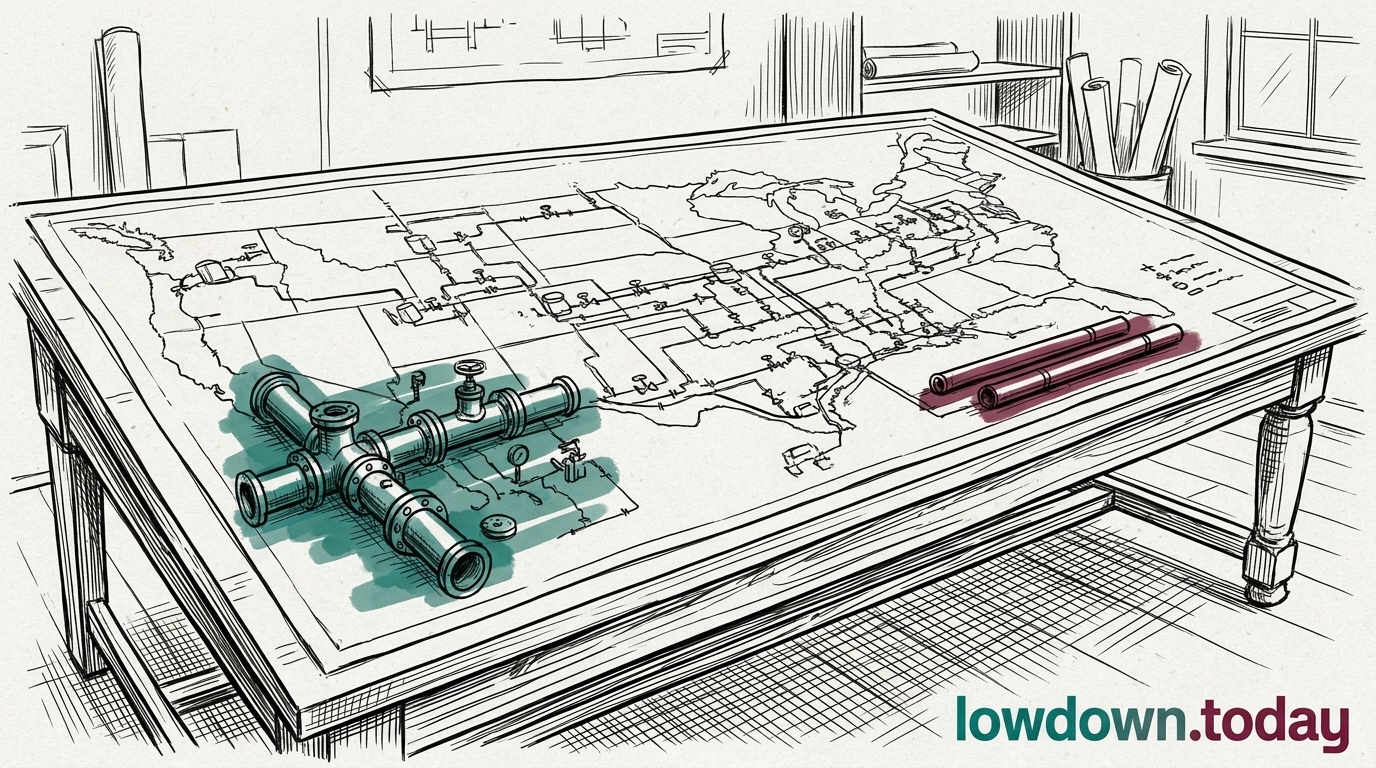
Kuwait said it would begin increasing production, and Gulf exporters drew on pipeline routes that skirt the strait of Hormuz entirely: Iraq's Kirkuk-Ceyhan line to Turkey's Mediterranean coast and Saudi Arabia's Yanbu East-West line to the Red Sea 1. Both run crude out to open water without touching the waterway the IRGC has formally declared closed.

The two pipelines carry roughly 9 million barrels a day between them, against the strait's normal 20 million 2. Producers can route under half their oil around Iran's leverage, which is why a closure threat still bites even as the workaround keeps prices calm: the alternatives soften the chokepoint without replacing it.

Three Saudi very large crude carriers reactivated their transponders off Oman on 19 June, the first confirmed commercial crossings since the closure declaration 3. Days earlier those same ships had only been positioned near Hormuz, not transiting ; by 22 June they were moving cargo across the closure line itself, turning a structural hedge for Riyadh and Baghdad into a live one.


Deep Analysis

In plain English

While Iran claims to have closed the Strait of Hormuz, Gulf oil producers have been routing crude through two alternative pipelines that avoid it entirely. One runs from Iraq's Kirkuk oilfields north to Turkey's Mediterranean coast; the other crosses Saudi Arabia from east to west, ending at the Red Sea port of Yanbu. Together these carry roughly 9 million barrels a day. The problem is that this is less than half of what normally goes through Hormuz (about 20 million barrels a day). So the world can get some oil out of the Gulf via these pipelines, but not nearly enough to replace what would normally flow through the strait. That is one reason energy prices remain elevated even as they fall from their peak.

What could happen next?
  • Consequence

    The 9 million barrels per day pipeline ceiling means Asian refiners dependent on Gulf crude face a persistent supply gap until the Oman corridor delivers full restoration; Kuwait's production increase partially offsets this but at reduced margin given sub-$80 Brent.

  • Precedent

    Saudi Aramco's resumption of VLCC transits through the Oman corridor, using AIS transparency rather than dark shipping, establishes a Gulf-producer norm for Hormuz reopening: producers will transit when the route is physically safe, regardless of IRGC declaration status.

First Reported In

Update #135 · Trump's threats peak, his paper stays blank

Wikipedia / Kpler· 22 Jun 2026
Read original
Different Perspectives
Cross-border power traders
The France-Germany day-ahead spread flipped from a EUR 17.20 German premium on 1 August to a EUR 4.15 French premium on 3 August, the same day French curtailment peaked. They cannot yet attribute the flip to curtailment alone, since a like-for-like overnight comparison shows French nuclear output rising while wind fell and demand returned on the weekday step.
EDF
EDF
River-cooling limits took 7.6 GW, 12 per cent of its fleet, offline on 3 August, the highest curtailment since the heatwave began, with an easing forecast to 4.3 GW on 4 August and 3 GW after. It manages the cut as a recurring seasonal constraint, expecting it to lift with river temperature, not repair.
Gasunie
Gasunie
TTF, the Dutch hub it operates, drifted to roughly EUR 55 to 58 per MWh across the window, staying inside its recent range through both the German spark reversal and the French curtailment. It reads a flat hub price as evidence that neither event this window carried enough weight to move the fuel leg on its own.
German gas-fired generators
Record German solar of 18,761 MW on 2 August pushed the clean spark spread to minus 18.48 EUR/MWh, a loss-making day, before it returned to plus 16.20 on 3 August. They now price dispatch against post-solar residual load rather than wind alone, since the sign flipped inside 48 hours on unchanged fuel and carbon costs.
European Commission (DG Energy)
Its implementing-measures register logged transposition notices from only Portugal and Slovakia against Wednesday's Article 94 deadline for Directive (EU) 2024/1788, with 25 states silent. It expects the register to fill only gradually, since filing routinely lags legislating and any infringement track against non-notifying states runs on a slower clock than the deadline itself.
Spain's LNG terminal operators
Spain's 9,145 GWh terminal inventory is the largest single stock in the EU LNG network, an option value that can reroute cargoes wherever the winter strip pays best rather than a cavern gas obligation tied to a fixed date. That flexibility matters more as Germany's cavern shortfall pushes more of the winter security question onto import infrastructure.



