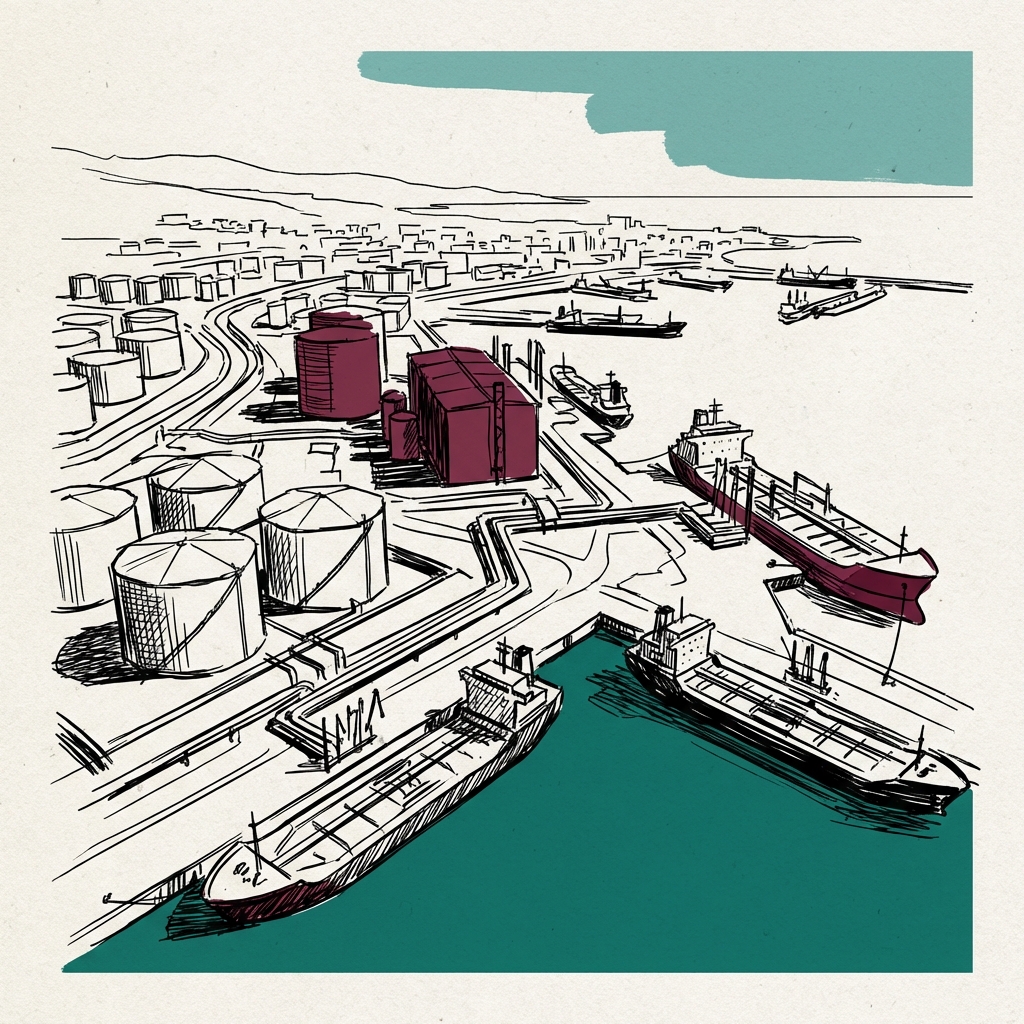
Ceyhan
Turkey's main Mediterranean crude export hub; terminus of the BTC and Iraq-Turkey pipelines.
Ceyhan is Turkey's Mediterranean crude terminus for the Iraq-Turkey and BTC pipelines, Europe's main non-Hormuz oil inlet. Iraq's ramp of the Kirkuk-Ceyhan line toward a 770,000 bpd target had stalled at 190,000 bpd by 10 June 2026.
Last refreshed: 22 September 2026 · Appears in 1 active topic
Can Iraq ramp Kirkuk-Ceyhan to 770kbd and restore Europe's non-Hormuz crude supply?
Timeline for Ceyhan
Mentioned in: Aramco restarts Petroline but not fully
Iran Conflict 2026Mentioned in: Qatar refuses to hedge against Hormuz
Iran Conflict 2026Mentioned in: Gulf producers build around the strait
Iran Conflict 2026Mentioned in: OFAC's GL 134C lapses 17 June; EU cap at risk
European Oil MarketsMentioned in: Iraq's Ceyhan backstop stalls at 190kbd
European Oil MarketsBackground
Ceyhan is a port city on Turkey's Mediterranean coast in Adana Province, the western terminus of two major crude export pipelines: the Baku-Tbilisi-Ceyhan (BTC) line carrying Azerbaijani Caspian crude, and the Iraq-Turkey Pipeline (Kirkuk-Ceyhan) carrying northern Iraqi crude. Under normal conditions the two pipelines together move roughly a million barrels a day, and Ceyhan is also the loading port for the Baltic Exchange's TD19 Aframax benchmark route to Lavera, France, making its throughput a direct driver of Mediterranean freight rates.
The Kirkuk-Ceyhan line entered 2026 already weakened by the Kurdistan Regional Government's long-running revenue dispute with Baghdad. Iraqi exports via the pipeline fell 43% to 135,000 bpd in early April 2026 as war-risk insurance costs and buyer caution compounded that existing disruption.
Ceyhan's importance to Europe rises whenever Gulf exports are constrained, since both Azeri and Kirkuk crude bypass the strait of Hormuz entirely. For the Kurdistan Regional Government, pipeline export revenue is the primary source of budget income, which keeps Ceyhan throughput a recurring fault line in Baghdad-Erbil fiscal relations Independent of the wider war.
The Kirkuk-Ceyhan ramp stalls well short
Iraq's Kirkuk-Ceyhan pipeline, the country's main Mediterranean outlet bypassing the Hormuz blockade, had stalled near 190,000 barrels a day by 10 June 2026, less than a quarter of Baghdad's 770,000 bpd cabinet target. Officials were discussing a smaller interim range of 500,000 to 650,000 bpd, but no increase materialised between 9 and 11 June.
The stall reflects more than the war: a longstanding revenue dispute between the Kurdistan Regional Government and Baghdad, plus compressor-station constraints, predate the 2026 conflict. Mediterranean refiners dependent on Iraqi medium-sour crude stayed short through the stall, keeping Ceyhan-to-France tanker rates elevated at Worldscale 228.
Ceyhan freight jumps as flows shift
Aframax freight on the Ceyhan-to-France route jumped 50 points to Worldscale 228, or $67,100 a day, on 6 June 2026, one of the routes carrying crude Europe can still reach without passing through Hormuz. The Caspian-to-Italy Suezmax route hit Worldscale 218, or $121,200 a day, the same week.
The jump underlines Ceyhan's growing weight as a substitute route while Gulf-origin supply stays constrained: freight on Europe's non-Hormuz Mediterranean corridors is being bid up even as small product-tanker rates elsewhere fall to multi-year lows.
Reference
What is the TD19 tanker route and where does it start?
Why is Ceyhan important for European oil supply?
What is the Ceyhan pipeline terminal?
How much oil is Iraq sending through the Kirkuk-Ceyhan pipeline in 2026?
What did Turkey and Iraq agree on the Ceyhan pipeline in August 2026?
Why did Iraqi oil exports via Ceyhan fall in 2026?
What is the current Kirkuk-Ceyhan pipeline throughput in September 2026?


