Skip to content
You can now search across every topic, entity and event.What's new
European Energy Markets
31JUL

Trump rejects every Pentagon off-ramp

4 min read
09:44UTC

Military planners present structured exit options in every daily war briefing. Trump has not taken one in 18 days, telling NBC the terms 'aren't good enough yet.'

EconomicDeveloping
Key takeaway

Daily un-exercised off-ramps transform inaction into an active choice to sustain pressure.

NBC News reported that military officials include off-ramp options alongside escalation options in Trump's daily war planning briefings 1. He has not exercised any exit option in 18 days. Aides are divided — some pressing for de-escalation over mounting economic instability, others arguing to deepen pressure on Tehran. Trump told NBC that Iran is ready for a deal but 'the terms aren't good enough yet.'

The Pentagon is presenting alternatives daily and watching them be declined — the institutional military building a paper trail when it judges a conflict lacks a defined endpoint. Trump conceded on 14 March that Regime change faces 'a very big hurdle' because Iranian civilians 'don't have weapons' . Administration officials have privately assessed Iran's leadership remains largely intact. The stated war aim has no mechanism for achievement, and the president has acknowledged as much. The off-ramps exist because senior planners can read the numbers: $900 million per day in operational costs 2, 200-plus wounded, diesel at $5 per gallon, Brent above $100 for the third consecutive session. Energy Secretary Wright and Treasury Secretary Bessent have publicly contradicted each other on Hormuz readiness . The incoherence is structural.

The distance between the two sides is shorter than either admits. On 15 March, Araghchi told CBS 'we never asked for a ceasefire' . By 16 March he had shifted to 'this war must end, in a way that our enemies never again think about repeating such attacks.' Trump's 'terms aren't good enough yet' and Araghchi's conditional end-state formulation are converging — but each side's domestic constraints prevent the first move. Joe Kent's resignation as NCTC director, the first named senior official to break with the war, shows the internal debate has moved from anonymous background briefings to public departures. Kent accused the administration of following Israel's lead — and Netanyahu's blanket pre-authorisation for assassinations and the IDF's public threat against Mojtaba Khamenei expand the war's scope at the same pace Washington's planners try to frame an exit from it.


Deep Analysis

In plain English

Every day Trump's military advisers lay out a menu of options ranging from 'strike harder' to 'start talking.' The fact that Trump keeps choosing neither dramatic escalation nor negotiation means he is running a poker strategy — maintaining pressure while waiting for Iran to offer better terms. The problem is that every day he declines the off-ramps, accepting them becomes politically harder, because it would require explaining why today's terms are acceptable when yesterday's identical terms were not.

Deep Analysis
Synthesis

The daily off-ramp presentation serves a secondary institutional function the body does not note. By documenting that exit options were regularly presented and rejected at presidential level, the Joint Chiefs and NSC staff create a contemporaneous record protecting themselves from post-conflict accountability for mission creep. The paper trail of declined off-ramps shifts responsibility for escalation unambiguously to the political level.

Root Causes

The structural cause of the aide split is the collision of two incompatible Trump political imperatives. The economic nationalist coalition — Rust Belt voters, truckers, agricultural logistics — feels fuel-price pain immediately and measurably. The hawkish unilateralist faction treats Iranian capitulation as the defining foreign-policy legacy of the second term. These imperatives cannot both be satisfied simultaneously, which is why the split is persistent rather than resolvable.

Escalation

The 18-day pattern of consistently presented but unexercised off-ramps establishes a revealed preference: Trump judges current Iranian pain insufficient. Each day without a negotiated exit makes de-escalation politically costlier. To accept terms tomorrow, Trump must explain why terms that were 'not good enough' yesterday are acceptable today — a rhetorical trap that narrows his manoeuvre room with every passing briefing cycle.

What could happen next?
  • Meaning

    Daily un-exercised off-ramps reveal a coercive bargaining strategy: extract maximum Iranian concessions before agreeing to any settlement.

    Immediate · Assessed
  • Risk

    As economic pain compounds over weeks, Trump's political flexibility to accept negotiated terms narrows — the longer he waits, the more total Iranian capitulation he must claim as justification.

    Short term · Assessed
  • Opportunity

    The convergence between Trump's conditional language and Araghchi's end-state framing creates a narrow back-channel window before domestic politics on both sides harden further.

    Short term · Suggested
  • Precedent

    The institutionalised daily off-ramp briefing format, if sustained, may establish a template for future presidential war management that embeds de-escalation options structurally rather than ad hoc.

    Long term · Suggested
First Reported In

Update #40 · Larijani dead; Israel hunts the new leader

NBC News· 18 Mar 2026
Read original
Causes and effects
This Event
Trump rejects every Pentagon off-ramp
The revelation that off-ramp options are presented daily and systematically rejected shifts the question from whether an exit strategy exists to why the president refuses to use one — particularly as Iranian diplomatic language inches toward describing an end-state and the administration's own stated aim of regime change has no achievable mechanism.
Different Perspectives
Spain's LNG terminal operators
Spain's 9,145 GWh terminal inventory is the largest single stock in the EU LNG network, an option value that can reroute cargoes wherever the winter strip pays best rather than a cavern gas obligation tied to a fixed date. That flexibility matters more as Germany's cavern shortfall pushes more of the winter security question onto import infrastructure.
European Commission
European Commission
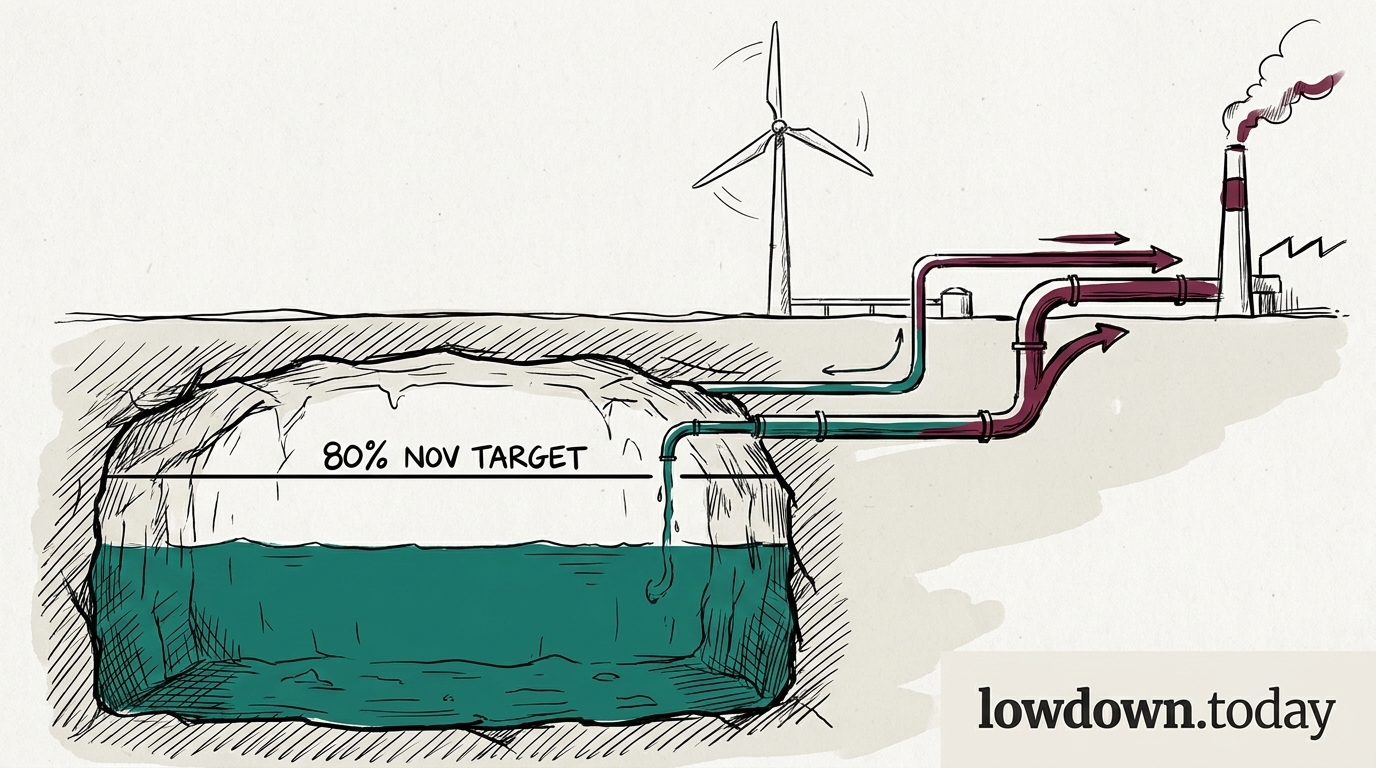
Brussels holds the bloc to 90% on a flexible window while Germany, holding roughly a quarter of EU storage capacity, tracks toward missing its own lower 80% figure by 21 points. A national shortfall this size in the anchor market matters more to bloc security than the flexible timetable alone can absorb.
French power exporters and CRE
French day-ahead rose in step with Germany but by less, reopening a EUR 7-17 premium that makes northward export flows commercially attractive again after the EUR 43.09 discount evaporated in days. CRE separately authorised RTE and Enedis to buy flexibility locally, betting the coming winter's binding constraint is grid congestion rather than a shortage of firm capacity.
TTF trading desk
TTF trading desk
A visible national shortfall like Germany's 21-point gap is a directional signal, not noise, for a desk holding the summer-winter spread. TTF's flat EUR 58-60 range through this week's German price swings says the market has not yet chosen to reprice refill risk into the front of the curve.
German cavern and CCGT operators
German caverns kept buying prompt gas at TTF near EUR 58-60 through the inversion; the wind collapse to 2.4 GW then flipped the spark spread to plus EUR 29 and put turbines back in the same queue. Every day turbines win that bid, injection at a third of the 877 GWh/day pace needed falls further behind.
Slovakia
Slovakia
Slovakia says it dropped its hold-out on the 21st sanctions package only after Ursula von der Leyen personally signed written gas-price and supply guarantees. The Council of the European Union's own 17,238-character release on the package names neither Slovakia nor any guarantee, leaving Bratislava's account unconfirmed by the institutional record.



