Midwest
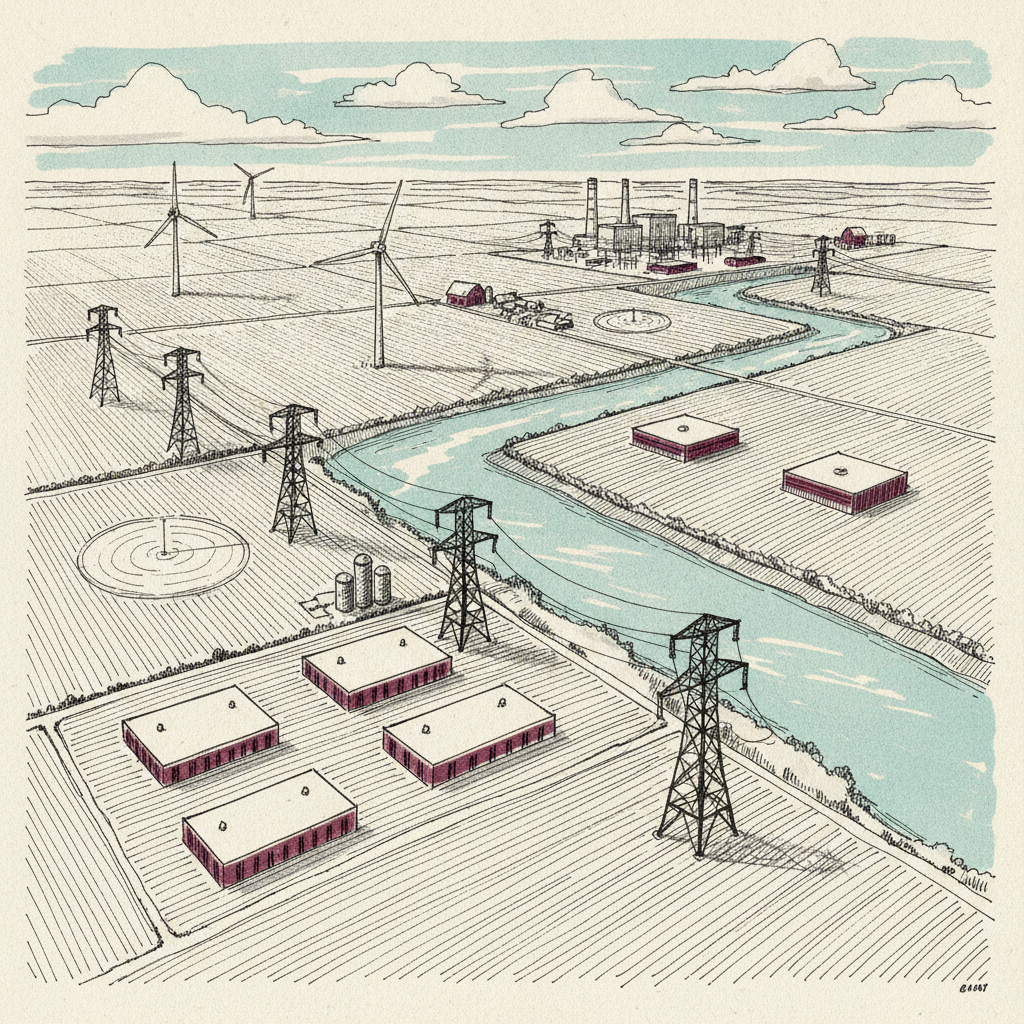
US Midwest region; agricultural heartland whose MISO grid faces mounting data-centre driven demand.
The Midwest, the US farming and manufacturing region running from Ohio to the Dakotas, depends on the MISO grid, which declared its second maximum-generation emergency of the month on 15 July as heat and data-centre demand drove a 122 GW peak.
Last refreshed: 31 July 2026
Why is MISO racing to keep the Midwest grid ahead of data-centre demand?
Timeline for Midwest
Mentioned in: PJM wants 50 MW loads curtailable
Data Centres: Boom and BacklashMentioned in: Moa raises £22.2m to outrun resistance
UK Startups and InnovationMentioned in: Maryland county caps campuses at 25 MW
Data Centres: Boom and BacklashMentioned in: Kansas City's tills beat its hotels
2026 FIFA World CupMentioned in: FERC delays its grid rule to 2027
Data Centres: Boom and BacklashBackground
The Midwest is the US Census Bureau region running from Ohio and Michigan to the Dakotas and Kansas, the country's agricultural heartland for maize, soybean, dairy and poultry, with a manufacturing base concentrated around the Great Lakes.
Most of the region's power comes from the Midcontinent Independent System Operator (MISO), whose footprint stretches from the Dakotas to Louisiana and serves roughly 42 million people across 15 states. MISO has become a bellwether for how the US grid absorbs data-centre growth, forecasting peak demand rising from 121 GW in 2025 to 163 GW by 2035, a 35% increase concentrated in its central region.
The region is also a recurring site of zoonotic disease surveillance, including a 2015 H5N2 poultry outbreak and ongoing H5N1 transmission in dairy herds, which keeps its agricultural sector under federal monitoring alongside its role in National Grid policy.
Federal grid rules keep slipping
For a region whose grid operator, MISO, just posted a 122 GW emergency peak, the absence of a federal cost-allocation standard is not an abstract regulatory delay but a live capacity problem. On 18 June the Federal Energy Regulatory Commission missed its own Deadline, sending show-cause questions to all six regional operators rather than binding rules, pushing any settlement to 2027 at the earliest.
That leaves MISO without a federal template just as it forecasts 8-14 GW of new data-centre load arriving within two years, concentrated in its Michigan, Indiana and Illinois core. Other operators are not waiting: Oregon's regulator moved first, shifting costs onto data-centre tariffs rather than households on 4 June, a template MISO states have yet to adopt.