Skip to content
Briefings are running a touch slower this week while we rebuild the foundations.See roadmap
European Energy Markets
18MAY

Kunpeng rejected at Dahej, LNG sanctions hold

3 min read
11:11UTC

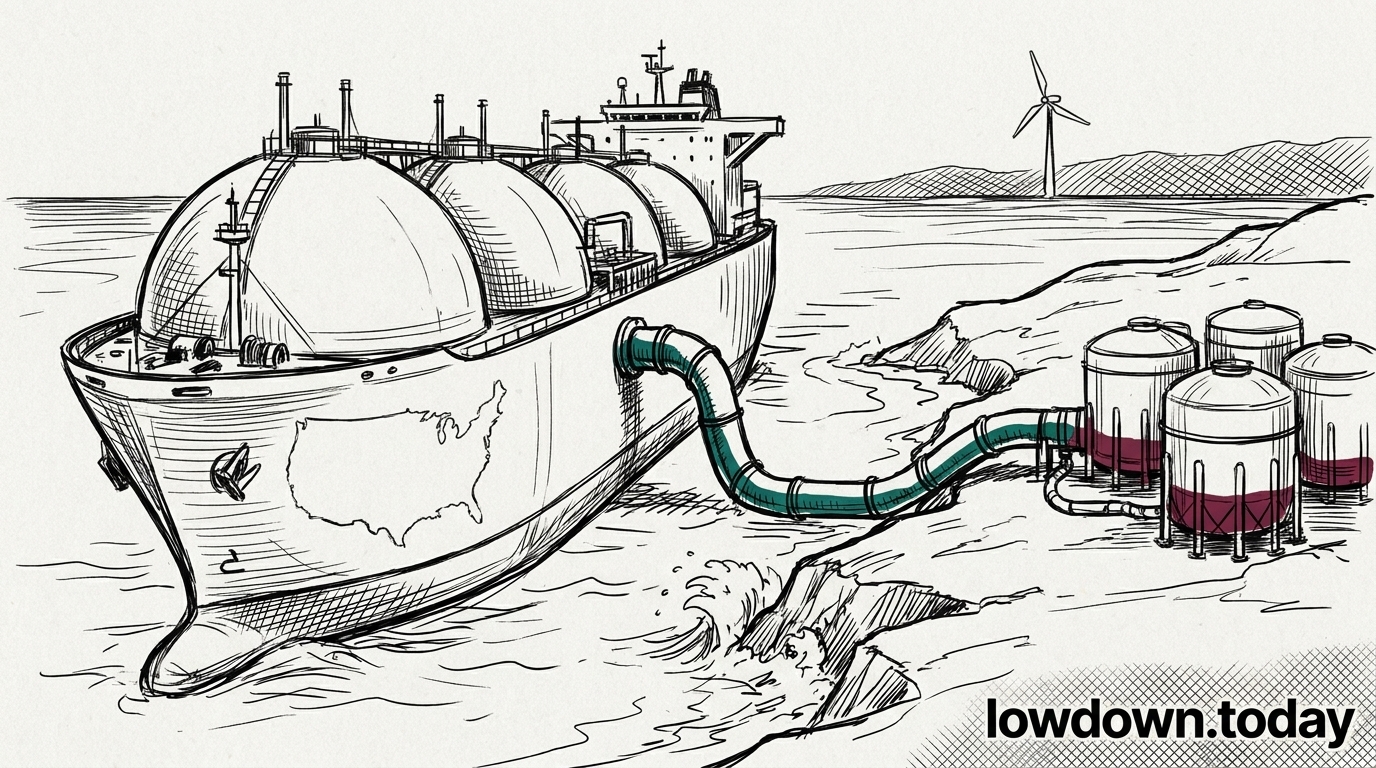
The LNG vessel Kunpeng was rejected by India's Dahej terminal in early May over US Treasury sanctions on its Portovaya cargo. AIS satellite tracking made the Russian origin traceable despite reported documentation obfuscation.

EconomicDeveloping
Key takeaway

Kunpeng is the first public test of an LNG sanctions architecture the Russian oil sanctions framework never matched.

The Kunpeng (138,200 cubic metres of LNG capacity), carrying cargo from Russia's Portovaya Baltic LNG facility, was rejected by India's Dahej LNG Terminal in early May 2026 over US Treasury sanctions designations. Shipping documentation reportedly attempted to obscure Russian cargo origin; AIS satellite tracking made the route traceable. As of Tuesday 12 May the vessel was stranded near Singapore with no declared destination.

The case is the first public test of the LNG sanctions enforcement architecture built under the EU's 20th package . LNG cryogenic constraints prevent ship-to-ship transfer at scale, the structural feature dark-fleet operators in the Russian oil trade exploited; the AIS chain from Portovaya loading to Dahej rejection is unbreakable, and any falsified bill of lading is contradicted by the satellite track. Separately, the Arc7 dry-dock carve-out under April's EU ban , remains unresolved: six Yamal LNG carriers (Rudolf Samoylovich, Georgiy Brusilov, Boris Davydov, Vladimir Vize, Nikolay Zubov, Nikolay Yevgenov) are due summer 2026 dry-dock servicing, and EU yards are prohibited under the ban.


Deep Analysis

In plain English

Russia exports some of its gas in liquid form, loaded onto specialist tankers called LNG vessels. One of these tankers, the Kunpeng, was turned away from a port in India because it was carrying Russian gas under Western sanctions. It is now floating near Singapore with nowhere to go. Unlike Russian oil tankers, which can transfer their cargo to other ships at sea to hide its origin, LNG tankers cannot do this because the gas has to be kept at extreme cold temperatures, making the tracking system much harder to beat.

Deep Analysis
Root Causes

LNG's physical properties, specifically the requirement for specialised cryogenic storage at minus 162 degrees Celsius, prevent the ship-to-ship cargo transfer that has been the primary evasion mechanism for Russian oil sanctions since 2022.

The 25 April 2026 EU ban on Russian LNG short-term contracts, combined with pre-existing US Treasury secondary sanctions on Portovaya-origin cargo, created overlapping enforcement jurisdictions that Indian terminal operators could not ignore without risking their own dollar-clearing access.

Russian LNG operators' reliance on documentation obfuscation (false bills of lading) as the primary evasion tactic was already defeated by the 2022-24 expansion of AIS satellite constellation coverage, which reduced gaps in the tracking chain to under two hours in most ocean basins.

What could happen next?
  • Meaning

    Asian terminal operators from Dahej to South Korea now face reputational and secondary-sanctions pressure on any cargo with origin obfuscation, effectively extending US Treasury enforcement reach to every major LNG import terminal without a formal bilateral agreement.

    Short term · Assessed
  • Meaning

    The Arc7 dry-dock carve-out for six Yamal LNG carriers due summer 2026 servicing remains unresolved; if no EU yards accept the vessels, the carve-out becomes the next structural test of the sanctions architecture.

    Short term · Assessed
  • Meaning

    Russia's LNG export infrastructure depends on Western Arctic technology for liquefaction train maintenance; the Kunpeng enforcement precedent accelerates the timeline on which Novatek must find non-Western service providers.

    Short term · Assessed
First Reported In

Update #10 · TTF breaks EUR 50; US LNG hits 58% of imports

Discovery Alert· 18 May 2026
Read original
Different Perspectives
US LNG exporter (Sabine Pass / Corpus Christi)
The 58% EU import share confirmed by ACER, heading toward 65% in 2026, represents a structural long-term offtake position that European terminal operators are now willing to underwrite against the German 2031 gas-demand floor. Ribera's warning lands inside a commercial relationship that is expanding, not contracting.
Teresa Ribera, European Commission EVP
Ribera warned Europe should 'avoid replacing one energy dependency with another', framing the ACER 58% US LNG figure as a supply-security risk in the same week TTF broke EUR 50. Her institution has spent EUR 117 billion on US LNG since 2022.
Yara International (ammonia producer)
Front-month TTF at EUR 50+ touches the demand-destruction threshold at which ammonia output curtailments have historically been triggered. Yara faces the same lock-or-ride binary as financial desks, but the downside is production loss rather than mark-to-market exposure.
Katherina Reiche, German Economy Minister
Reiche confirmed the 12 GW hydrogen-ready gas tender is formally agreed with the EU Commission, with first auctions in 2026 and all units operational by 2031. The confirmation closes three years of SPD environment-ministry obstruction and anchors German gas demand through the early 2030s.
European gas trader (Amsterdam desk)
The EUR 50 break is a watershed signal, not a squeeze: the forward curve at EUR 55.21 twelve months out implies the market has repriced structural winter risk, not a positioning overshoot. The lock-or-ride decision on winter hedges closes in June when injection-pace data for May lands.
Hungarian and Slovak gas buyers and regulators
Hungary cleared EUR 123.23/MWh on 12 May, EUR 54 above Spain's same-day clearing and the largest single-market premium of the briefing series, as ACER named it among seven NRAs in TurkStream derogation opinions with the 5 August EC ruling pending. A denial of derogation removes the only available pipeline substitute for Russian LNG banned since 25 April.
