Skip to content
Briefings are running a touch slower this week while we rebuild the foundations.See roadmap
European Energy Markets
18MAY

TTF breaks EUR 50; US LNG hits 58%

3 min read
11:11UTC

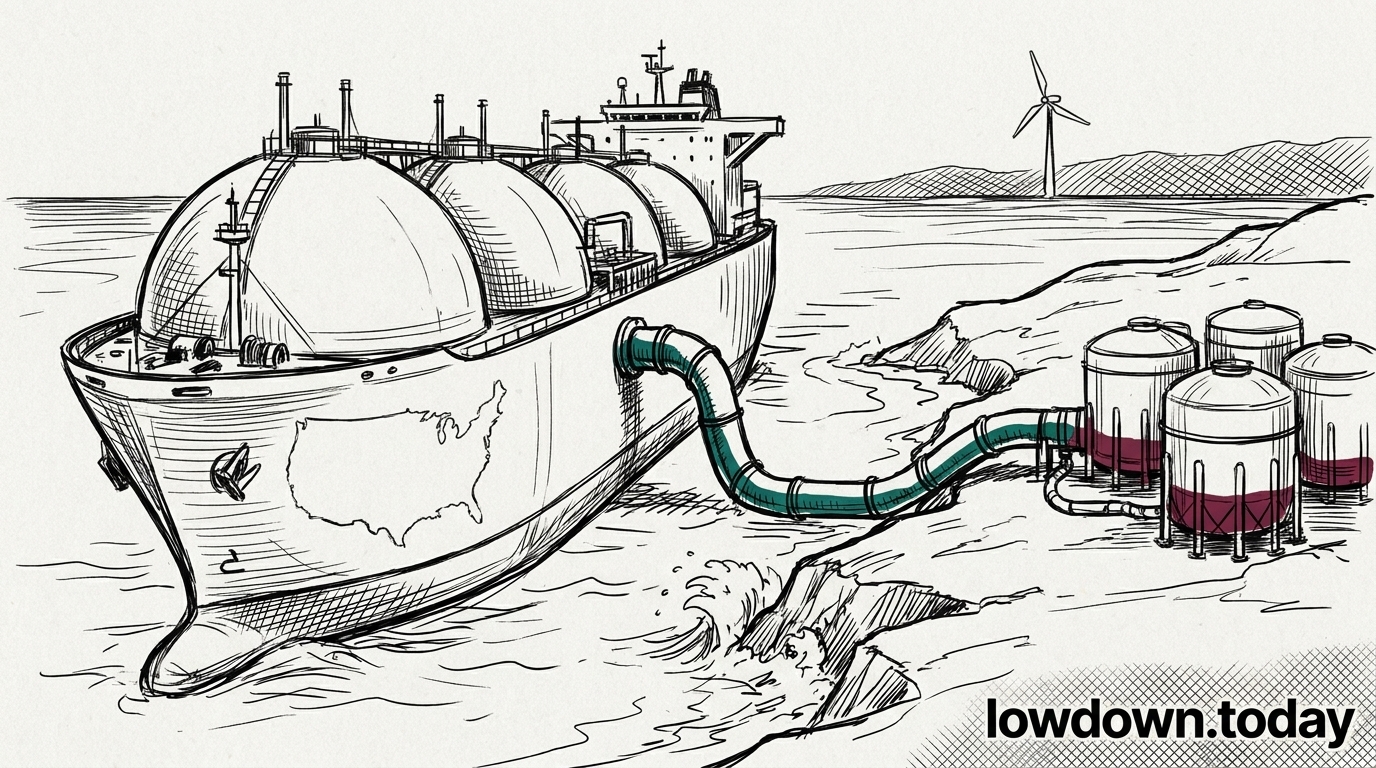
TTF settled EUR 50.17/MWh on Monday 18 May, an 11% weekly gain that finally prices the storage arithmetic into the curve as ACER confirmed US suppliers now provide 58% of EU LNG imports.

EconomicDeveloping
Key takeaway

TTF priced the storage deficit and the US 58% LNG share into the curve in the same week.

TTF (Title Transfer Facility, the Dutch wholesale gas benchmark) settled at EUR 50.17/MWh on Monday 18 May, the first close above EUR 50 since early April , an 11% weekly gain from the EUR 47.23 close on Tuesday 12 May. ACER, the EU energy regulator, published its Annual LNG Report 2025 on Wednesday 13 May confirming US suppliers now provide 58% of EU LNG imports, projected by IEEFA to reach 65% in 2026 as Russian short-term contracts wash out under the 25 April ban.

The Dutch front-month is finally pricing two pricing dynamics at once: the storage arithmetic the beat has tracked since the season opened , , and the structural concentration story ACER's report quantified this week. Russian pipeline gas peaked at roughly two-fifths of Total EU gas in 2021; the US 58% LNG share, multiplied through LNG's share of Total EU supply, now equates to roughly a fifth of EU gas demand routing through one country's terminals. Commission Executive Vice-President Teresa Ribera warned the same week that Europe should 'avoid replacing one energy dependency with another'; her institution has spent approximately EUR 117 billion on US LNG since 2022.

Deep Analysis

In plain English

TTF is the main European gas price benchmark, like Brent crude for oil. When it breaks EUR 50, it means European wholesale gas costs more, which eventually flows through to household energy bills. The trigger this week was twofold: gas storage tanks are not filling fast enough for winter, and a report confirmed that over half of Europe's gas ship imports now come from a single country, the United States.

Deep Analysis
Root Causes

The 25 April 2026 EU Russian LNG short-term ban accelerated US LNG's share shift from 58% toward a projected 65% faster than the 2025 baseline assumed, removing the residual Russian short-term contract buffer that had kept US deliveries below two-thirds.

The 1 January 2026 abolition of Germany's gas storage levy removed the principal incentive instrument for early-season injection, leaving the EU without a mechanism to incentivise fills at TTF levels above industrial demand-destruction thresholds.

Middle East LNG to Europe fell to its lowest level since 2019 in April 2026 (Bruegel dataset), reducing the swing-supplier cushion that had historically moderated US pricing power in Atlantic Basin spot markets.

What could happen next?
  • Meaning

    If TTF holds above EUR 50 through June, the Bruegel EUR 26 billion refill cost estimate becomes materially understated on both the price and pace assumptions used in the model.

    Short term · Assessed
  • Meaning

    US LNG tariff exposure becomes a politically live risk vector for the first time since 2022: a 65% single-supplier share concentrates European gas pricing power in a single bilateral trade relationship.

    Short term · Assessed
  • Meaning

    Industrial demand destruction at EUR 50+ front-month may slow European gas consumption enough to partially offset the storage injection shortfall, creating an involuntary demand-side adjustment the EU has not formally planned for.

    Short term · Assessed
First Reported In

Update #10 · TTF breaks EUR 50; US LNG hits 58% of imports

EnergyRiskIQ / GIE AGSI+· 18 May 2026
Read original
Causes and effects
This Event
TTF breaks EUR 50; US LNG hits 58%
Two regimes priced at once: the storage deficit and a structural supplier-concentration story whose 2026 trajectory points to roughly a fifth of EU gas demand routing through one country's logistics chain.
Different Perspectives
US LNG exporter (Sabine Pass / Corpus Christi)
The 58% EU import share confirmed by ACER, heading toward 65% in 2026, represents a structural long-term offtake position that European terminal operators are now willing to underwrite against the German 2031 gas-demand floor. Ribera's warning lands inside a commercial relationship that is expanding, not contracting.
Teresa Ribera, European Commission EVP
Ribera warned Europe should 'avoid replacing one energy dependency with another', framing the ACER 58% US LNG figure as a supply-security risk in the same week TTF broke EUR 50. Her institution has spent EUR 117 billion on US LNG since 2022.
Yara International (ammonia producer)
Front-month TTF at EUR 50+ touches the demand-destruction threshold at which ammonia output curtailments have historically been triggered. Yara faces the same lock-or-ride binary as financial desks, but the downside is production loss rather than mark-to-market exposure.
Katherina Reiche, German Economy Minister
Reiche confirmed the 12 GW hydrogen-ready gas tender is formally agreed with the EU Commission, with first auctions in 2026 and all units operational by 2031. The confirmation closes three years of SPD environment-ministry obstruction and anchors German gas demand through the early 2030s.
European gas trader (Amsterdam desk)
The EUR 50 break is a watershed signal, not a squeeze: the forward curve at EUR 55.21 twelve months out implies the market has repriced structural winter risk, not a positioning overshoot. The lock-or-ride decision on winter hedges closes in June when injection-pace data for May lands.
Hungarian and Slovak gas buyers and regulators
Hungary cleared EUR 123.23/MWh on 12 May, EUR 54 above Spain's same-day clearing and the largest single-market premium of the briefing series, as ACER named it among seven NRAs in TurkStream derogation opinions with the 5 August EC ruling pending. A denial of derogation removes the only available pipeline substitute for Russian LNG banned since 25 April.

