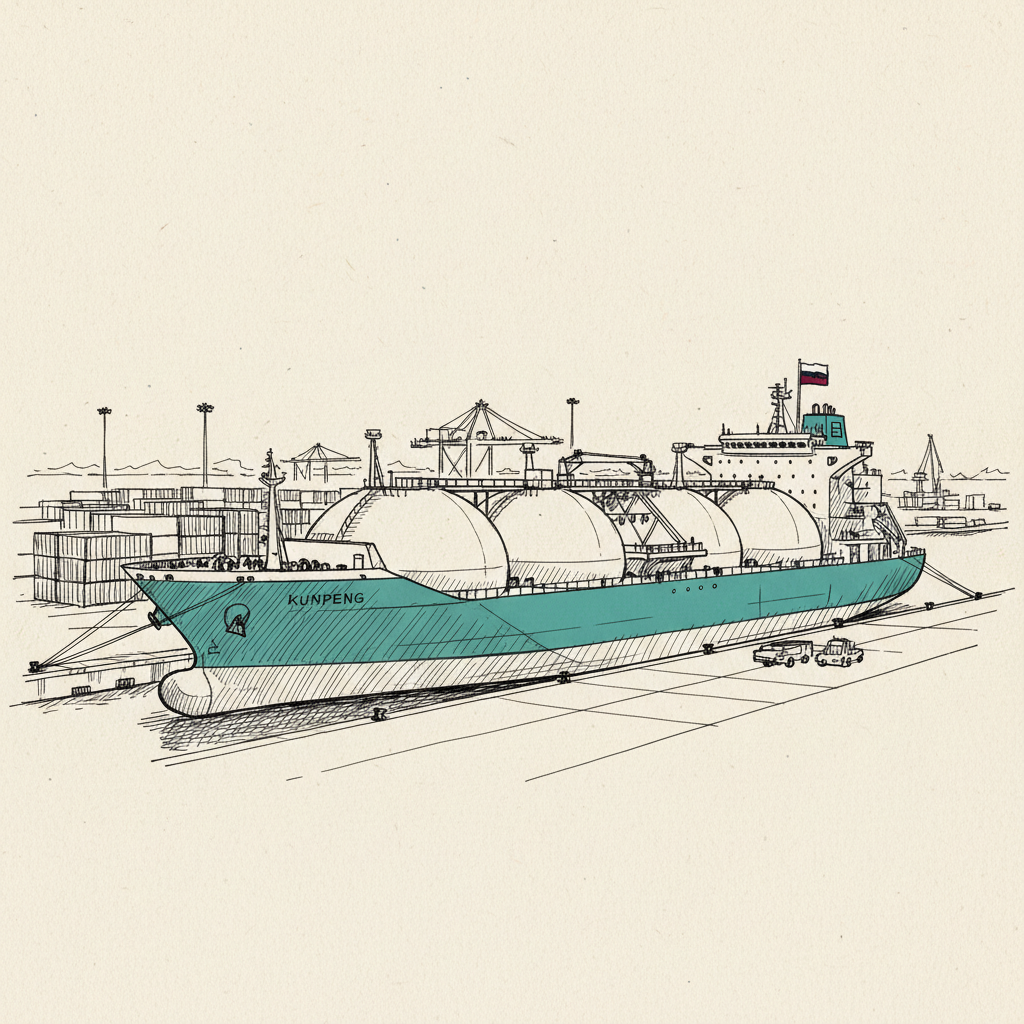
Kunpeng
138,200 cbm LNG carrier from Russia's Portovaya; rejected at India's Dahej terminal, May 2026.
Last refreshed: 18 May 2026 · Appears in 1 active topic
Where is the Kunpeng now and what happens to its stranded Russian LNG cargo?
Timeline for Kunpeng
Mentioned in: BOTAS blend is the gap at the border
European Energy MarketsMentioned in: Berlin confirms 12 GW gas tender
European Energy MarketsRejected at Dahej LNG terminal; stranded near Singapore with no declared destination
European Energy Markets: Kunpeng rejected at Dahej, LNG sanctions holdBackground
Kunpeng is a large LNG carrier with a cargo capacity of 138,200 cubic metres, which was transporting Liquefied Natural Gas from Russia's Portovaya Baltic SEA terminal when it was rejected by India's Dahej LNG Terminal in early May 2026 over US Treasury sanctions designations. As of Tuesday 12 May the vessel was stranded near Singapore with no declared destination. Shipping documentation reportedly attempted to obscure the Russian origin of the cargo, but AIS satellite tracking made the origin from Portovaya traceable and the obfuscation failed.
The Kunpeng case is significant as the first publicly documented test of LNG sanctions enforcement under the EU's 25 April 2026 ban on Russian short-term LNG contracts. LNG cryogenic constraints prevent the ship-to-ship transfer that Russian oil sellers have used to launder cargo origin through dark-fleet tankers. The AIS chain from a loading terminal to a discharge terminal is effectively unbreakable, and any falsified bill of lading is contradicted by the continuous satellite track. This structural feature makes LNG sanctions enforcement materially different from, and more effective than, the Russian oil sanctions framework.
The Kunpeng's stranding near Singapore illustrates the practical enforcement architecture that now operates against Russian LNG flows to Asian markets. If Asian terminals continue to reject Portovaya cargoes on sanctions grounds, Russian LNG export volumes face growing logistical constraint rather than merely economic deterrence. The vessel's eventual fate — whether cargo is returned to Russia, redirected, or held in floating storage — will set a practical precedent for subsequent enforcement cases.
What is the Kunpeng LNG ship and why was it rejected?
Why can't Russian LNG be transferred at sea to avoid sanctions like oil is?
What happened to the Russian LNG tanker stranded near Singapore?
Where is the Portovaya LNG facility and what is the Kunpeng linked to?
Is the Kunpeng under US sanctions and who designated it?

