
Skip to content
You can now search across every topic, entity and event.What's new
Data Centres: Boom and Backlash
28JUN

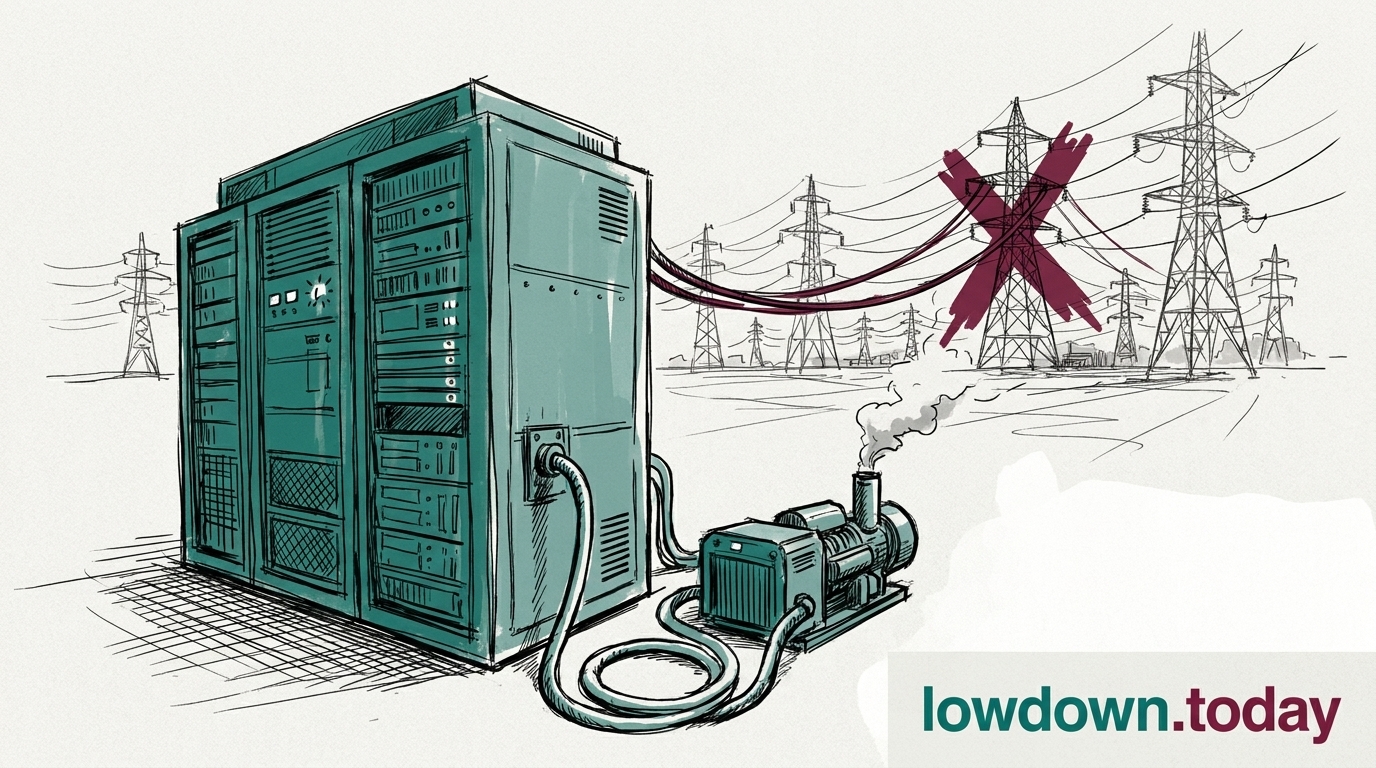
Data centres build their own power plants

3 min read
12:23UTC

Chevron will build Microsoft a 2.67 GW gas plant in West Texas, the year's largest dedicated-power deal, struck because the grid route slowed and the cheaper workarounds are closing fast. FERC deferred a binding connection rule to 2027, Virginia taxed self-generated power, transformer waits reached four years, and fresh commitments flowed to India, where Amazon alone lifted its total to $48bn.

Key takeaway

Operators now spend $7bn on private power because the US grid cannot connect them before 2027.

This briefing mapped
Loading map…
Infrastructure
Regulatory
Economic
Competitive
Domestic

Chevron signed a 20-year deal with Microsoft on 22 June to build Project Kilby, a 2.67 GW gas plant in West Texas that feeds one data centre and skips the grid entirely. At roughly $7bn it is the largest dedicated-power deal struck for a data centre this year.

Sources profile:This story draws on mixed-leaning sources from United States
United States

Chevron agreed on 22 June to build a 2.67 GW gas plant beside a Microsoft data centre in West Texas for about $7bn. Project Kilby feeds the data centre directly, bypassing the public grid. First power arrives in 2028.

At 2.67 GW it is the largest dedicated power deal for a data centre in 2026. By owning the generator, Microsoft sidesteps the federal curtailment orders that twice cut power to grid-connected AI facilities this year

Sources:Chevron·CNBC

FERC met its end-June deadline on 18 June, then chose its slowest tool: show-cause orders to all six US grid operators instead of the connection rule it promised in April. Any binding standard now slips to 2027 at the earliest.

Sources profile:This story draws on neutral-leaning sources

The US Federal Energy Regulatory Commission (FERC) met its end-of-June deadline on 18 June by sending formal questions to all six regional grid operators. Binding rules are now pushed to 2027 at the earliest.

FERC chose its slowest procedural tool, a show-cause order requiring each operator to justify its existing tariffs or propose reforms. The delay leaves data-centre operators without a federal standard during the peak investment window. 

Sources:FERC

Virginia's two-year budget, passed 22 June, charges data centres $0.011 for every kilowatt-hour they burn, including power they generate on site. No US state had taxed power generated behind the meter until now.

Sources profile:This story draws on neutral-leaning sources

Virginia passed a $0.011 per kilowatt-hour consumption tax on data centres on 22 June, covering both grid power and self-generated behind-the-meter electricity. The tax is capped at $600m per year and expires in July 2028.

Virginia's law is the first US state levy to reach past the electricity meter to captive generation. It gives Compass Datacenters, which abandoned two Virginia sites over tax uncertainty , a cost figure to plan around, and a template other data-centre states will study. 

US transformer lead times reached three to four years by May, and only about 5 GW of the 12 GW of data-centre capacity announced for 2026 is under construction. The rest is delayed or cancelled because the hardware cannot be built fast enough.

Sources profile:This story draws on neutral-leaning sources

US transformer lead times reached 36 to 48 months by May 2026, up from 128 weeks in April . Of 12 GW of data-centre capacity announced for 2026, only about 5 GW is under construction. Transformer shortages have stalled the other 7 GW.

Each transformer takes 12 to 18 months to produce; manufacturers cannot ramp fast enough for the demand surge. The 7 GW stall defers roughly $14bn in annual cloud revenue. 

Texas approved its first formal large-load study process on 18 June, even as ERCOT's connection queue climbed to 438 GW, about 90% of it data centres. The plan to clear it is not due until autumn 2027.

Sources profile:This story draws on neutral-leaning sources

Texas approved on 18 June a formal process for ERCOT (Electric Reliability Council of Texas) to clear a data-centre connection queue now at 438 GW. The final transmission plan is due autumn 2027.

The queue has nearly doubled since Texas first tried to clear it at 225 GW . Operators needing Texas grid power before late 2027 will build captive gas generation instead. 

Sources:Utility Dive

Amazon's Andy Jassy met Narendra Modi on 25 June and raised Amazon's total India commitment to $48bn, days after CPPIB took a stake in CtrlS and Google committed $15bn to a Visakhapatnam hub. Capital is routing to where consent clears fastest.

Sources profile:This story draws on mixed-leaning sources from United States and India
United StatesIndia
LeftRight

Three large India data-centre commitments landed within ten days. Canada's CPPIB (Canada Pension Plan Investment Board) took an $840m stake in CtrlS Datacenters on 17 June. Amazon's Andy Jassy raised the company's India pledge to $48bn on 25 June, with $13bn for Amazon Web Services (AWS) capacity in Mumbai and Hyderabad.

India is absorbing capital diverted from consent-constrained US and European markets . Indian state governments approve data-centre permits in 6-12 months; Virginia or London take 3-5 years. 

Digital Realty lifted its stake in Teraco, Africa's largest data-centre platform, from about 61% to 77% on 22 June, paying roughly $650m, and in the same announcement bought Columbia Capital and a Kansas City campus site.

Sources profile:This story draws on neutral-leaning sources

Suaram director Kua Kia Soong called on 26 June for a halt to new Malaysian data centres until citizens' electricity is guaranteed, with the sector now holding 43% of national utility TNB's contracted capacity.

Malaysian data centres hold 5.9 GW of contracted grid capacity, equal to 43% of the total committed by TNB (Tenaga Nasional Berhad, Malaysia's national electricity utility). Suaram director Kua Kia Soong called publicly for a moratorium on 26 June. Johor has already rejected 30% of applications over water and electricity limits.

Malaysia mirrors Ireland : cheap power and fast consent attracted data centres at scale. One sector now crowds out the residential load the government must protect. 

Closing comments

Tightening across all three constraint layers through 2026. On the regulatory side, FERC's show-cause route produces six separate tariff proceedings rather than one binding rule, multiplying the points at which reform stalls; the mechanism that would tip this to faster resolution is a successful legal challenge to the show-cause process itself, forcing FERC to a direct rulemaking on a court-ordered timeline. On the hardware side, the tipping event is GE Vernova's Prolec deal ($5.3bn Mexican transformer capacity acquired April 2026) beginning to ship at scale, which the company has not guided before 2028. On the siting side, a Malaysia federal moratorium formalising Johor's informal 30% rejection rate would redirect 2 to 3 GW of in-flight ASEAN capacity toward Indonesia or Thailand, tightening the Southeast Asian overflow valve that US capital currently relies on.

AI-assisted, human-edited under the editorial responsibility of Bannermedia Ltd. Reviewed by Ed Woodcock on 28 June 2026. Editorial standards.

Different Perspectives
FERC and US federal regulators
FERC met its end-June deadline on 18 June by choosing show-cause orders to six RTOs over direct rulemaking, building an evidentiary record before committing to a standard that could face the same Fifth Amendment challenges already filed against DOE's curtailment authority. Any binding connection rule now arrives in 2027 at the earliest, after the peak 2026-2027 investment window closes.
Modi government and India's investment-attracting states
Modi received Amazon CEO Jassy on 25 June and secured a $48bn total commitment; Maharashtra, Andhra Pradesh, and Telangana approve large-campus clearances in 6-12 months against Virginia's 3-5 years. India is absorbing the capacity the US cannot site, though the grid and water stress that follows is already showing in Malaysia.
Suaram and Malaysian civil society
Suaram director Kua Kia Soong called on 26 June for a halt to new data centres after the sector reserved 43% of national utility TNB's contracted capacity. Johor already rejects 30% of applications on electricity and water grounds; the moratorium call gives that informal cap quantitative political backing.
Digital Realty and African colocation (Teraco)
Digital Realty raised its Teraco stake to 77% on 22 June for $650m, paying a $4.1bn implied value for the dominant sub-Saharan internet exchange. The deal buys carrier-neutral interconnection in South Africa, Nigeria, and Kenya while its Western pipeline stalls on tax and hardware.
Hyperscale operators as a bloc (Microsoft, Amazon, Google, Chevron)
Microsoft's 20-year Chevron PPA is a statement that owning the generator is cheaper than waiting for a grid connection that will not arrive before 2027. Amazon's $48bn India total adds the corollary: where consent clears fastest, capital follows.
