Skip to content
You can now search across every topic, entity and event.What's new
Data Centres: Boom and Backlash
7JUL

US data-centre backlash becomes law

2 min read
09:27UTC

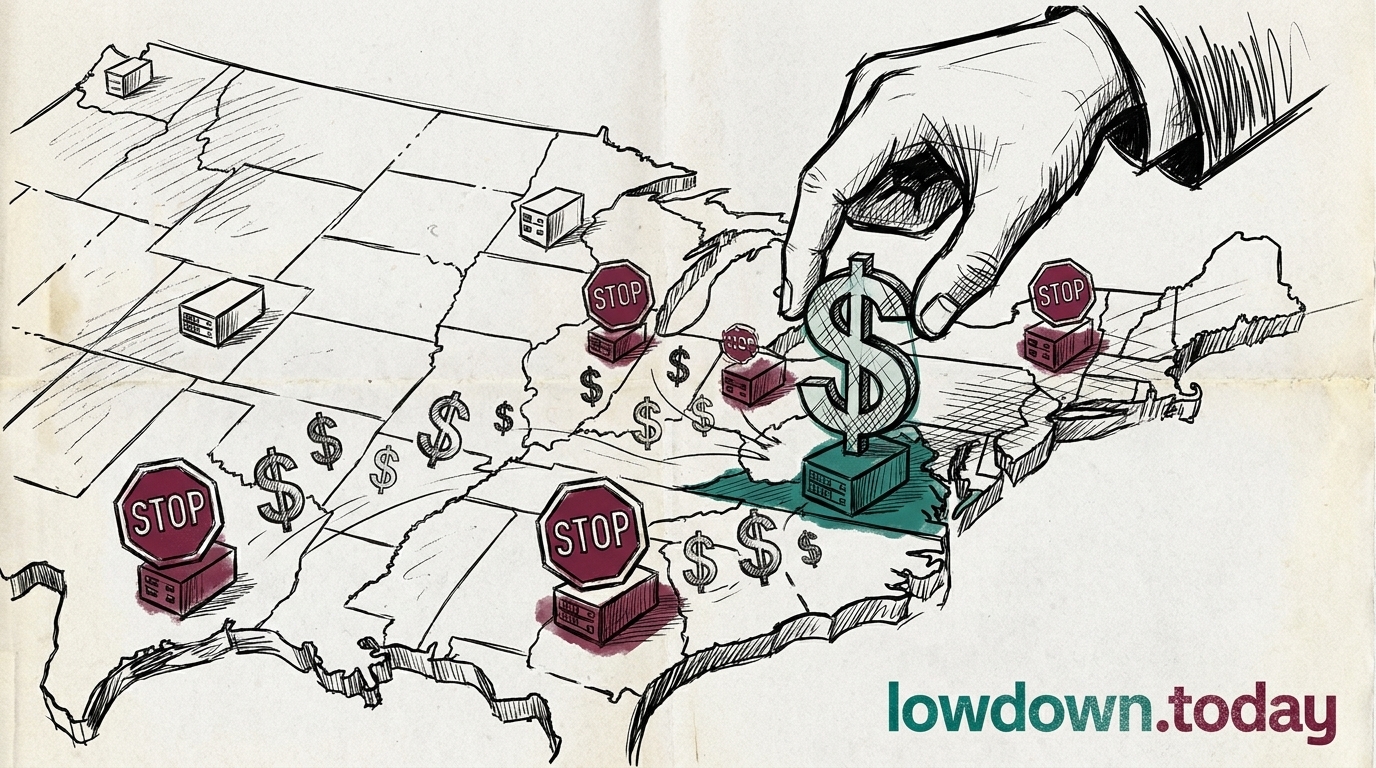
Virginia's $0.011-per-kilowatt-hour data-centre tax took effect on 1 July, the first US per-unit levy on compute power, and the rival backup-generator fee died. New York's one-year freeze now waits on Governor Hochul's signature. The backlash is spreading below the statehouse: nearly a third of Indiana's counties now restrict data centres, and Santa Fe County set the lowest bar yet at one megawatt.

Key takeaway

Virginia priced data-centre power like an excise tax; Indiana and Santa Fe show a legislature was never required.

This briefing mapped
Loading map…
Regulatory
Domestic

Abigail Spanberger signed Virginia's $0.011-per-kilowatt-hour data-centre tax on 30 June, the first US levy on compute power itself, and the rival backup-generator fee died with it.

Sources profile:This story draws on neutral-leaning sources

Virginia Governor Abigail Spanberger signed the state's $0.011-per-kilowatt-hour data-centre electricity consumption tax into law on 30 June 2026, and it took effect the next day on 1 July; the rival Senate proposal for a $35-45 per kilowatt fee on backup generators, the 'Lucas fee', was dropped in favour of the consumption model, and the State Corporation Commission will begin monthly collection with first payment due in September.

It gives every other state a working template for taxing what a data centre burns rather than what it installs, on the instrument least exposed to a takings lawsuit. 

Sources:Tech Times

New York's data-centre permit freeze cleared both chambers on 4 June and now sits unsigned on Governor Kathy Hochul's desk; a North Country lawmaker urged a veto on 30 June.

Sources profile:This story draws on neutral-leaning sources

New York's Responsible Data Center Development Act, which passed the Assembly 102-39 and the Senate 44-16 on 4 June 2026, remained unsigned as of 7 July; the bill would impose a one-year freeze on state Department of Environmental Conservation permits for data centres of 20 MW or more, and a North Country lawmaker publicly urged Governor Kathy Hochul to veto it on 30 June.

Hochul's signature would make New York the first US statewide moratorium to take effect, reviving a model Maine's veto was thought to have buried. 

Roughly 30 of Indiana's 92 counties now restrict data centres, up from 12 three weeks earlier, while Indianapolis voted 5-3 to write zoning rules rather than pause approvals outright.

Sources profile:This story draws on neutral-leaning sources

Roughly 30 of Indiana's 92 counties now restrict data centres, up from 12 three weeks earlier, and Indianapolis's Metropolitan Development Commission voted 5-3 on 1 July to advance new zoning rules rather than impose a full moratorium.

It is the fastest county-level acceleration this sector has recorded, and it shows opposition no longer needs a legislature to move. 

Sources:WFYI

Santa Fe County voted unanimously on 2 July for an 18-month data-centre moratorium at a one-megawatt threshold, the lowest this topic has tracked, driven by groundwater rather than grid cost.

Sources profile:This story draws on neutral-leaning sources

Santa Fe County, New Mexico voted unanimously on 2 July for an 18-month moratorium on data centres above 1 megawatt, the lowest threshold this topic has tracked, citing groundwater supply and the acequia irrigation commons.

At one megawatt the freeze catches even a single modest server hall, extending opposition from hyperscale campuses to almost any commercial computing build. 

A new Virginia law will make water utilities report data-centre use separately from 2027, landing as Google fights to keep one Botetourt County site's draw sealed after a court forced its release.

Sources profile:This story draws on neutral-leaning sources

A new Virginia law reported on 25 June 2026 will require water utilities to disclose data-centre water sales separately from other customer classes starting in 2027; the mandate lands as Google's Botetourt County subsidiary fights to keep site-level water-draw records sealed despite publishing per-site figures elsewhere, after a November 2025 court order forced disclosure that put the draw at 2 to 8 million gallons a day.

Statutory per-class reporting removes the aggregation that lets operators publish flattering company-wide figures while site-level draw stays hidden. 

Closing comments

Sideways to up. The single mechanism that would tip the direction is Kathy Hochul's decision on the Responsible Data Center Development Act, which passed both chambers on 4 June 2026. A signature makes New York the first statewide freeze to take effect since Maine's April veto and hands every undecided legislature a signed precedent to copy; a veto, following the North Country lawmaker's 30 June call, would leave county-level ordinances like Indiana's roughly 30 counties and Santa Fe's one-megawatt rule as the only instruments actually restraining build-out, accelerating the shift to sub-state authority regardless of which way she rules.

AI-assisted, human-edited under the editorial responsibility of Bannermedia Ltd. Reviewed by Ed Woodcock on 7 July 2026. Editorial standards.

Different Perspectives
Acequia communities, Santa Fe County
Santa Fe County commissioners voted unanimously on 2 July to freeze any data centre over one megawatt, citing the acequia irrigation commons that has shared scarce water since Spanish colonial rule. They expect the low threshold to draw the same Fifth Amendment challenge RCM Hill brought against Hill County, Texas.
Damac Digital
Damac Digital
Damac Digital keeps building toward roughly 6,000 megawatts of hyperscale capacity across 13 countries while Virginia taxes power and New York weighs a freeze. Every dollar or month of delay a US state adds is capacity a Gulf developer can site somewhere with faster permitting and no equivalent levy.
Hassan Allam Digital Infrastructure
Hassan Allam Digital Infrastructure, an Egyptian conglomerate rather than a foreign hyperscaler, reportedly secured a domestic hyperscale licence with a $400m first phase, per single-source reporting still to be verified. It reads as home-grown sovereign compute ambition, building national capacity rather than importing a US or Gulf operator's campus.