
Skip to content
You can now search across every topic, entity and event.What's new
Data Centres: Boom and Backlash
17JUN

Virginia taxes the backup, not the draw

3 min read
10:13UTC

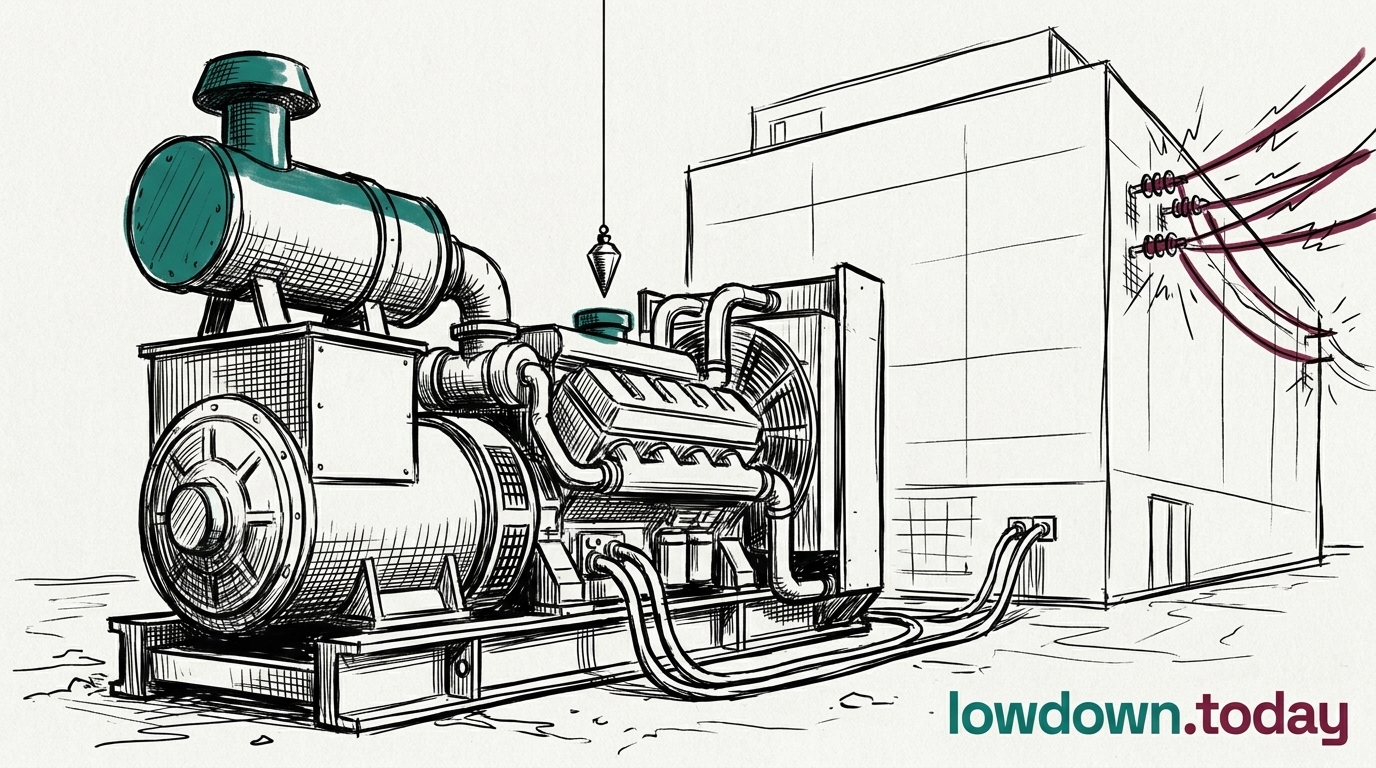
Virginia's Senate has floated a $35 to $45 per-kilowatt fee on data-centre backup generators, the first US levy aimed at installed fallback capacity rather than the power a campus actually uses. It lands the same week Oregon's consumption tariff stalls at the regulator, both targeting the behind-the-meter gas Washington has switched off twice this year. The fight over who pays for AI's grid burden is changing shape.

Key takeaway

Seven regulators target the same BTM gas fleet from seven angles; none reaches the whole cost.

This briefing mapped
Regulatory
Economic
Infrastructure

Senate Finance chair L. Louise Lucas proposed a $35-$45 per-kilowatt charge on data-centre diesel generators around 16 June, the first US levy aimed at installed fallback capacity rather than the power a campus draws.

Sources profile:This story draws on neutral-leaning sources from United States
United States

Virginia Senate Finance proposed a $35-$45 per-kilowatt fee on data-centre backup generators on 16 June, projecting $582 million in FY2027 revenue. The House cancelled its budget session the same day. Governor Spanberger sided with the opposition. A 30 June deadline raises the prospect of Virginia's first partial shutdown.

The fee taxes installed fallback capacity, not electricity drawn. A site pays even when generators never run, changing the break-even on every large-campus siting decision in Virginia

The suspended Microsoft-G42 geothermal campus at Olkaria missed its May 2026 construction start. Reporting now says the binding obstacle was a sovereign payment guarantee Kenya Power declined, rather than grid capacity alone.

Sources profile:This story draws on neutral-leaning sources

The suspended $1 billion Microsoft-G42 campus at Olkaria, Kenya has a second stall reason beyond grid capacity. The consortium asked Kenya Power for a sovereign capacity payment guarantee. Kenya Power declined. ThinkGeoEnergy and Techish Kenya reported the dispute in June 2026.

Without the guarantee, the consortium cannot secure project finance. The dispute shifts from a grid-scale problem to a question of who carries offtake risk on a 1 GW facility. 

The Oregon PUC delayed Portland General Electric's 29% large-load rate rise and the matching 1.3% household cut to 7 July, citing 200 pages of tariff updates staff had not yet reviewed.

Sources profile:This story draws on neutral-leaning sources

Oregon's PUC (Public Utility Commission) delayed Portland General Electric's 29% large-load rate rise and 1.3% residential cut to 7 July, citing 200 pages of tariff documents. Portland General Electric filed the rise under Oregon's cost-attribution law as the first US utility to convert it into an actual tariff.

No money has shifted. PUC chair Letha Tawney set 7 July publicly, giving 12 other states a specific deadline to watch. 

Sources:OPB
1 OPB

Boone County voted unanimously on 15 June for a one-year data-centre pause, the 12th Indiana county to do so. No state bill passed; there is no single decision for an operator or governor to overturn.

Sources profile:This story draws on neutral-leaning sources

Boone County, Indiana voted unanimously on 15 June for a one-year data-centre moratorium, the 12th Indiana county to do so. County commissioners are building a de-facto freeze through individual votes, avoiding the single veto point that killed Maine's LD 307 in April 2026 .

Meta's Lebanon campus escapes via municipal annexation inside the LEAP (Limitless Exploration Advanced Pace) innovation district. Operators inside city limits before the votes keep their sites; those in unincorporated areas do not. 

Seattle's City Council voted 9 to 0 on 9 and 10 June to enact the 365-day moratorium it introduced on 30 April, attaching dated power and water deliverables the introduction lacked.

Sources profile:This story draws on neutral-leaning sources

Seattle's City Council voted 9-0 on 9 and 10 June. The vote made its 365-day moratorium legally binding on new loads above 20 MVA (megavolt-amperes, the draw of 16,000 homes). The ordinance sets firm deadlines: Seattle City Light must propose rate changes by 1 July; Seattle Public Utilities must report water usage by 30 October.

Seattle City Light is municipally owned, giving the council a direct load-approval lever that most US cities lack. 

Ireland's CRU reopened data-centre grid connections in early 2026, while its grid operator EirGrid warns of peak supply shortfalls through 2028. Labour has tabled a Dail moratorium motion for 18 June.

Sources profile:This story draws on neutral-leaning sources

Ireland's CRU (Commission for Regulation of Utilities) reopened large-load grid connections in early 2026, yet EirGrid's February report warns demand will exceed supply at peak through 2028. Data centres now use roughly 32% of national electricity, up from 22% in 2024. New applications could require 5.8 GW against Ireland's 6.024 GW all-time peak.

Labour's Ciaran Ahern tabled a Dail moratorium motion on 18 June. The CRU opened connections EirGrid's own figures suggest the grid may not honour. 

Google's 3 June pledge promised to replenish more water than its data centres use by 2030. At The Dalles, one campus already takes 40% of the city's water and residents face a 99% rate rise.

Sources profile:This story draws on neutral-leaning sources

Google committed $17 million on 3 June for water replenishment across seven US states, targeting 19 billion gallons returned annually by 2030. At The Dalles, Oregon, Google draws roughly 40% of the city's water supply and residents face a 99% rate rise by 2036.

Google's target nets water returned across all sites nationally. The Dalles loses 40% of its supply at a single local tap. The city is eyeing the Hood River salmon basin to supply a fifth Google building. 

Sources:Google·OPB
Closing comments

Direction: sideways, with two dated tipping points. Oregon's 7 July PUC decision will either confirm the consumption-tariff model with real figures or hand operators a reduced benchmark to use against 12 pending state bills; that outcome sets the trajectory for the US cost-attribution fight through the rest of 2026. Virginia's 30 June fiscal deadline is the nearer pressure: a partial government shutdown would collapse the generator-fee proposal in its current form and send the BTM gas question back to square one. If both instruments stall in the same fortnight, the DOE's Section 202(c) curtailment authority remains the only operational tool with national reach, and it can shut the fleet off but still cannot price it.

AI-assisted, human-edited under the editorial responsibility of Bannermedia Ltd. Reviewed by Ed Woodcock on 17 June 2026. Editorial standards.

Different Perspectives
US states and federal regulators (Virginia, Oregon, Indiana, Seattle, DOE)
Virginia taxes backup gas the DOE curtails but cannot charge for; Oregon bills the same load as drawn consumption; Indiana and Seattle freeze the buildings. The DOE has used 202(c) twice against this load class in 2026 and still has no pricing authority over it.
Ireland's CRU and EirGrid
The CRU reopened large-load connections in early 2026 while EirGrid's February adequacy assessment warned of peak shortfalls through 2028; no statutory mechanism requires the two bodies to align before a connection offer is issued. Labour's Ciaran Ahern put the cost in human terms on 18 June: 500,000 Irish households already in energy-bill arrears, with a data-centre levy his proposed remedy.
Kenya Power and the Ruto government
Kenya Power declined the Microsoft-G42 sovereign capacity guarantee; the utility's balance sheet cannot backstop a 1 GW offtake commitment on its own authority without Treasury support that has not been offered. President Ruto's grid-capacity objection (ID:4090) and the financing refusal are two separate blocks on the same project.
Hyperscale operators and data-centre developers (Google, Microsoft, G42)
Google's 3 June water pledge set the accountability metric on its own terms ahead of mandatory disclosure frameworks, repricing the Dalles draw as a replenishment portfolio question rather than a 40% municipal-supply depletion. Microsoft and G42 at Olkaria face the same financing structure problem every operator faces on a sub-Saharan grid: no anchor guarantee, no bankable project.