Skip to content
You can now search across every topic, entity and event.What's new
Autonomous Systems: Land & Sea
12AUG

AUKUS names two American sea robots

4 min read
14:17UTC

Hegseth, Healey and Marles signed AUKUS's first Pillar II Signature Project on 30 May; the two underwater vehicles named in the fact sheet are both US-built, with no British hull listed.

TechnologyDeveloping
Key takeaway

AUKUS's first undersea Signature Project names only US-built vehicles, leaving UK hardware content undisclosed.

US Defense Secretary Pete Hegseth, UK Defence Secretary John Healey and Australian Deputy Prime Minister Richard Marles announced the first AUKUS Pillar II Signature Project on 30 May 2026, with the joint statement carried at the Shangri-La Dialogue in Singapore 1. AUKUS is the trilateral security pact between Australia, the United Kingdom and the United States; Pillar II is its advanced-technology track. The project covers payloads and enabling systems for uncrewed underwater vehicles (UUV): sensors, navigation, common control of crewed and uncrewed craft, and offensive strike. Hardware deliveries begin in 2027, and no budget figure was disclosed.

The mission set covers protection of seabed cables and pipelines, mine countermeasures (MCM), anti-submarine warfare (ASW) and manoeuvre in contested coastal waters. Those are the tasks the Royal Navy's crewless minehunter sailed toward in the Strait of Hormuz a week earlier . The fact sheet names two platforms: the Mission Specialist Defender Mk IV, a remotely operated vehicle (ROV), and the L3Harris Iver4 900, an autonomous underwater vehicle (AUV). Both are built in the United States.

Pillar II is scoped to payloads and enabling systems, not hulls, so the UK may supply the autonomy software, sonar and sensing where BAE Systems and Thales are strong, even aboard an American host vehicle. That software layer carries higher intellectual-property value than the platform. The narrower signal for procurement teams sits elsewhere: BAE's Herne extra-large autonomous underwater vehicle (XLAUV), described in April as on track for Lloyd's Register certification and 2026 delivery, appears nowhere in the fact sheet. Read that absence as a question to put to the programme, not a settled UK industrial failure. The pattern of US primes embedding inside allied subsea work through British partners was already visible in May .

Deep Analysis

In plain English

AUKUS is a defence partnership between Australia, the United Kingdom, and the United States created in 2021. Its Pillar I covers nuclear-powered submarines; Pillar II covers advanced technologies from artificial intelligence to undersea robotics. Underwater robots fall into two broad types: remotely operated vehicles (ROVs), which a human operator steers via a cable or radio link, and autonomous underwater vehicles (AUVs), which navigate on their own to a programmed location. Both are used to hunt mines, monitor undersea cables, and gather intelligence in shallow or contested waters. The Signature Project does not buy a new submarine or ship. It funds the sensors, weapons, and software that get loaded onto these robots, allowing all three AUKUS navies to share the same kit rather than each developing their own. Hardware deliveries start in 2027.

Deep Analysis
Root Causes

The AUKUS Pillar II structure reflects a US policy shift crystallised in the 2022 National Defense Strategy: rather than waiting for allies to develop independent capabilities, the US identified specific technology gaps in allied inventories and offered access to US systems in exchange for basing, intelligence, and cost-sharing.

The platform choice follows a technical logic rooted in certification timelines. The L3Harris IVER4 series had already entered US Navy service under a Defense Innovation Unit contract by May 2026, meaning the platform carried an existing safety case, logistics chain, and software baseline. Certifying a new allied vehicle to the same operational standard from scratch carries a multi-year cost penalty that no partner was willing to absorb for a 2027 hardware target.

The absence of UK platforms reflects a third structural cause: BAE Systems' Herne XLAUV was described at the Undersea Defence Technology conference in April 2026 as targeting Lloyd's Register certification, not yet achieved. A programme with a 2027 hardware delivery date cannot wait for a certification that was not yet complete at programme signature.

What could happen next?
  • Risk

    UK firms absent from the named platform list risk being locked into a subcontractor position on payloads rather than prime-level programme ownership, a pattern visible in previous US-UK undersea programmes.

    Short term · Suggested
  • Opportunity

    British sensor and countermeasures firms with existing Royal Navy certification paths, particularly Thales and Ultra Electronics, hold an advantage in payload competitions where allied interoperability is a requirement.

    Short term · Suggested
  • Precedent

    The Signature Project establishes the AUKUS Pillar II mechanism as a vehicle for rapid allied technology transfer at a faster pace than Foreign Military Sales, creating a template for subsequent AI, hypersonics, and electronic-warfare projects.

    Medium term · Assessed
First Reported In

Update #2 · Britain writes the rules; AUKUS names US robots

US Department of Defense· 6 Jun 2026
Read original
Different Perspectives
Conservative opposition
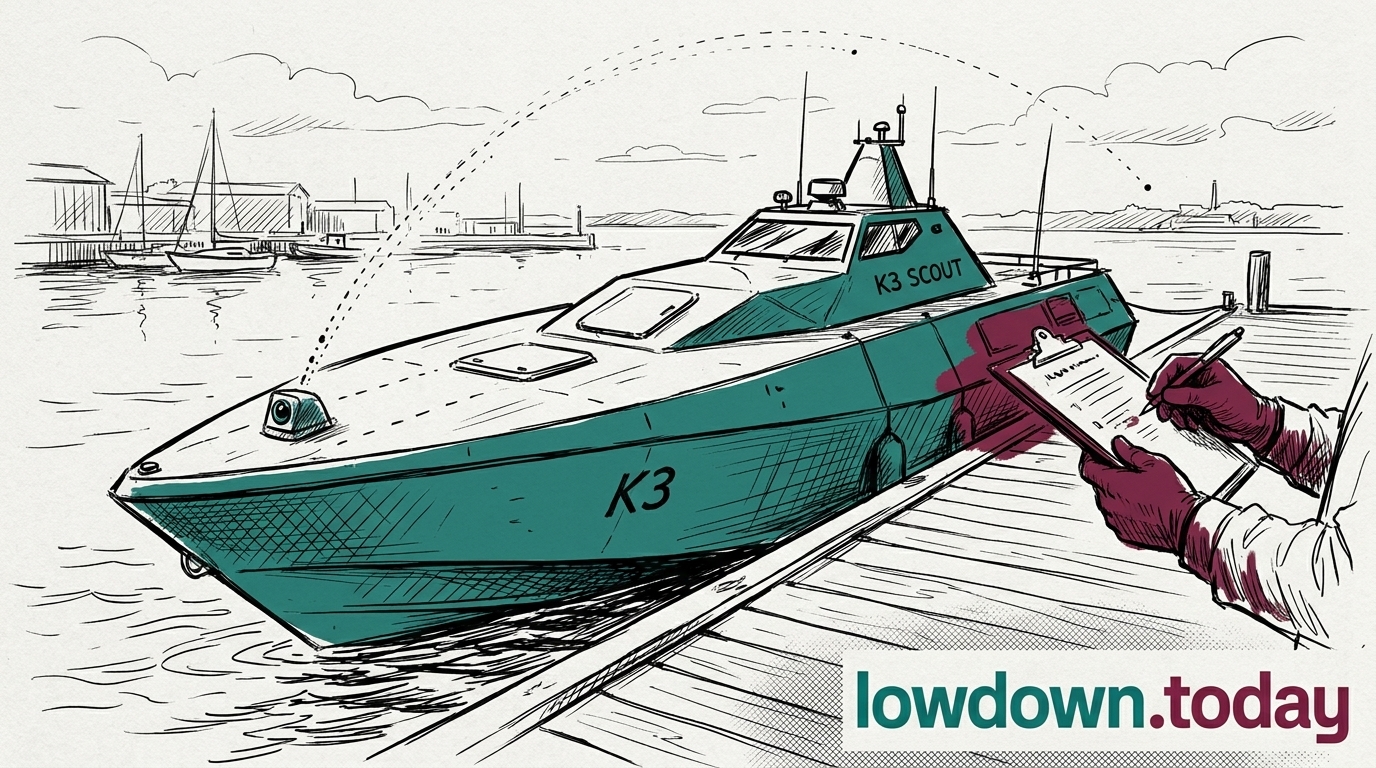
The Conservative opposition called on the Government on 9 August to 'urgently audit' equipment for hidden Chinese components, after the Telegraph's K3 SCOUT report. No named MP has been quoted on the record; the call came at party level, alongside the Ministry of Defence's own 10 August statement that no data had been compromised.
Netherlands Ministry of Defence
The Netherlands Ministry of Defence authorised Dutch Naval Design on 4 August to design 12-metre anti-submarine warfare uncrewed vessels for the Dutch-Belgian frigate programme, and to buy an adapted Compact FLASH dipping sonar from Thales Underwater Systems France. The order commits money and a named supplier while Britain's own certification body remains at the market-engagement stage.
Kraken Technology Group
Kraken Technology Group is a UK maritime-defence company based in Portsmouth that builds the K3 SCOUT, and crossed a $1bn valuation in July on a single-sourced $175m raise. The camera components reached the fleet under a third party's written security assurance, which the Platform Authority, which does not yet exist, was never positioned to check.
Navy Commercial
Navy Commercial
Navy Commercial at Whale Island published two notices on 5 August: 074032-2026, asking industry how to build a Platform Authority to certify uncrewed vessels, and 074351-2026, a GBP10m multi-role USV testbed for the Defence Chief Technology Officer. Responses on the Platform Authority close 19 August, ten days after the cameras were found transmitting to China.
Ministry of Defence
Ministry of Defence
The Ministry of Defence said on 10 August that a routine cyber vulnerability assessment found the camera fault, and a thorough investigation found no evidence that MoD data or systems had been accessed, compromised or transmitted externally. It stripped the cameras of internet connectivity but did not say whether it acted against the supplier.
Thales
Thales
Thales converted its 6 July engaging accord with Exail into a definitive combination agreement on 30-31 July, but the tender offer for Exail's remaining shares now closes by early 2028, later than July's timetable implied. Thales integrates its new undersea prime while still bidding against Kongsberg and DRASS's 2027 target for the AUKUS Pillar II contest.
