Skip to content
You can now search across every topic, entity and event.What's new
Autonomous Systems: Land & Sea
12AUG

Britain names four uncrewed warship classes

2 min read
14:17UTC

The Prime Minister's Defence Investment Plan committed more than £5bn to autonomy on 30 June and named Type 91 to Type 94, the first uncrewed platforms written into the Royal Navy's formal class list.

TechnologyDeveloping
Key takeaway

The Royal Navy named its uncrewed fleet on schedule; the contracts, numbers and dates did not follow.

The Defence Investment Plan assigned four class numbers on 30 June 2026: Type 91 for uncrewed missile platforms, Type 92 for anti-submarine sensing, Type 93 for extra-large uncrewed underwater vessels, and Type 94 for air-threat sensing. The 90-series numbering sits above the frigate and destroyer lines (Type 23, 26, 45), so the Royal Navy is counting these as fleet units, not auxiliaries.

For a supplier the naming matters more than the £5bn headline. A class definition is the anchor a requirement document, a competition and a support contract all hang from, so the taxonomy tells primes and SMEs which of four distinct product lines to align research and bid teams to. Weapons for Type 91 and Type 93 are being developed under the AUKUS Pillar II Signature Project that named two US-built vehicles and no British hull , the same undersea programme Norway's Kongsberg and Italy's DRASS are now contesting .

What did not arrive were numbers, contractors or in-service dates; expansion sits in 'the 2030s'. The £5bn is a slice of a £15bn settlement, roughly £13bn short of the ask, so the vague delivery language and the constrained topline are the same fact seen twice.

Deep Analysis

In plain English

The government has given official names to four kinds of robot warship the Royal Navy wants: one that carries missiles, one that hunts submarines, one that works underwater, and one that watches for air threats. Naming them is a real step, because the military can only buy and budget for something once it officially exists as a type. But the plan did not say how many it will buy, from whom, or when, so this is the navy drawing up the shopping list, not doing the shopping.

Deep Analysis
Root Causes

The naming answers a structural gap the AUKUS Pillar II Signature Project exposed in May, when the trilateral named two US-built undersea vehicles and no British platform: Britain needed its own class framework to bid its industry into future undersea and surface autonomy.

A GBP15bn settlement against a reported GBP28bn ask is the second cause, forcing the plan to lead with taxonomy and defer quantities: naming classes costs nothing this year and buying them does.

What could happen next?
  • Consequence

    UK primes and SMEs will realign bid and research teams to the four named class lines ahead of any tender.

    Short term · Assessed
  • Risk

    With no numbers or dates attached and a topline below the ask, the 'the 2030s' delivery language may slip further.

    Medium term · Suggested
  • Precedent

    The class-numbering ties two of the four platforms to AUKUS Pillar II, so their timelines depend on a trilateral programme the UK does not solely control.

    Long term · Assessed
First Reported In

Update #5 · Britain names four robot warship classes

GOV.UK· 3 Jul 2026
Read original
Different Perspectives
Conservative opposition
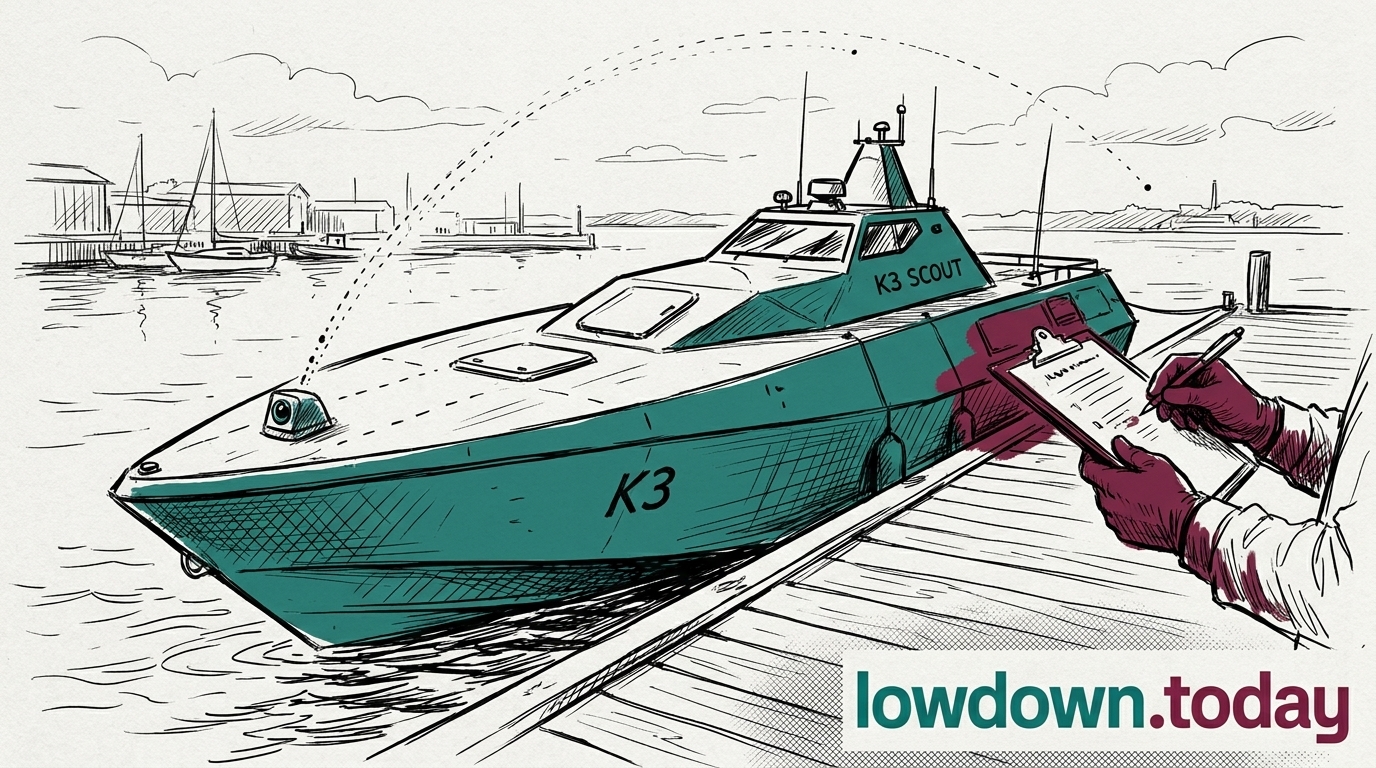
The Conservative opposition called on the Government on 9 August to 'urgently audit' equipment for hidden Chinese components, after the Telegraph's K3 SCOUT report. No named MP has been quoted on the record; the call came at party level, alongside the Ministry of Defence's own 10 August statement that no data had been compromised.
Netherlands Ministry of Defence
The Netherlands Ministry of Defence authorised Dutch Naval Design on 4 August to design 12-metre anti-submarine warfare uncrewed vessels for the Dutch-Belgian frigate programme, and to buy an adapted Compact FLASH dipping sonar from Thales Underwater Systems France. The order commits money and a named supplier while Britain's own certification body remains at the market-engagement stage.
Kraken Technology Group
Kraken Technology Group is a UK maritime-defence company based in Portsmouth that builds the K3 SCOUT, and crossed a $1bn valuation in July on a single-sourced $175m raise. The camera components reached the fleet under a third party's written security assurance, which the Platform Authority, which does not yet exist, was never positioned to check.
Navy Commercial
Navy Commercial
Navy Commercial at Whale Island published two notices on 5 August: 074032-2026, asking industry how to build a Platform Authority to certify uncrewed vessels, and 074351-2026, a GBP10m multi-role USV testbed for the Defence Chief Technology Officer. Responses on the Platform Authority close 19 August, ten days after the cameras were found transmitting to China.
Ministry of Defence
Ministry of Defence
The Ministry of Defence said on 10 August that a routine cyber vulnerability assessment found the camera fault, and a thorough investigation found no evidence that MoD data or systems had been accessed, compromised or transmitted externally. It stripped the cameras of internet connectivity but did not say whether it acted against the supplier.
Thales
Thales
Thales converted its 6 July engaging accord with Exail into a definitive combination agreement on 30-31 July, but the tender offer for Exail's remaining shares now closes by early 2028, later than July's timetable implied. Thales integrates its new undersea prime while still bidding against Kongsberg and DRASS's 2027 target for the AUKUS Pillar II contest.
