Skip to content
Briefings are running a touch slower this week while we rebuild the foundations.See roadmap
Autonomous Systems: Land & Sea
6JUN

Britain writes the rules; AUKUS names US robots

2 min read
11:59UTC

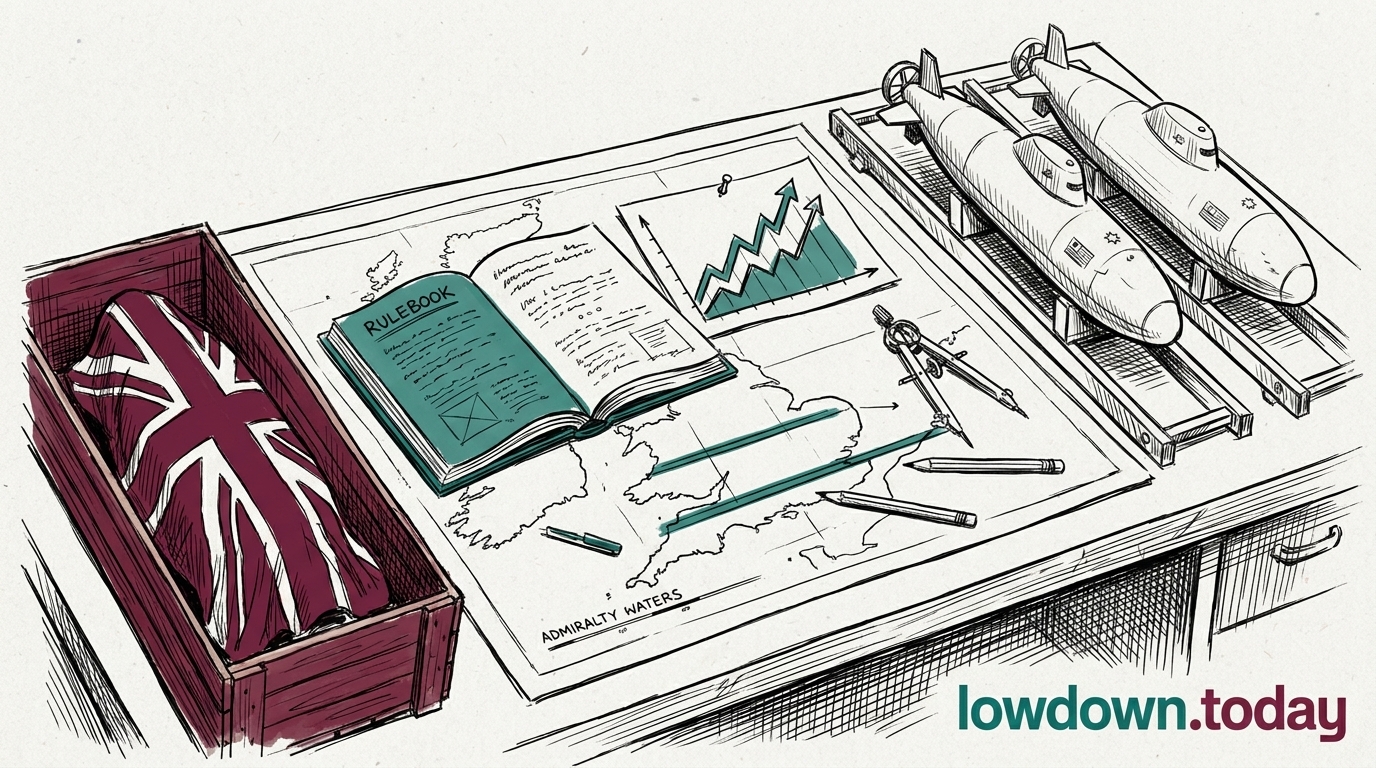
Britain spent the week building the institutions for a maritime-autonomy industry: a regulatory route for crewless-ship trials, an £8.3bn market case, and a research programme to write the rulebook. Yet the trilateral undersea-autonomy flagship it co-announced with the US and Australia named only American underwater vehicles. The contrast is Milrem and VDL, who opened a Dutch robot-vehicle line for Ukraine the same week.

Key takeaway

Britain is building MASS rules faster than hardware; AUKUS named US robots while UK frameworks multiplied.

This briefing mapped
Loading map…
Military
Regulatory
Economic
Competitive

Hegseth, Healey and Marles signed AUKUS's first Pillar II Signature Project on 30 May; the two underwater vehicles named in the fact sheet are both US-built, with no British hull listed.

Sources profile:This story draws on neutral-leaning sources

The AUKUS (Australia-UK-US) defence pact signed its first Pillar II advanced-technology project on 30 May 2026 in Singapore. It names two US-built underwater robots for a shared payload programme: the Mission Specialist Defender Mk IV and the L3Harris Iver4 900. Hardware deliveries start in 2027.

No UK-built platform appears in the fact sheet. British firms may still bid for payload and sensor contracts, but no UK industrial role has been confirmed at launch. 

The UK Maritime and Coastguard Agency opened a crewless-ship trial route on 3 June, designated Plymouth Harbour two days later, then deleted the word "sandbox" to recast the route as permanent.

Sources profile:This story draws on neutral-leaning sources

Lloyd's Register, the NPL and the National Shipbuilding Office put the UK maritime-autonomy sector at £600m today and £8.3bn by 2050, the first official measurement of a market the procurement papers will now cite.

Sources profile:This story draws on neutral-leaning sources

Three UK bodies published the first official maritime-autonomy sector baseline on 4 June 2026. Lloyd's Register, the National Physical Laboratory, and the National Shipbuilding Office put current turnover at £600m and around 5,000 jobs. The central projection reaches £8.3bn by 2050.

Lloyd's Register co-authored the report while also certifying autonomous vessels. The classification body DNV (Det Norske Veritas) faced the same advocate-and-certifier conflict when it published an equivalent shipping assessment in 2018. 

Milrem Robotics and VDL Defentec opened a THeMIS line at Born in the Netherlands on 4 June, handing over the first of 100-plus Dutch-funded ground robots for Ukraine, the first THeMIS production beyond Estonia.

Sources profile:This story draws on neutral-leaning sources

Milrem Robotics and its Dutch assembly partner opened a ground robot production line at Born, Netherlands, around 4 June 2026. They handed over the first of more than 100 Dutch-funded THeMIS unmanned ground vehicles for Ukraine. Born is the first site outside Milrem's Estonian factory.

The Netherlands required in-country assembly as a contract condition. That precedent may shape how other EU governments source combat robots going forward. 

Liverpool John Moores University launched FAVOR on 1 June with £1.2m of Horizon Europe money to design a unified rulebook for autonomous ships, the pan-European architecture the MASS Code left unwritten.

Sources profile:This story draws on neutral-leaning sources

Liverpool John Moores University launched FAVOR (a Horizon Europe autonomous-ship regulation project) on 1 June 2026 with £1.2m in funding. FAVOR covers cybersecurity, human factors, and seafarer workforce transition. It aims to fill gaps the global MASS (Maritime Autonomous Surface Ships) Code left open.

The IMO (UN shipping body) adopted the MASS Code on 22 May but set principles only. Nautilus International, the seafarers' union, argues a master should stay aboard while any crew are present. 

Closing comments

Sideways with a UK industrial-content decision point approaching. The AUKUS Pillar II Signature Project has locked US platforms at the hardware layer; the next decision gate is whether enabling-systems and payload contracts open to BAE Systems and Thales on competitive terms before the 2027 hardware delivery date. If those contracts are let on a sole-source basis to US primes via the AUKUS Advanced Capabilities Industry Forum, UK industrial content reduces to subcontractor level. The named actor is the US Navy programme manager for the Signature Project, whose contract-award decisions in the second half of 2026 will determine whether the UK's institutional momentum in maritime autonomy translates to industrial revenue or remains a regulatory exercise.

Different Perspectives
UK Ministry of Defence / Royal Navy
The Royal Navy co-signed the AUKUS Pillar II Signature Project naming two US-built vehicles in the same week the MCA and NSO built the institutional scaffolding for a British maritime-autonomy industry. Doctrine and rule-making are running ahead of the hardware: the Herne XLAUV was still seeking certification when the fact sheet was locked.
L3Harris / US defence industry
L3Harris secured AUKUS platform naming one week after the IVER4 900 entered US Navy delivery under a Defence Innovation Unit contract, using an existing certification baseline that allied vehicles could not match in April 2026. The pattern positions US primes at the hardware layer of allied undersea programmes.
Milrem Robotics / VDL Defentec (European UGV industry)
Milrem and VDL Defentec demonstrated that European UGV manufacturers can open a second cross-border production line in months rather than years when procurement demand is large enough, handing over the first Dutch-funded THeMIS units for Ukraine at Born. The Born model gives European governments a template for mandating in-country final assembly as a contract condition, bypassing single-supplier bottlenecks.
Nautilus International (seafarer labour)
Nautilus International argued at the IMO that a master must remain aboard any vessel where crew are present, directly contesting the empty-bridge model the MASS Code permits. FAVOR's workforce-transition strand is now the academic forum where that position will be researched into a policy recommendation, giving union arguments independent evidence rather than leaving them as assertions against industry.
Norwegian Maritime Authority
Norway has operated six MASS trial zones since 2019 and its AUTOSEA framework already covers the weather and traffic diversity that Plymouth's single-zone approach cannot generate from one harbour. The MCA's 12-day post-IMO publication is fast, but Norway holds four years of certification-grade operational data that the UK trial route cannot compress away.
EU / Horizon Europe (FAVOR regulatory programme)
The EU funded FAVOR through Horizon Europe to fill the technical and workforce gaps the MASS Code's principles-only adoption left open, with LJMU leading a consortium spanning Belgian, Dutch, and Greek partners. The timing confirms Horizon Europe's post-Brexit UK association agreement is operational: LJMU is leading an EU maritime research call for the first time since 2020.
