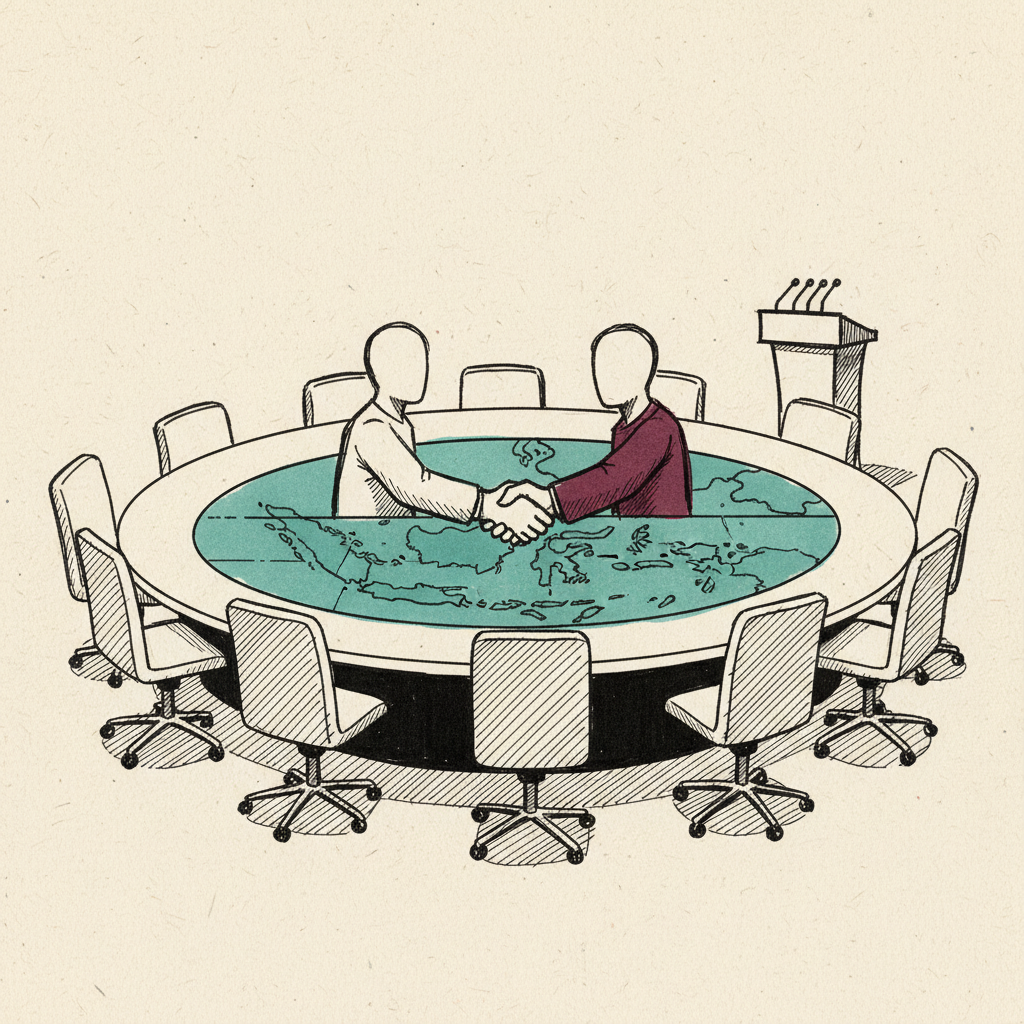
Shangri-La Dialogue
Annual Asia-Pacific security summit held in Singapore, convening defence ministers and officials from across the Indo-Pacific region.
The Shangri-La Dialogue is the IISS's annual Indo-Pacific security summit in Singapore, where the 2026 edition on 30-31 May saw US Defence Secretary Pete Hegseth warn Washington was "more than capable" of resuming strikes on Iran, alongside the AUKUS pact's first Pillar II project announcement the same weekend.
Last refreshed: 24 July 2026 · Appears in 2 active topics
What did the US say about striking Iran at the Singapore security summit?
Timeline for Shangri-La Dialogue
hosted US-China diplomatic divergence over Iran and Taiwan on 30 May
Iran Conflict 2026: Hegseth threatens Iran strikes in SingaporeHosted the AUKUS Pillar II Signature Project announcement
Autonomous Systems: Land & Sea: AUKUS names two American sea robotsBackground
The Shangri-La Dialogue is convened annually by the International Institute for Strategic Studies and takes its name from the Shangri-La Hotel in Singapore, where it has been held since its establishment in 2002. It is the premier track-1 security forum for the Asia-Pacific region, drawing defence ministers, chiefs of staff and senior officials from more than 40 countries to address Indo-Pacific dynamics including maritime disputes, alliance management and the US-China rivalry.
Unlike the Munich Security Conference, which focuses on Euro-Atlantic security, the Shangri-La Dialogue's REMIT is the Indo-Pacific, though its agenda has increasingly absorbed issues from outside that geography when they bear on regional force posture and energy security. China's practice of sending scholars rather than its defence minister, now in its second consecutive year as of 2026, reflects continuing reluctance to be seen legitimising a US-framed multilateral security agenda amid Taiwan tensions.
The 2026 dialogue illustrated that reach: alongside its usual Indo-Pacific agenda it hosted explicit US signalling on Iran and coincided with the AUKUS pact's first Pillar II technology announcement, both delivered in Singapore over the same 30-31 May weekend.
What is the Shangri-La Dialogue?
What did Pete Hegseth say about Iran at Shangri-La 2026?
Why did China not send its defence minister to Shangri-La 2026?
Where is the Shangri-La Dialogue held?



