Skip to content
You can now search across every topic, entity and event.What's new
Autonomous Systems: Land & Sea
12AUG

Thales buys Exail for EUR 3.9 billion

2 min read
14:17UTC

Thales agreed on 6 July to pay EUR 134 a share for Exail Technologies, an enterprise value of EUR 3.9 billion, folding France's undersea supply chain under one prime.

TechnologyDeveloping
Key takeaway

Thales's EUR 3.9 billion Exail buy makes France a single undersea prime and sets a sector valuation benchmark.

Thales agreed on 6 July 2026 to buy Exail Technologies for EUR 134 a share, an enterprise value of EUR 3.9 billion (USD 4.5 billion), in a deal announced at its Meudon headquarters. 1 Thales is France's largest defence-electronics group; Exail makes the autonomous underwater vehicles (AUV), uncrewed surface vessels (USV) and inertial navigation units that mine-hunting fleets increasingly run on.

The purchase folds those lines into a group whose TSAM towed synthetic-aperture sonar already sits aboard the Royal Navy's RNMB Ariadne and France's Sirius minehunting drone under the Anglo-French mine-countermeasures (MCM) programme . Thales was buying a supplier its own flagship programme already leaned on, a backward integration into vehicles and navigation it had been sourcing rather than a move into an unrelated line.

That vertical buy gives France a single national champion spanning sonar, autonomy and navigation, in the same undersea-hardware space where Kongsberg and DRASS pitched a European counter-bid for the hardware layer of the AUKUS pact (Australia, UK and US) in June . EUR 134 a share also sets a public benchmark for undersea-autonomy valuations, the first nine-figure deal in a sector that until now traded in trials and memoranda; smaller European AUV specialists will be repriced against it before their next funding rounds.

Deep Analysis

In plain English

Thales, one of France's biggest defence-electronics companies, is buying a smaller French company called Exail Technologies for about EUR 3.9 billion. Exail makes uncrewed submarines and boats, plus the navigation systems that tell them where they are underwater, and mine-hunting kit. This matters because Thales already supplies the sonar fitted to the robot mine-hunting boats used by the UK and French navies. Buying Exail means one company now owns both the sonar and the boats it rides on, instead of two separate firms trading with each other. That can speed up development, but it also means depending on a single supplier for an entire capability rather than being able to shop around.

Deep Analysis
Root Causes

Exail's balance sheet as a standalone mid-cap could not fund the parallel research tracks (autonomous vehicles, uncrewed surface craft, inertial navigation, mine-countermeasures integration) that a shrinking pool of prime contractors now expects bundled into a single tender response, so specialists without their own sonar or vehicle line increasingly cannot bid solo against Thales or Kongsberg's combined offer.

The Anglo-French mine-countermeasures programme's shared TSAM sonar supply, running since 2015, carries no contractual mechanism forcing dual-sourcing, so when Thales chose to buy the vehicle-and-navigation layer rather than keep licensing it, the UK had no structural lever to require the supplier stay independent.

What could happen next?
  • Risk

    Single-owner control of the sonar-to-vehicle stack underlying the Anglo-French MMCM programme raises a competition and interoperability question for the UK, which relies on Thales-equipped drones it does not itself manufacture.

  • Consequence

    The EUR134-a-share price sets a public valuation benchmark that will reprice smaller European autonomous-vehicle specialists in their next funding rounds.

First Reported In

Update #7 · Thales buys Exail; UK retires a minehunter

Bloomberg· 18 Jul 2026
Read original
Different Perspectives
Conservative opposition
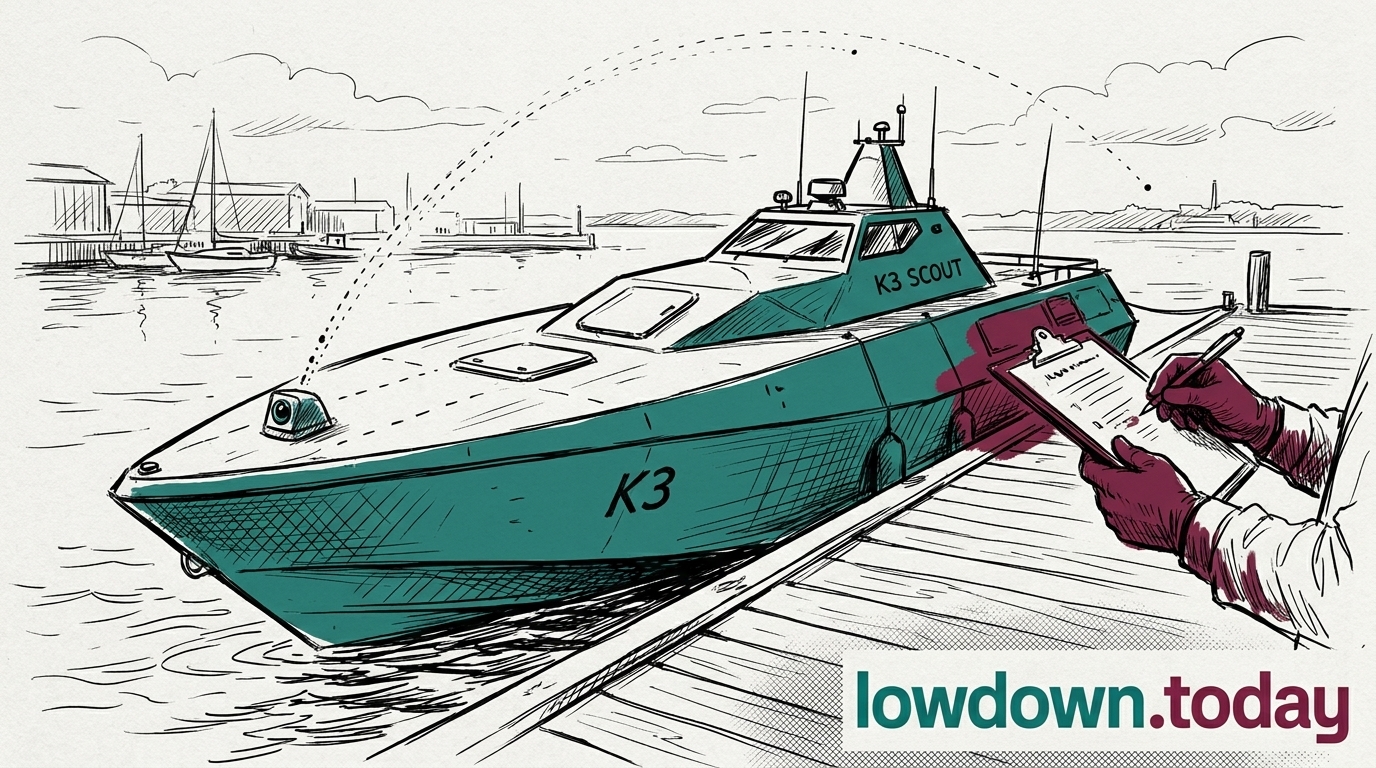
The Conservative opposition called on the Government on 9 August to 'urgently audit' equipment for hidden Chinese components, after the Telegraph's K3 SCOUT report. No named MP has been quoted on the record; the call came at party level, alongside the Ministry of Defence's own 10 August statement that no data had been compromised.
Netherlands Ministry of Defence
The Netherlands Ministry of Defence authorised Dutch Naval Design on 4 August to design 12-metre anti-submarine warfare uncrewed vessels for the Dutch-Belgian frigate programme, and to buy an adapted Compact FLASH dipping sonar from Thales Underwater Systems France. The order commits money and a named supplier while Britain's own certification body remains at the market-engagement stage.
Kraken Technology Group
Kraken Technology Group is a UK maritime-defence company based in Portsmouth that builds the K3 SCOUT, and crossed a $1bn valuation in July on a single-sourced $175m raise. The camera components reached the fleet under a third party's written security assurance, which the Platform Authority, which does not yet exist, was never positioned to check.
Navy Commercial
Navy Commercial
Navy Commercial at Whale Island published two notices on 5 August: 074032-2026, asking industry how to build a Platform Authority to certify uncrewed vessels, and 074351-2026, a GBP10m multi-role USV testbed for the Defence Chief Technology Officer. Responses on the Platform Authority close 19 August, ten days after the cameras were found transmitting to China.
Ministry of Defence
Ministry of Defence
The Ministry of Defence said on 10 August that a routine cyber vulnerability assessment found the camera fault, and a thorough investigation found no evidence that MoD data or systems had been accessed, compromised or transmitted externally. It stripped the cameras of internet connectivity but did not say whether it acted against the supplier.
Thales
Thales
Thales converted its 6 July engaging accord with Exail into a definitive combination agreement on 30-31 July, but the tender offer for Exail's remaining shares now closes by early 2028, later than July's timetable implied. Thales integrates its new undersea prime while still bidding against Kongsberg and DRASS's 2027 target for the AUKUS Pillar II contest.
