Skip to content
You can now search across every topic, entity and event.What's new
Autonomous Systems: Land & Sea
12AUG

Kongsberg to design a US Navy drone sub

2 min read
14:17UTC

The US Defense Innovation Unit picked Norway's Kongsberg and America's Oceaneering on 15 July to design an extra-large uncrewed submarine, with concept work due in Q3 2026.

TechnologyDeveloping
Key takeaway

The US Navy hired Norway's Kongsberg to design its next big underwater drone, blurring the neat US-versus-Europe autonomy split.

The US Defense Innovation Unit (DIU), the Pentagon body that fast-tracks commercial technology into military programmes, selected Kongsberg Discovery and Oceaneering International on 15 July 2026 to develop an extra-large uncrewed underwater vehicle (XLUUV) under its Combat Autonomous Maritime Platform (CAMP) programme, with a concept and system design due in the third quarter of 2026. 1 The pair will run architecture and trade studies weighted toward modularity and interoperability. 2

A Norwegian prime leading design for the US Navy cuts against the AUKUS pact's pattern of naming only US-built vehicles for its inaugural seabed programme , and against any tidy story of two sealed European and American camps. This is the same Kongsberg that anchors the DRASS European counter-bid for AUKUS Pillar II hardware , now sitting inside a US next-generation programme.

DIU's non-traditional acquisition route lets it pull the best available design partner regardless of nationality; choosing Kongsberg values the firm's HUGIN AUV heritage over a US-only supply chain, the reverse of the AUKUS Pillar II selection logic. The Q3 2026 design milestone becomes a near-term test of whether the CAMP path competes with or feeds AUKUS Pillar II.

Deep Analysis

In plain English

The US military's Defense Innovation Unit, a Pentagon office set up to buy commercial technology faster than usual defence contracts allow, has picked Kongsberg, a Norwegian company, and Oceaneering, a US robotics firm, to design a huge uncrewed submarine, known as an XLUUV. This is notable because the US usually prefers American-only suppliers for big defence programmes. Choosing a Norwegian design partner shows the Pentagon is willing to look outside its own borders when a foreign company has proven underwater-robot technology the US does not yet have in-house.

Deep Analysis
Root Causes

DIU's mandate exists because service acquisition tracks move too slowly for autonomy hardware refresh cycles; its Other Transaction Authority prototype agreements bypass full-and-open competition requirements that would otherwise favour incumbent US primes over an unproven design.

Kongsberg's HUGIN lineage gives it decades of at-sea autonomous-vehicle hours that no untested US-only team can match on schedule for a Q3 2026 concept-design deadline, effectively forcing DIU's hand toward an established non-US design regardless of sourcing preference.

What could happen next?
  • Precedent

    A foreign-led design team winning a US Navy next-generation autonomy programme weakens the assumption that AUKUS-adjacent US procurement stays US-only.

  • Meaning

    Kongsberg now sits inside both the US CAMP design effort and the European AUKUS Pillar II counter-bid with DRASS, undercutting a clean two-bloc narrative.

First Reported In

Update #7 · Thales buys Exail; UK retires a minehunter

Naval Today· 18 Jul 2026
Read original
Different Perspectives
Conservative opposition
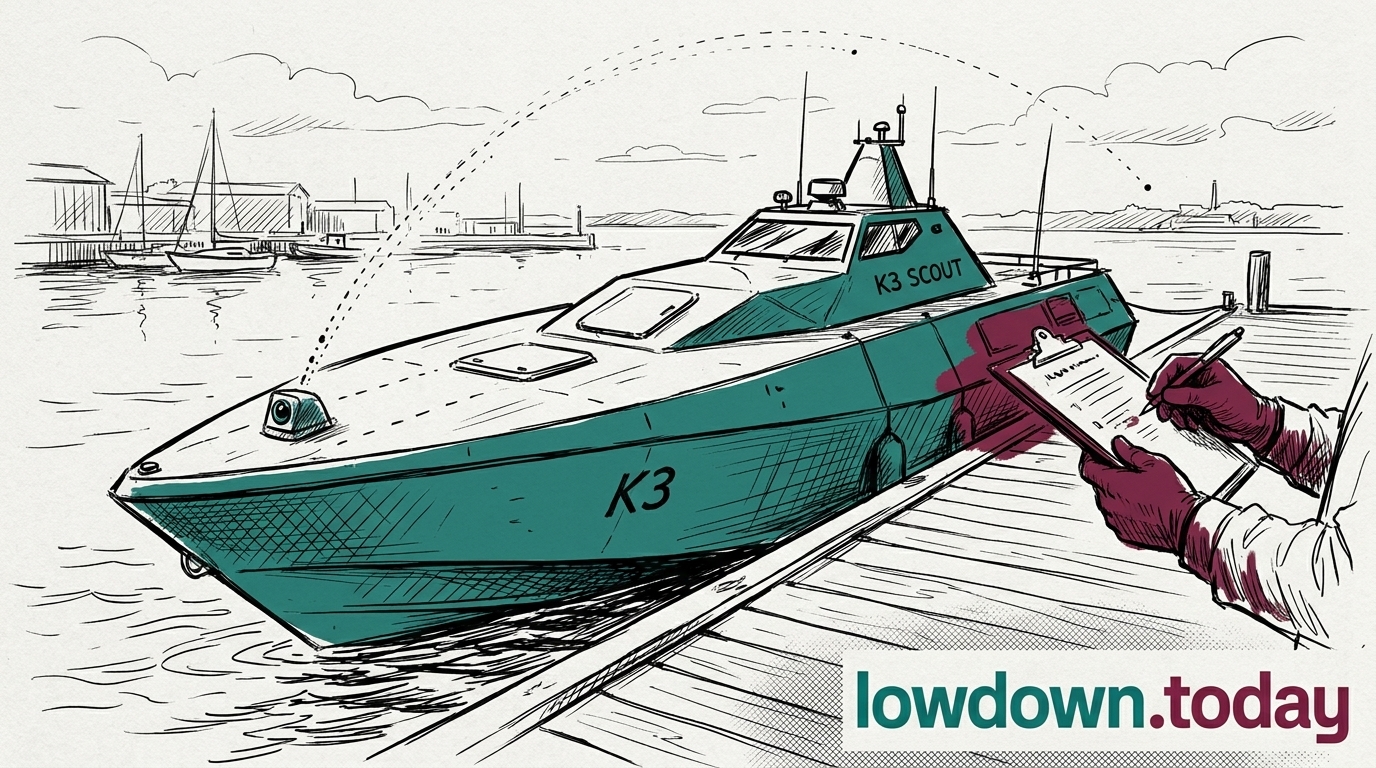
The Conservative opposition called on the Government on 9 August to 'urgently audit' equipment for hidden Chinese components, after the Telegraph's K3 SCOUT report. No named MP has been quoted on the record; the call came at party level, alongside the Ministry of Defence's own 10 August statement that no data had been compromised.
Netherlands Ministry of Defence
The Netherlands Ministry of Defence authorised Dutch Naval Design on 4 August to design 12-metre anti-submarine warfare uncrewed vessels for the Dutch-Belgian frigate programme, and to buy an adapted Compact FLASH dipping sonar from Thales Underwater Systems France. The order commits money and a named supplier while Britain's own certification body remains at the market-engagement stage.
Kraken Technology Group
Kraken Technology Group is a UK maritime-defence company based in Portsmouth that builds the K3 SCOUT, and crossed a $1bn valuation in July on a single-sourced $175m raise. The camera components reached the fleet under a third party's written security assurance, which the Platform Authority, which does not yet exist, was never positioned to check.
Navy Commercial
Navy Commercial
Navy Commercial at Whale Island published two notices on 5 August: 074032-2026, asking industry how to build a Platform Authority to certify uncrewed vessels, and 074351-2026, a GBP10m multi-role USV testbed for the Defence Chief Technology Officer. Responses on the Platform Authority close 19 August, ten days after the cameras were found transmitting to China.
Ministry of Defence
Ministry of Defence
The Ministry of Defence said on 10 August that a routine cyber vulnerability assessment found the camera fault, and a thorough investigation found no evidence that MoD data or systems had been accessed, compromised or transmitted externally. It stripped the cameras of internet connectivity but did not say whether it acted against the supplier.
Thales
Thales
Thales converted its 6 July engaging accord with Exail into a definitive combination agreement on 30-31 July, but the tender offer for Exail's remaining shares now closes by early 2028, later than July's timetable implied. Thales integrates its new undersea prime while still bidding against Kongsberg and DRASS's 2027 target for the AUKUS Pillar II contest.
