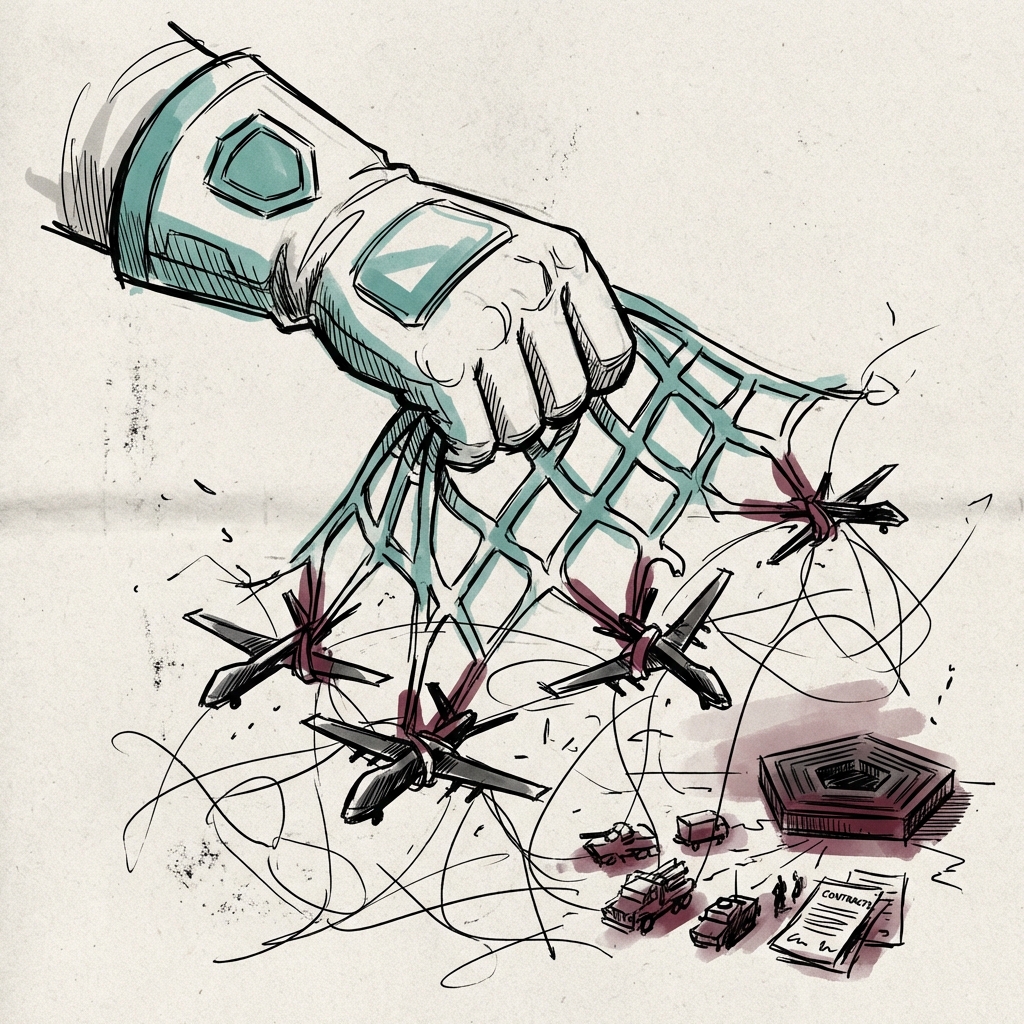
US Army
US land warfare branch; primary Pentagon buyer for drones and counter-drone systems in 2026.
On 15 April, the US Army received four LOCUST X3 laser systems for evaluation as its Enduring High Energy Laser competition moved to late 2026.
Last refreshed: 1 October 2026 · Appears in 3 active topics
Can the US Army's European drone tests unlock allied procurement at scale?
Timeline for US Army
Mentioned in: ARX delivers first GEREONs to Ukraine
Autonomous Systems: Land & SeaMentioned in: JIATF-401 adds ten Domestic Shield firms
Drones: Industry & DefenceMentioned in: US and Kuwait meet, agenda unpublished
Iran Conflict 2026Mentioned in: Overland AI to automate six army trucks
Autonomous Systems: Land & SeaMentioned in: Rheinmetall opens a UK autonomy centre
Autonomous Systems: Land & SeaBackground
The US Army is the United States land warfare branch. Its procurement choices shape the equipment available to ground formations, particularly drones, counter-drone systems and autonomous vehicles.
The Army is also a major Pentagon customer for counter-drone command systems. On 14 March, Army Contracting Command awarded Anduril a 10-year, $20bn enterprise contract vehicle for the Lattice platform, consolidating more than 120 procurement actions.
Field testing gives the Army a role beyond contract award. On 9 June, V Corps soldiers tested Helsing's HX-2 autonomous strike drone in Lithuania while satellite navigation and communications were disrupted, hitting 15 of 17 targets.
The Army tests laser alternatives
On 10 April, the US Army delayed selection of an Enduring High Energy Laser winner from the second to the fourth quarter of financial year 2026. The decision prolonged its assessment of systems intended to defeat drones, rather than committing the service to one design.
On 15 April, AeroVironment delivered four LOCUST X3 systems to the Army's Rapid Capabilities and Critical Technologies Office. Two were mounted on Infantry Squad Vehicles and two on Joint Light Tactical Vehicles. The delivery gave the Army equipment to evaluate during the extended competition.
Recently resolved
What happened at Project Flytrap 5.0 in Lithuania?
What directed-energy weapons programme is the US Army running?
What is the US Army Gauntlet competition for drones?
How many drones did the US Army buy under Drone Dominance Phase 1?
Why did a US Army Apache helicopter crash near the Strait of Hormuz?
What does the FY2027 Pentagon budget mean for drone spending?
What is Gauntlet II and when does it happen?
How many drones is the US Army trying to procure?
What is the US Army's $20 billion Anduril contract?
What did JIATF-401 award AeroVironment in July 2026?


Written with AI from Lowdown's published reporting. Not individually reviewed by an editor. Updated 1 October 2026. Editorial standards.