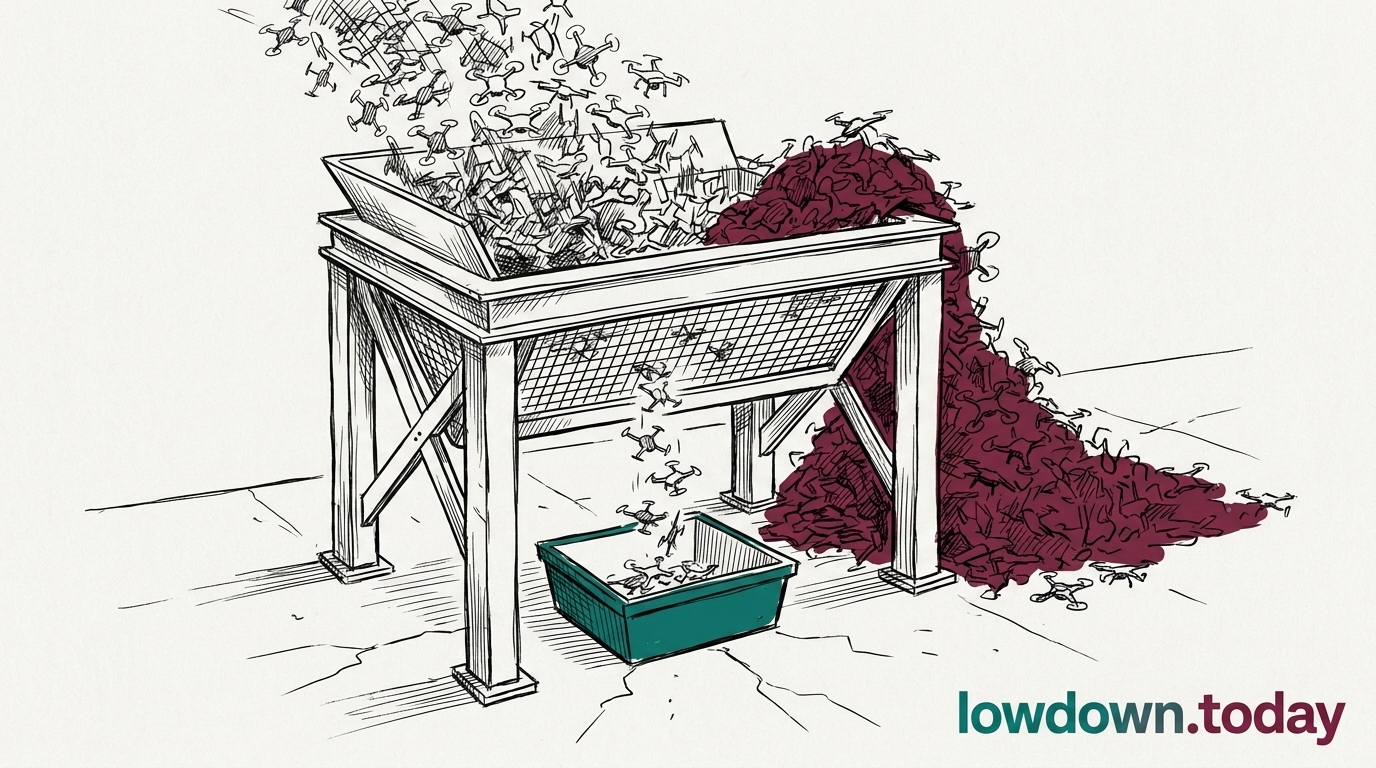
Phase 1 of the Pentagon's first-person-view (FPV) attack-drone buy finished about 10,000 units below its 30,000-drone target 1. FPV drones are cheap, camera-guided airframes a pilot steers onto a target. The original programme ordered 30,000 of them at $5,000 each . Lead vendor Neros shipped every one of its 2,400 ARCHeR drones; the military accepted only 1,040, a 43% acceptance rate 2. Other vendors delivered roughly 560 more, still awaiting sign-off. For months the order volume drove the headlines. The count that clears inspection drives them now.
The gap sits in industrial maturity rather than design. Neros shipped its full contract, then watched more than half the airframes fail the quality gate, the wall that historically separates a prototype shop from a production prime. Accepting half of what one lead supplier delivers tells a buyer the bottleneck has moved from invention to repeatable manufacture at volume. That is a harder problem to fund away, and it reshapes who wins the next round.
The Phase 2 qualifier is already running. The Gauntlet Stage 1 fly-off, the Pentagon's competitive ranking exercise that orders drones by performance, opened at Camp Grayling, Michigan on 8 June and runs to 20 June, with 49 companies fielding around 79 designs . The pressure sits in the price card. Phase 2 caps long-range strike drones at $4,500 and urban-assault drones at $3,500, down from the flat $5,000 of Phase 1 3. Vendors that could not hit the target at the higher price must now hit a sharper one.
A second filter runs underneath. From August 2026, programme drones must strip out Chinese motors and batteries to stay eligible, a supply-chain gate the trade calls the Chinese cliff 4. That deadline binds every entrant, including the Ukrainian firms that joined Phase 2 alongside London's Skycutter ; combat pedigree does not exempt a bill of materials. A shortfall at the start of a production ramp can read as friction rather than a ceiling, and Phase 2 still promises at least $300m in fresh orders. The yardstick has simply moved from units ordered to units the Pentagon will accept.





