LOCUST X3
AeroVironment's third-generation directed-energy weapon; defeats drones for roughly $5 per shot.
Last refreshed: 5 July 2026 · Appears in 1 active topic
Will LOCUST X3 win an Army production contract before its missile-based rivals exhaust Gulf war stocks?
Timeline for LOCUST X3
AeroVironment books record and a caveat
Drones: Industry & DefenceMentioned in: RAF Typhoons fire APKWS in Gulf combat
Drones: Industry & DefenceMentioned in: Switchblade 400 wins Army LASSO at $1.2bn ceiling
Drones: Industry & DefenceMentioned in: Army-Navy commit $676m to JLWS laser
Drones: Industry & DefenceMentioned in: RTX demos reusable Coyote against swarms
Drones: Industry & DefenceBackground
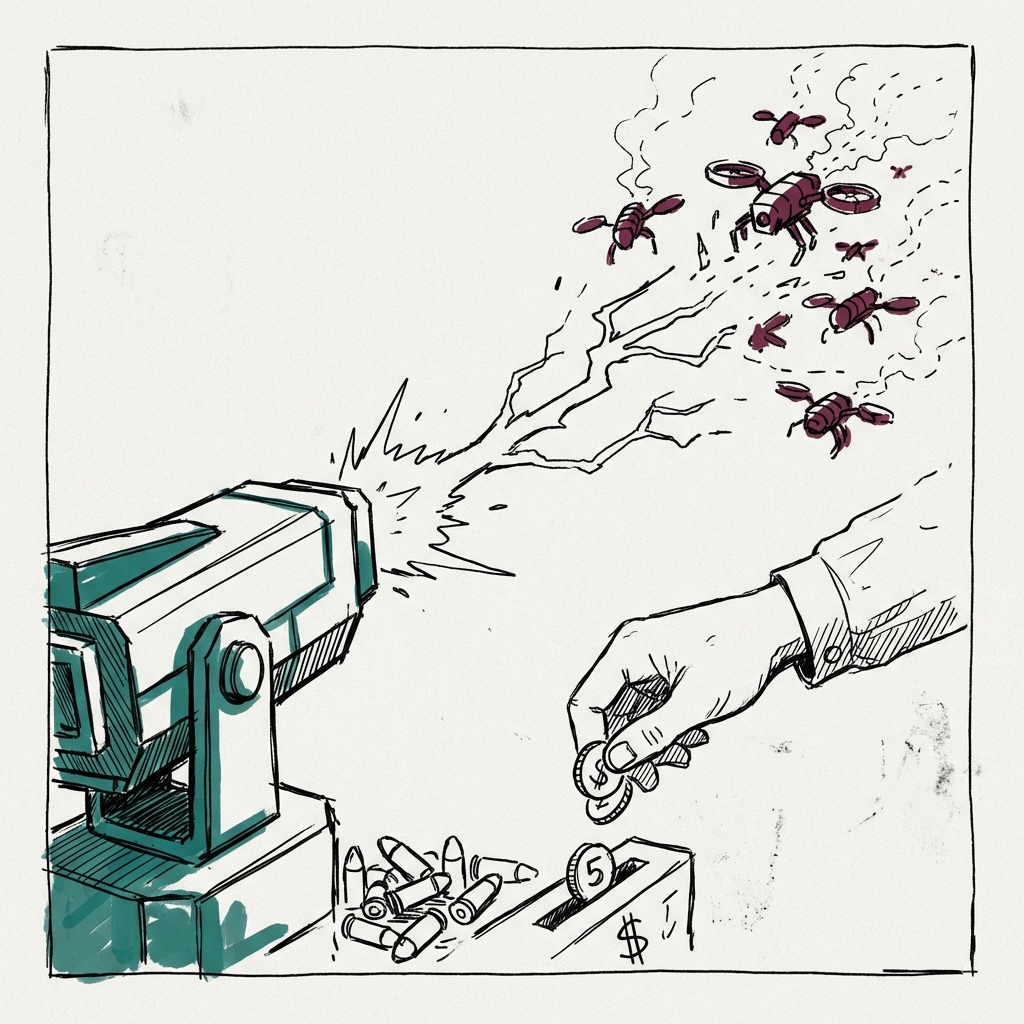
LOCUST X3 is a modular directed-energy weapon unveiled by AeroVironment at the AUSA Global Force conference in Huntsville, Alabama on 25 March 2026. The third-generation laser system delivers 20 to 35-plus kilowatts, defeats Group 1 through Group 3 unmanned aircraft, and costs approximately $5 per engagement — contrasted with the $4 million cost of a Patriot interceptor missile.
In April 2026, AeroVironment delivered four LOCUST X3 units to the Army's Rapid Capabilities and Critical Technologies Office (RCCTO) for formal Enduring High Energy Laser (EHEL) evaluation, two mounted on Infantry Squad Vehicles and two on JLTVs. The EHEL competition winner selection slipped from Q2 to Q4 FY26, extending the evaluation timeline. No production contract has been awarded as of April 2026. On 1 July 2026, the US Army awarded AeroVironment a $500 million layered Counter-UAS contract, disclosed the same week the company reported record full-year revenue of $1.98 billion (up 141%), the clearest production-scale validation yet for the company's counter-drone line, though the award covers layered Counter-UAS capability broadly rather than confirming LOCUST X3 specifically as the EHEL winner.
The system's debut coincided with two other directed-energy announcements in March 2026: Epirus's Leonidas AGV high-power microwave vehicle and the US Navy's confirmation that its shipboard ODIN laser saw combat during Operation Epic Fury. The convergence of three directed-energy systems reaching field readiness in a single month marks a structural shift in counter-drone economics — from expensive interceptor missiles to effectively unlimited-magazine energy weapons. The Army's separate $675.93 million Joint Laser Weapon System programme (28 April 2026, 150 kW, aimed at Cruise Missiles) sits above the Group 1–3 drone layer that LOCUST X3 targets, suggesting the two programmes are complementary rather than competing.
What is the LOCUST X3 directed energy weapon?
LOCUST X3 cost per shot compared to Patriot?
Is LOCUST X3 in production?
What is the LOCUST X3 laser and what drones can it shoot down?
Has LOCUST X3 won any Army contracts yet?
Why is a $5 laser cheaper than a missile for shooting down drones?
How does LOCUST X3 fit alongside the Army's $675 million Joint Laser Weapon System?
Who else is competing against LOCUST X3 in the EHEL competition?
Has AeroVironment won a US Army contract related to LOCUST X3?
