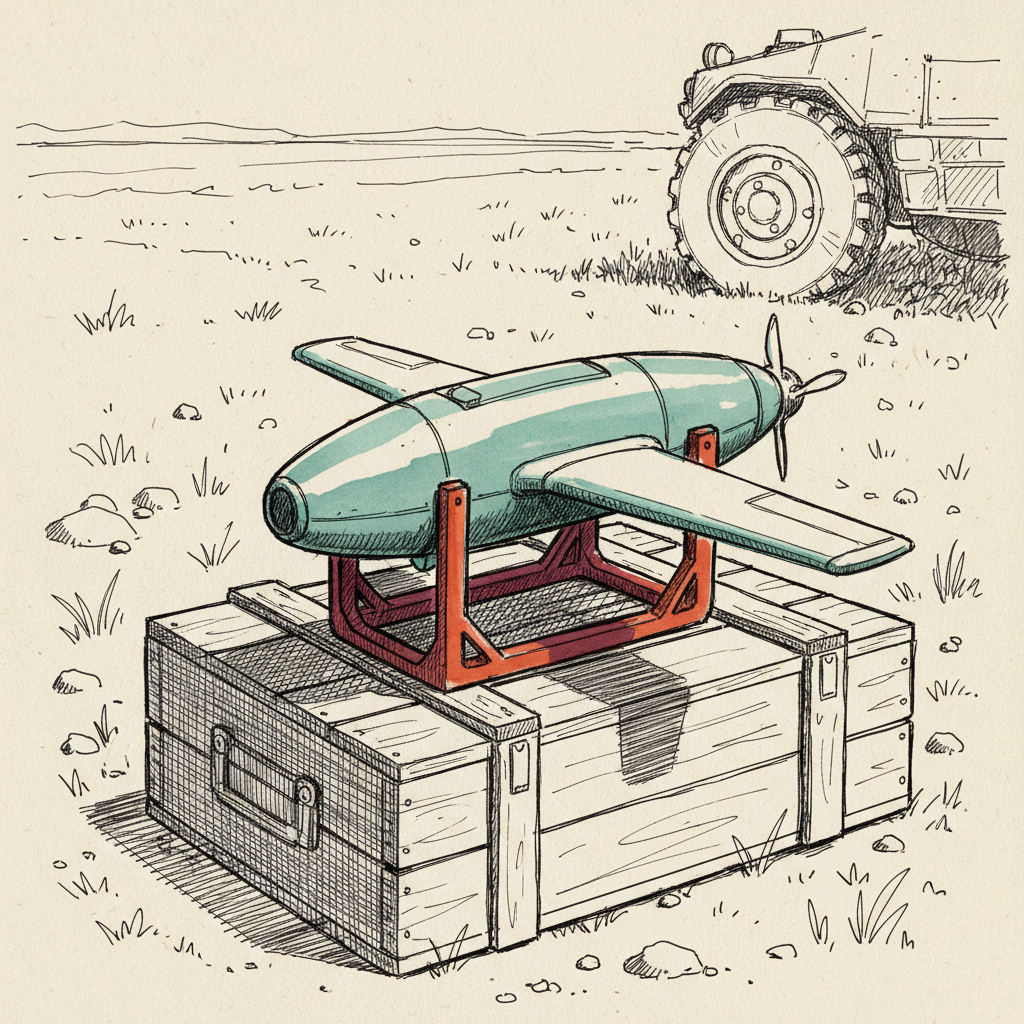
Merops
AI interceptor drone by Project Eagle; credited with 40% of Shahed kills in Ukraine, 10,000 deployed to The Gulf in 2026.
Last refreshed: 14 July 2026 · Appears in 2 active topics
Can one autonomous interceptor fight Ukraine and the Gulf simultaneously without exhausting either front?
Timeline for Merops
Mentioned in: AeroVironment banks $580.5m in a day
Drones: Industry & DefenceMentioned in: France buys a Baltic interceptor drone
Drones: Industry & DefenceMentioned in: Latvia defence chief resigns over drones
Drones: Industry & DefenceDesignated as primary platform under JIATF-401 IDIQ at $15,000 per unit
Drones: Industry & Defence: Perennial wins first JIATF-401 IDIQ at $500MMentioned in: CSIS: Russia's AI drones run mostly on US chips
Drones: Industry & DefenceBackground
Merops became the canonical example of the Ukraine-to-Gulf technology pipeline in 2026. Developed by Project Eagle with backing from former Google CEO Eric Schmidt, the AI interceptor drone was credited with 40% of all Shahed drone kills in Ukraine before the US Army diverted 10,000 units directly to the Middle East within five days of the Iran war's start. At $14,000-15,000 per unit, Merops costs less than one Iranian Shahed-136, reversing the usual counter-drone economics where the attacker's cheap swarm forces the defender to expend expensive interceptors.
The Baltic drone wave confirmed Merops as the benchmark procurement reference for NATO's eastern flank: Lithuania purchased 48 Merops interceptors in April 2026, drawing directly on Ukrainian combat data and pricing at approximately $15,000 per unit. The Lithuanian purchase sits within a broader Baltic procurement wave, as Estonia, Latvia, and Finland each absorbed or detected incoming drones in May 2026 following Russian EW jamming incidents. In the same cycle, JIATF-401 awarded Perennial Autonomy a $500 million three-year IDIQ contract covering Merops interceptors at approximately $15,000 per unit, naming Munich-based Twentyfour Industries as European production partner, a structural step toward removing the transatlantic supply bottleneck that The Gulf diversion exposed.
The Gulf diversion exposed a supply constraint with direct implications for Ukraine. CSIS analysis published in April 2026, which examined Russia's parallel autonomous-drone programme, implicitly framed Merops as the Western answer to Russia's V2U: two systems running autonomous target recognition, built on combat data from the same front. The Pentagon has not disclosed whether Ukraine's Merops allocation will be backfilled. The European production partnership through Twentyfour Industries is the most concrete step yet toward addressing that constraint, though Munich production at scale is measured in months rather than weeks.
The $500 million ceiling Merops's IDIQ established in May was matched for the first time on 6 July 2026, when JIATF-401 awarded AeroVironment its own $500 million Domestic Shield IDIQ plus an $80.5 million Titan award. Rather than eroding Merops's position, the repeat award confirms JIATF-401 is running a distributed multi-vendor model, in keeping with the wider July procurement pattern of spreading awards across many suppliers rather than consolidating around one.
What happened to Ukraine's Merops supply in 2026?
Merops drone vs Shahed-136: which is cheaper?
How much does a Merops drone cost?
Did another company get a contract as big as Merops's?
How does the Merops drone intercept targets?
What is the Merops drone?
How many Merops drones were sent to the Middle East?
Who makes the Merops drone?



Written with AI from Lowdown's published reporting. Not individually reviewed by an editor. Updated 14 July 2026. Editorial standards.