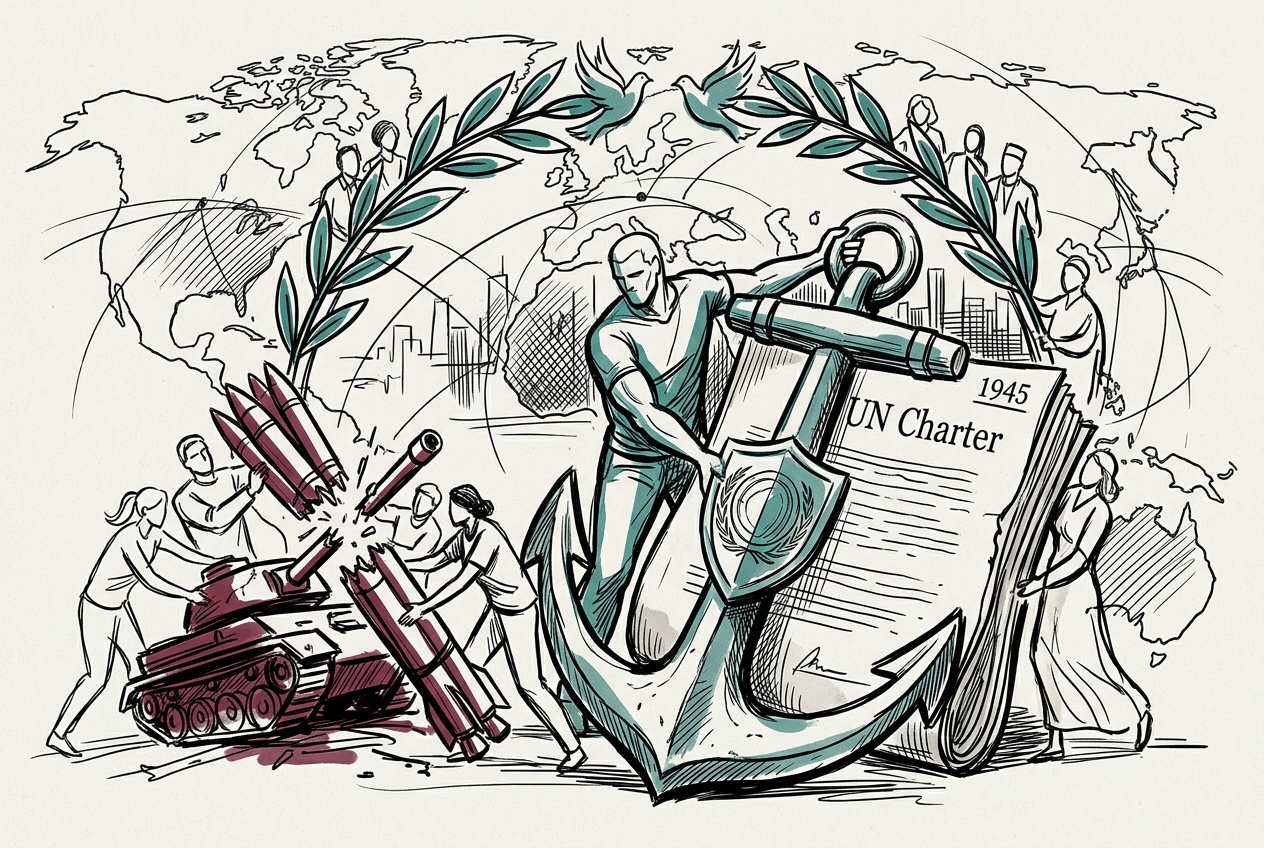
UN Charter
The 1945 founding treaty of the United Nations, prohibiting force and enshrining collective security.
On 29 July, Saudi jets struck Iraq after Riyadh invoked Article 51 of the UN Charter, extending the treaty’s self-defence language beyond the war’s original combatants.
Last refreshed: 22 September 2026 · Appears in 1 active topic
Can the Charter's own depositary state be held accountable for violating it?
Timeline for UN Charter
Mentioned in: Riyadh holds fire at Baghdad's request
Iran Conflict 2026Mentioned in: Tehran calls tanker strikes a war crime
Iran Conflict 2026Mentioned in: Riyadh names energy, port and airport targets
Iran Conflict 2026Mentioned in: White House signs nothing on Iran
Iran Conflict 2026Mentioned in: Saudi jets hit Iraq, citing Article 51
Iran Conflict 2026Background
The UN Charter is the founding treaty of the United Nations. It sets out collective security, prohibits threats or uses of force against another state’s territorial Integrity or political independence, and preserves self-defence after an armed attack through Article 51. On 1 March, the Security Council’s emergency session on the Iran war showed how competing parties still use its provisions to argue the legality of force.
Its enforcement structure rests chiefly with the Security Council, where five permanent members hold vetoes, while the International Court of Justice is the United Nations’ principal judicial body. The Charter does not make every invocation of self-defence valid; it provides the common legal test against which such claims are made. Kuwait’s 28 May invocation of Article 51 illustrates that continuing practical role.
Article 51 widens self-defence claims
On 28 May, Kuwait invoked Article 51 after a missile was fired at Ali Al Salem Air Base. The move made the UN Charter’s self-defence clause the formal language of a Gulf response to the Iran war.
On 29 July, Saudi Arabia cited Article 51 when its jets struck Iraq. The two invocations show the Charter functioning as the common legal vocabulary for states seeking to frame military action as self-defence. They do not settle whether a claim meets the Charter’s threshold, but they make Article 51 central to how the conflict is argued.
Qatar preserves a Charter claim
On 21 July, Qatar filed letters with the United Nations describing three Iranian attacks since 7 July, seeking compensation and reserving its right to self-defence under Article 51. The filing placed the UN Charter inside a live dispute without making it a basis for immediate military action.
As of 21 July, Qatar continued to host talks on reopening the strait of Hormuz while keeping its claim open. For the Charter, this showed its language serving diplomacy and legal notice as well as a claimed justification for force.
What is the UN Charter?
Did the US violate the UN Charter by striking Iran?
What is Article 51 of the UN Charter?
Why can the UN Charter not be enforced against a permanent Security Council member?
What is the difference between the UN Charter and the Geneva Conventions?
What does the UN Charter have to do with the Falklands World Cup banner row?

