Skip to content
Briefings are running a touch slower this week while we rebuild the foundations.See roadmap
Iran Conflict 2026
19MAY

PGSA goes live on Hormuz transit

3 min read
17:44UTC

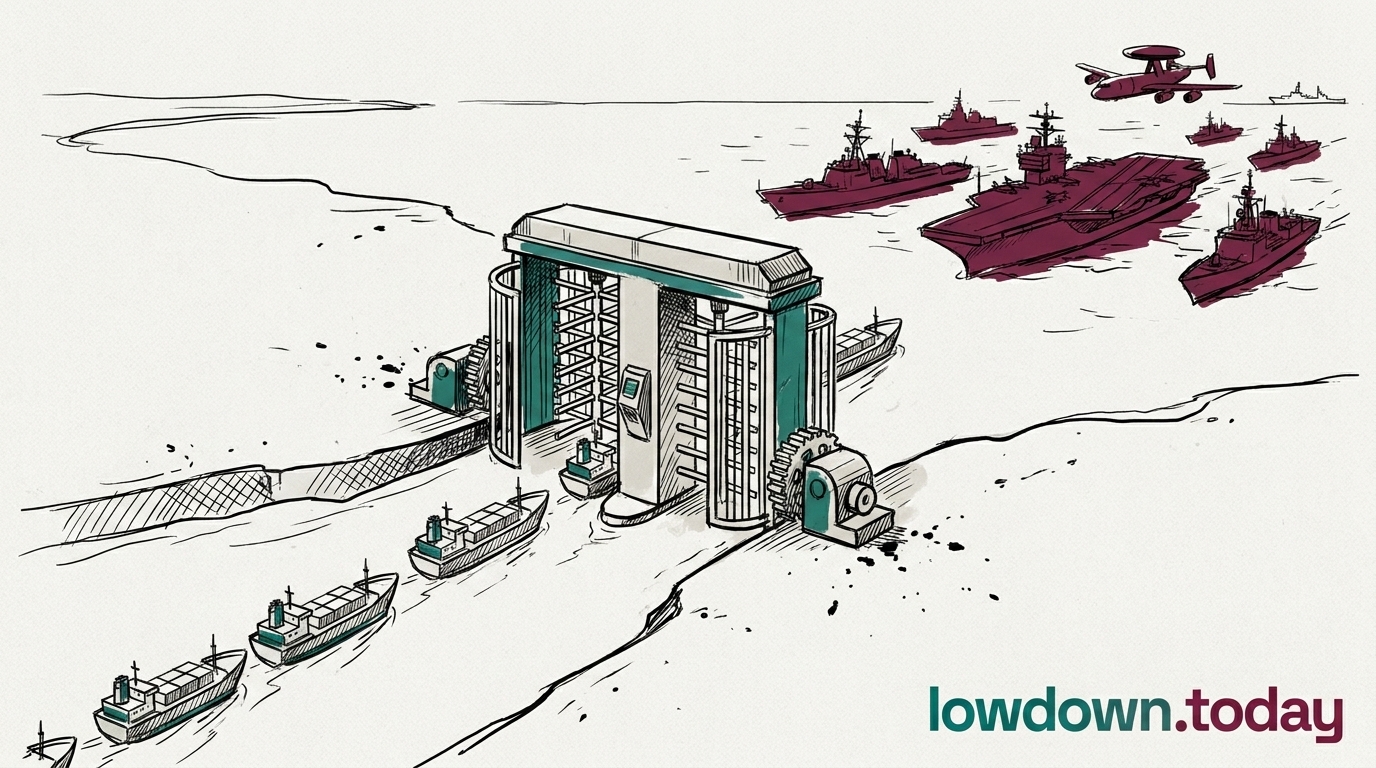
Iran's Persian Gulf Strait Authority launched an official X account and a vessel-submission portal on 18 May, converting the Majlis-backed Hormuz toll from political signalling into an administrative interface ships must engage with.

ConflictDeveloping
Key takeaway

Iran's Hormuz toll moved from a slogan to a working permit office on 18 May.

Iran's Persian Gulf Strait Authority launched an official X account and a live vessel-submission portal on 18 May 2026, demanding ownership details, insurance, crew manifests, cargo declarations and routing for a transit permit through the Strait of Hormuz. Euronews reported the launch the same day 1. The body is IRGC (Islamic Revolutionary Guard Corps)-backed and answers to the Majlis, Iran's parliament. PGSA replaces a parliamentary mechanism Azizi posted as legislative intent two days earlier with a working administrative interface that ships now have to engage with one way or another.

the strait of Hormuz is the 33-km chokepoint through which roughly a fifth of seaborne oil moves each day. Permit systems there are not a matter of fee schedules alone; they reset who counts as the gatekeeper. Euronews relayed a market-reported figure of up to $2 million per transit in yuan-denominated fees 2, though PGSA has not published an official tariff. The absence of a public price list means insurance underwriters and tanker owners are bidding into a system whose terms are still being written by the office collecting them.

For the 26-nation Coalition that signed the Hormuz joint statement on 12 May , the PGSA portal is the first hard test of UNCLOS Article 38 transit-passage rights against a sovereign administrative system. UNCLOS (UN Convention on the Law of the Sea) Article 38 protects freedom of transit through international straits, but it presumes the strait state is not running a permit office. Once a vessel registers with PGSA, even under protest, the Coalition's legal frame stops being an open-seas argument and becomes a treaty dispute over a working bureaucracy.

Deep Analysis

In plain English

Iran set up a new government body called the Persian Gulf Strait Authority (PGSA) to control who passes through the Strait of Hormuz, the narrow waterway through which about 20% of the world's oil moves. For weeks the PGSA existed on paper only. On 18 May, it went live online: shipping companies can now submit their vessel's details and pay a fee of up to $2 million per trip, in Chinese yuan, to get a transit permit. Ships that file the paperwork are implicitly accepting Iran's right to charge. Ships that refuse must decide whether to risk the consequences. Neither option removes the legal dilemma the PGSA has created.

Deep Analysis
Root Causes

The PGSA's X-account launch rests on three structural conditions that no ceasefire automatically removes.

First, Iran never ratified the 1982 UN Convention on the Law of the Sea (UNCLOS). The transit-passage right that coalition planners invoke under UNCLOS Article 38 simply has no standing in Iranian domestic law, which Tehran updated in 2024 to assert jurisdiction over 'hostile-linked vessels' in what it terms Persian Gulf rather than international waters.

Second, the yuan-denominated payment rail routes outside the US dollar correspondent-banking system, creating a financial infrastructure whose utility to China, Russia, and sanctioned states predates and survives any Iran-specific political settlement.

Third, the PGSA emerged from a Majlis legislative mandate rather than an executive decree, giving it institutional depth that a presidential ceasefire commitment cannot unilaterally revoke without a parliamentary counter-vote.

Escalation

The PGSA going operational marks a qualitative step beyond political posturing: Iran now has an administrative interface that generates compliance dilemmas for every vessel, rather than a legislative threat that ships could ignore. Escalation risk comes not from the fee itself but from the first enforcement action against a vessel that refuses to file.

What could happen next?
  • Consequence

    Shipping companies face an immediate compliance fork: file with PGSA and implicitly accept Iranian jurisdiction, or refuse and absorb unquantified transit risk.

    Immediate · 0.85
  • Risk

    If even a handful of carriers pay the yuan toll, the payment rail becomes self-reinforcing and difficult to wind back in a ceasefire negotiation.

    Short term · 0.72
  • Precedent

    A functioning yuan-denominated strait-toll mechanism would represent the first major energy-chokepoint fee collected outside the US dollar system, with implications for renminbi internationalisation well beyond the Iran conflict.

    Long term · 0.65
First Reported In

Update #102 · Iran signs Hormuz toll; Trump posts a cancelled strike

Euronews· 19 May 2026
Read original
Different Perspectives
IAEA
IAEA
Director General Rafael Grossi appeared in person at the UNSC on 19 May and warned that a direct hit on an operating reactor 'could result in very high release of radioactivity'. The session produced a condemnation record but no resolution, and the Barakah perimeter was already struck on 17 May.
Hengaw (Kurdish rights monitor)
Hengaw documented three judicial executions and the detention of Kurdish writer Majid Karimi in Tehran on 19 May, establishing Khorasan Razavi province as the newest geography in Iran's wartime judicial record. The organisation's Norway-based operation continues to surface a domestic repression track running in parallel with every diplomatic and military development.
India
India
Six India-flagged vessels conducted a coordinated cluster transit under PGSA bilateral assurances during the 17 May window, paying no yuan tolls. New Delhi's inclusion in Iran's state-to-state passage track insulates Indian energy supply without requiring endorsement of the PGSA's yuan-toll architecture or alignment with the US coalition.
Pakistan
Pakistan
Pakistan is the only functioning diplomatic bridge between Tehran and Washington. Its role is relay, not mediation in the settlement sense: it conveyed Iran's 10-point counter-MOU in early May, relayed the US rejection, and is now passing 'corrective points' in the third documented exchange of this sub-cycle without either side working from a shared text.
UK and France (Northwood coalition)
Twenty-six coalition members have published no rules of engagement eight days after the Bahrain joint statement; Lloyd's underwriters have conditioned war-risk reopening on written ROE from either Iran or the coalition. Italian and French mine-countermeasures deployments are operating on the in-water clearance task CENTCOM Admiral Brad Cooper's 90% mine-stockpile claim does not address.
Saudi Arabia
Saudi Arabia
Riyadh has not publicly commented on the Barakah strike or the 50-47 discharge vote. Saudi output feeds the IEA's $106 base case; the $5 Brent premium above that model reflects institutional uncertainty no Gulf producer can compress through supply adjustment alone.