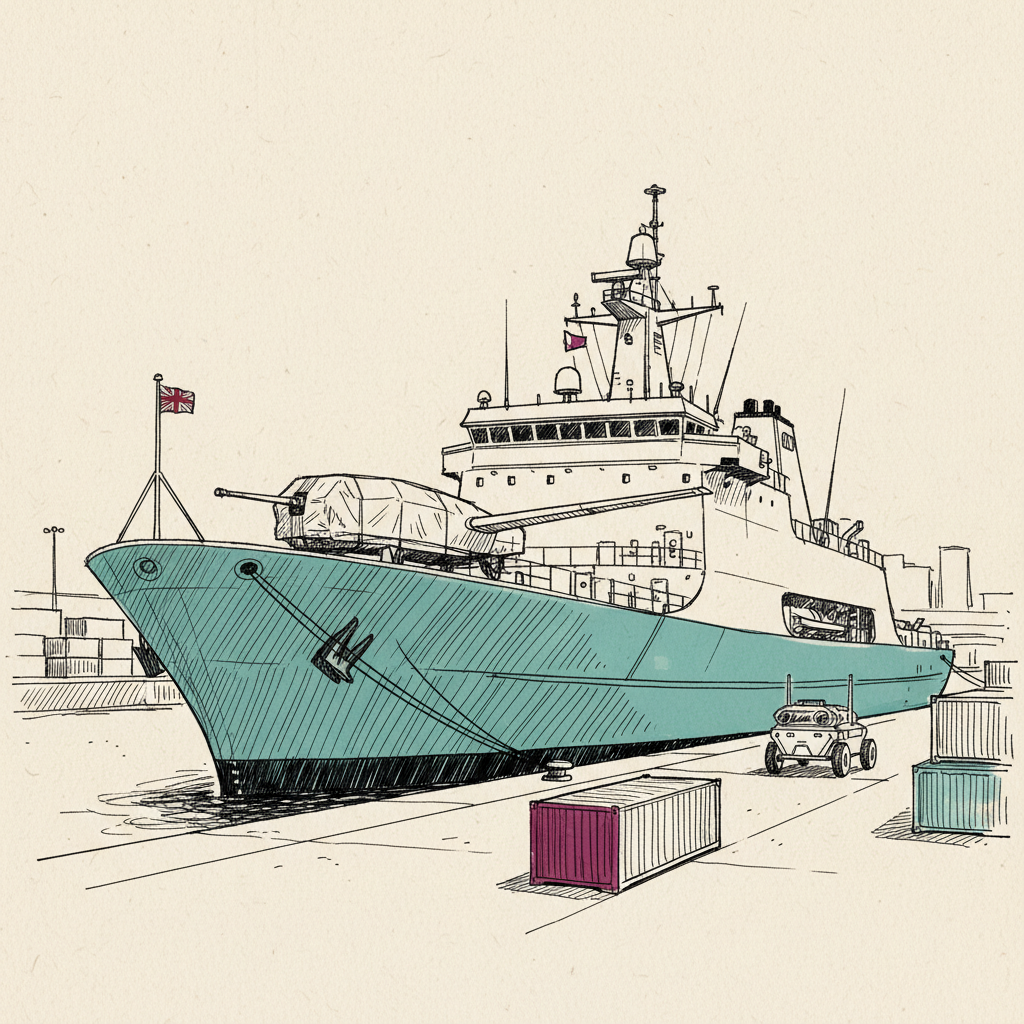
RFA Lyme Bay
Royal Fleet Auxiliary landing ship, mothership for the UK's Hormuz autonomous mine-clearance force.
RFA Lyme Bay is the mothership for the Royal Navy's autonomous mine-countermeasures force; Oman authorised her embarked drones to clear Hormuz mines in early July 2026, but a 7 July tanker attack stalled the operation before any recovery, launch or neutralisation cycle began.
Last refreshed: 3 August 2026 · Appears in 1 active topic
Is RFA Lyme Bay still holding station near Hormuz or has the mine-clearance force begun operations?
Timeline for RFA Lyme Bay
proved the mothership-recovery concept
Autonomous Systems: Land & Sea: The mothership Britain has not boughtMentioned in: £10m buys a robot boat testbed
Autonomous Systems: Land & SeaMentioned in: Belgium's twelve robots come with cables
Autonomous Systems: Land & SeaOman clears mine mission, then a stall
Autonomous Systems: Land & SeaArrived in Middle East theatre with allied autonomous MCM suite embarked
Autonomous Systems: Land & Sea: Allied robot minehunters reach the GulfBackground
RFA Lyme Bay is a Royal Fleet Auxiliary landing ship dock serving as the mothership for the Royal Navy's autonomous mine-countermeasures force package. She carries both RNMB Ariadne and Project Beehive's Kraken K3 SCOUT vessels, making her the platform from which the Royal Navy's first operational autonomous mine-countermeasures force is commanded and controlled.
Using a large support ship as a carrier for uncrewed systems reflects Royal Navy doctrine of crewed platforms as motherships, with crew kept ashore or aboard the mother vessel rather than above a minefield. Her Toulon call in June extended that concept to Coalition operations, putting French and British autonomous systems under one hull for the first time.
Her Hormuz deployment is the operational test of that doctrine: whether a Bay-class support ship, rather than a dedicated warship, can command and recover autonomous minehunters at sea under real operational pressure.
Lyme Bay's embarked force stays idle
Lyme Bay recovered the crewless minehunter RNMB Ariadne into her dock off Gibraltar on 27 May 2026, the Royal Navy's first at-sea recovery of an autonomous minehunter into a mothership. She called at Toulon in early June to embark France's Sirius alongside Ariadne, then reached Gulf waters on 23 June under escort from HMS Dragon and two German minehunters, carrying more than 270 personnel.
Oman authorised the UK and France to begin clearing roughly 80 remaining mines from its southern Hormuz route in early July, but a strike on a Qatari LNG carrier on 7 July reset the timeline before her embarked force package could start. As of early August she remains in Omani waters holding station rather than working.
Lyme Bay's embarked force stays idle
Has RFA Lyme Bay's force package started clearing mines near Hormuz?
What happened when RFA Lyme Bay visited Toulon in June 2026?
Did RFA Lyme Bay recover an autonomous minehunter at sea?
What is RFA Lyme Bay and why is it near the Strait of Hormuz?
What is RFA Lyme Bay's role in the Hormuz mission?
How many uncrewed vessels does RFA Lyme Bay carry?


Written with AI from Lowdown's published reporting. Not individually reviewed by an editor. Updated 3 August 2026. Editorial standards.