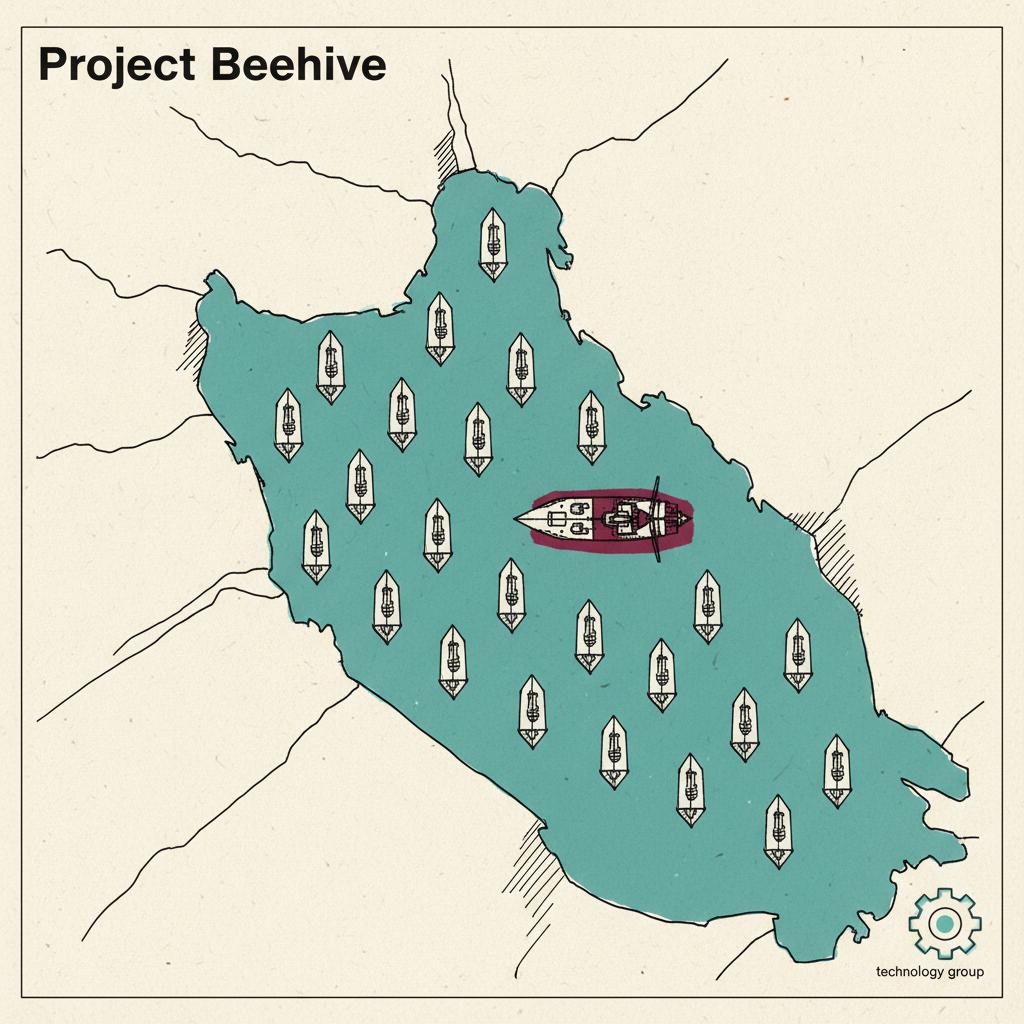
Project Beehive
Royal Navy programme awarding a £12.3m contract to Kraken Technology Group in March 2026 for 20 K3 SCOUT autonomous surface vessels deployed in the strait of Hormuz force package.
On 8 July 2026, Kraken and Capewell airdropped a K3 SCOUT vessel from an A400M into Sea State 4 water, Beehive's first delivery test Independent of a mothership, days after Oman authorised then stalled mine clearance near the strait of Hormuz.
Last refreshed: 24 July 2026 · Appears in 2 active topics
Will Project Beehive USVs support Ariadne in live mine-clearance near Hormuz?
Timeline for Project Beehive
A400M airdrops a working robot boat
Autonomous Systems: Land & SeaProvided USVs for the Lyme Bay force package deploying toward Hormuz
Autonomous Systems: Land & Sea: Robot minehunter now sails for HormuzMentioned in: UK sends £115M to Hormuz drones
Drones: Industry & DefenceBackground
Project Beehive is the Royal Navy's programme to field a fleet of uncrewed surface vessels for mine-countermeasures and force-multiplying tasks, built around Kraken Technology Group's K3 SCOUT hulls. The programme's founding order, placed in March 2026, put 20 K3 SCOUT hulls under a single £12.3 million line, the first time the Royal Navy had committed to a crewless-vessel fleet of that size, and the First Sea Lord named Beehive explicitly when he set out the service's autonomy doctrine at the Combined Naval Event that May.
The Beehive boats are complementary to RNMB Ariadne: Ariadne hunts and neutralises mines, while Beehive vessels provide surveillance, perimeter patrol and wider ISR coverage. The programme marks the point at which Royal Navy autonomy moved from experimentation to an operational force package, accelerated outside the standard multi-year Defence Equipment Plan cycle.
Beehive tests delivery beyond a mothership
Beehive's own delivery trial closed 8 July 2026: six days of drops that put a K3 SCOUT hull into Sea State 4 water after release from an Airbus A400M, the first Beehive vessel fielded by air rather than launched from a ship.
The trial extends a programme that began with a £12.3 million, 20-vessel contract in March 2026 and had already put Beehive boats to SEA alongside RNMB Ariadne in the Lyme Bay force package bound for the Strait of Hormuz.
Why did the Hormuz mine-clearance mission stall after Oman authorised it?
Did Project Beehive test airdropping a robot boat from a plane?
How much did Project Beehive cost the Royal Navy?
What is Project Beehive in the Royal Navy?
