Skip to content
You can now search across every topic, entity and event.What's new
Autonomous Systems: Land & Sea
12AUG

The mothership Britain has not bought

3 min read
14:17UTC

Navy Lookout put a number on the hull the Royal Navy's mine-hunting programme needs on 11 August: at least 1,000 square metres of working deck, against the roughly 600 the existing mothership offers.

TechnologyAssessed
Key takeaway

MHC Block 2 needs 1,000 square metres of deck and has seed money, not construction money.

Navy Lookout published a technical read of Mine Hunting Capability (MHC) Block 2 on 11 August and set the requirement in square metres: an offshore support vessel (OSV) with at least 1,000 square metres of working deck, enough to host three or more uncrewed surface vessels, uncrewed underwater vehicles and their control gear 1. HMS Stirling Castle, the mothership the Royal Navy already runs, offers roughly 600. That shortfall of at least 400 square metres separates carrying one minehunting system from carrying the three the programme is built around.

The money splits awkwardly. GBP1.3bn sits inside June's Defence Investment Plan for MHC Block 2 across 2026 to 2030, and the GBP90m Britain earmarked with Norway in July buys the start of OSV development rather than any steel. Navy Lookout reads that as a minimum initial tranche, written on an assumption that larger sums follow to complete a three-vessel build once estimated at roughly GBP330m 2. Development money buys drawings. A mine countermeasures drone does not deploy without a hull to launch, recover, refuel and command it. The remaining Hunt-class minehunters must leave service by 2032, and HMS Chiddingfold already went in July after 42 years .

The hull requirement itself belongs to a Norwegian programme. Norway's Parliament has approved 28 standardised vessels, 18 coastal and 10 ocean-going, built on an "as civilian as possible, as military as necessary" philosophy, and Britain formally joined under the December 2025 Lunna House Agreement 3. Kongsberg's Vanguard Solution family appears in the programme material as an illustration of that philosophy, not as a selected design. Buying into a 28-hull production run costs less per vessel than a bespoke British class, and is correspondingly harder to vary once joined.

The trade runs both ways. Norway chose at least five UK-built Type 26 frigates in 2025, a deal the UK government valued at around GBP10bn, with DE&S (Defence Equipment and Support) citing strategic offset programmes in the follow-on cooperation, meaning investment a seller nation commits to the buyer's industry as part of a defence sale 4. Britain has already proved the difficult part of the concept: the autonomous minehunter RNMB Ariadne docked inside RFA Lyme Bay off Gibraltar at the first attempt on 27 May, the first at-sea recovery of a crewless Royal Navy minehunter into a mothership . Recovery works. Norway's production run is where Britain now intends to buy the deck it happens on.

Deep Analysis

In plain English

The Royal Navy is replacing its old mine-hunting ships, called the Hunt-class, with a new approach: instead of one crewed ship doing everything, a mothership carries and launches small robot boats and submarines that do the actual mine-hunting. But the Navy's current mothership, HMS Stirling Castle, used to be a support ship for oil rigs, and it only has about 600 square metres of deck space. The new robot systems need at least 1,000 square metres to work properly, so Stirling Castle is too small for the job it has been given, at least until purpose-built replacements arrive.

Deep Analysis
Root Causes

HMS Stirling Castle began as an offshore support vessel, not a warship, and offshore support vessels are built to service oil and gas platforms, not to launch, recover and stow autonomous systems at the density mine-countermeasures work now requires. Converting her was quicker and cheaper than commissioning a purpose-built mothership, but the deck-space shortfall is the bill for that shortcut.

The GBP90m Norway development funding sits inside a roughly GBP330m full three-hull build estimate, which means the Royal Navy is already budgeting for purpose-built replacements while Stirling Castle is still in service. That is a tacit admission that conversion was a stopgap, not the end state, ahead of the Hunt-class's mandated exit by 2032.

What could happen next?
  • Risk

    The Hunt-class must leave service by 2032, and if the Norway-funded purpose-built hulls slip, Stirling Castle's deck-space shortfall becomes the fleet's binding constraint rather than a temporary gap.

  • Consequence

    Every uncrewed system procured for mine countermeasures now has to fit Stirling Castle's constrained deck footprint until the purpose-built hulls arrive, which shapes vehicle size choices industry-wide.

First Reported In

Update #11 · Chinese cameras in the Navy's robot boats

Navy Lookout· 12 Aug 2026
Read original
Different Perspectives
Conservative opposition
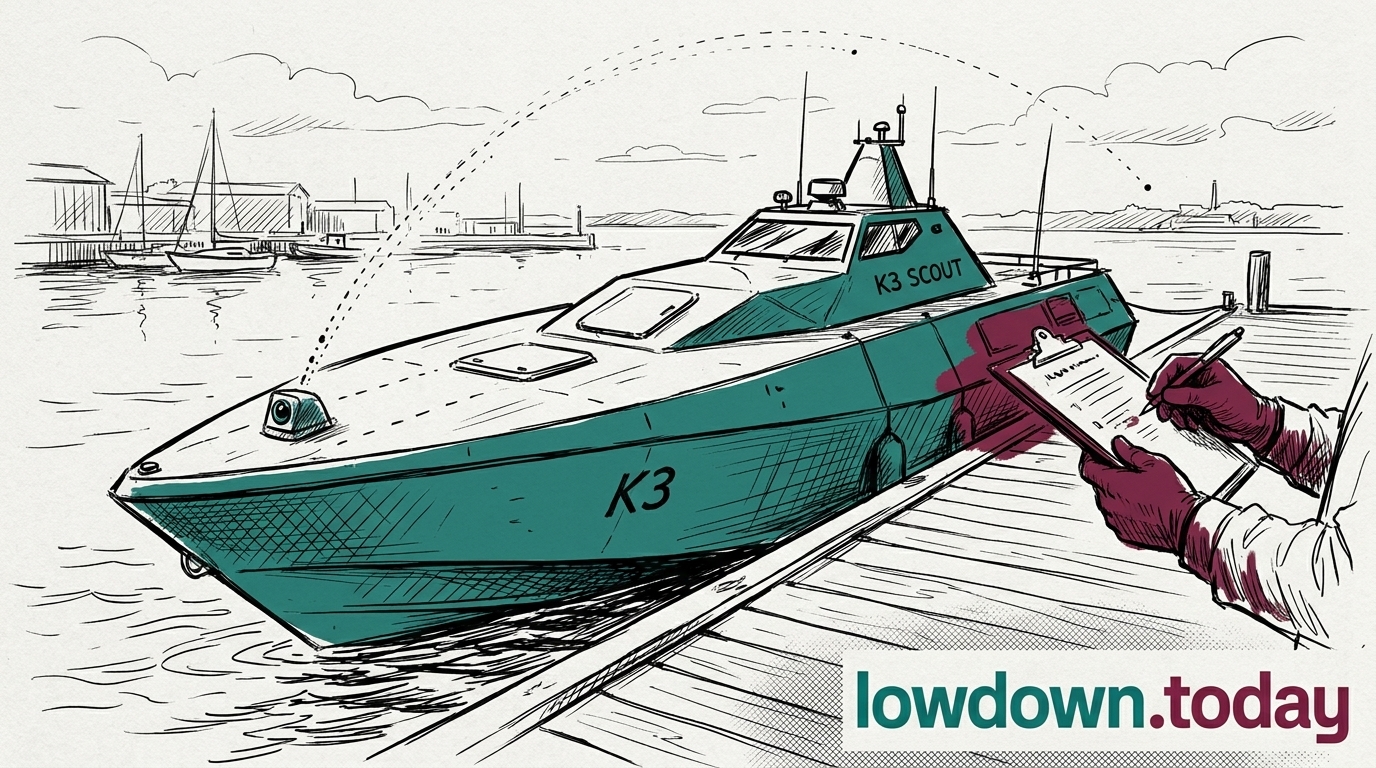
The Conservative opposition called on the Government on 9 August to 'urgently audit' equipment for hidden Chinese components, after the Telegraph's K3 SCOUT report. No named MP has been quoted on the record; the call came at party level, alongside the Ministry of Defence's own 10 August statement that no data had been compromised.
Netherlands Ministry of Defence
The Netherlands Ministry of Defence authorised Dutch Naval Design on 4 August to design 12-metre anti-submarine warfare uncrewed vessels for the Dutch-Belgian frigate programme, and to buy an adapted Compact FLASH dipping sonar from Thales Underwater Systems France. The order commits money and a named supplier while Britain's own certification body remains at the market-engagement stage.
Kraken Technology Group
Kraken Technology Group is a UK maritime-defence company based in Portsmouth that builds the K3 SCOUT, and crossed a $1bn valuation in July on a single-sourced $175m raise. The camera components reached the fleet under a third party's written security assurance, which the Platform Authority, which does not yet exist, was never positioned to check.
Navy Commercial
Navy Commercial
Navy Commercial at Whale Island published two notices on 5 August: 074032-2026, asking industry how to build a Platform Authority to certify uncrewed vessels, and 074351-2026, a GBP10m multi-role USV testbed for the Defence Chief Technology Officer. Responses on the Platform Authority close 19 August, ten days after the cameras were found transmitting to China.
Ministry of Defence
Ministry of Defence
The Ministry of Defence said on 10 August that a routine cyber vulnerability assessment found the camera fault, and a thorough investigation found no evidence that MoD data or systems had been accessed, compromised or transmitted externally. It stripped the cameras of internet connectivity but did not say whether it acted against the supplier.
Thales
Thales
Thales converted its 6 July engaging accord with Exail into a definitive combination agreement on 30-31 July, but the tender offer for Exail's remaining shares now closes by early 2028, later than July's timetable implied. Thales integrates its new undersea prime while still bidding against Kongsberg and DRASS's 2027 target for the AUKUS Pillar II contest.
