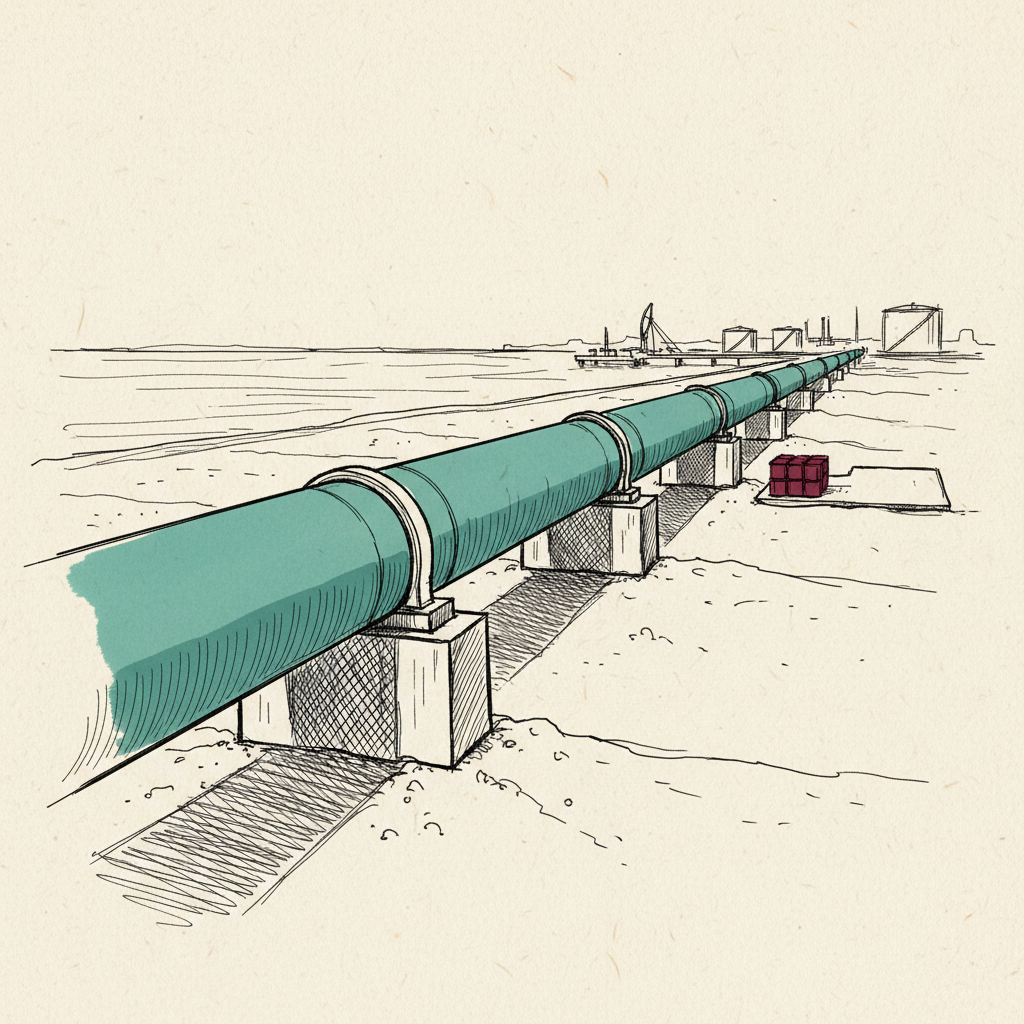
Abu Dhabi Crude Oil Pipeline (ADCOP)
370 km pipeline from Abu Dhabi's interior to Fujairah, bypassing the strait of Hormuz.
Last refreshed: 22 September 2026 · Appears in 1 active topic
How close is ADCOP to its capacity ceiling as Hormuz stays blocked?
Timeline for Abu Dhabi Crude Oil Pipeline (ADCOP)
Mentioned in: Fujairah distillates double at the floor
European Oil MarketsMentioned in: Brent $106 on summit Day 1; buffers near exhaustion
Iran Conflict 2026Approached its 2 mbpd design ceiling as Fujairah throughput rose to 1.62 mbpd
Iran Conflict 2026: Fujairah hits 1.62 mbpd; ADCOP nears capBackground
The Abu Dhabi Crude Oil Pipeline (ADCOP) runs 370 kilometres from Habshan in Abu Dhabi's interior to the port of Fujairah on the UAE's eastern (Indian Ocean) coast, bypassing the strait of Hormuz entirely. Commissioned in 2012 and operated by the Abu Dhabi Company for Onshore Petroleum Operations (ADCO) on behalf of ADNOC, it has a design capacity of 2 million Barrels Per Day (mbpd). Its sole strategic purpose is to give Abu Dhabi an export route that does not depend on Hormuz passage.
Crude flow through Fujairah rose from 1.17 mbpd in February to 1.62 mbpd by late March 2026, a 38% increase that puts ADCOP within 380,000 bpd of its published design ceiling. Real-world throughput under sustained conflict-zone stress is likely 200,000 to 300,000 bpd below the design figure, meaning the effective margin may already be exhausted. The IRGC claimed maritime control zones over UAE's eastern coastline on 5 May and struck the Fujairah Oil Industry Zone on 4 May, signalling that Iran views the bypass route as a legitimate target. ADCOP is the only high-volume alternative to a blocked Hormuz; saturation is no longer a hypothetical ceiling.
What is the Abu Dhabi Crude Oil Pipeline and why does it matter now?
How much capacity does ADCOP have left as Hormuz stays closed?
Can Iran threaten the Abu Dhabi pipeline that bypasses Hormuz?



