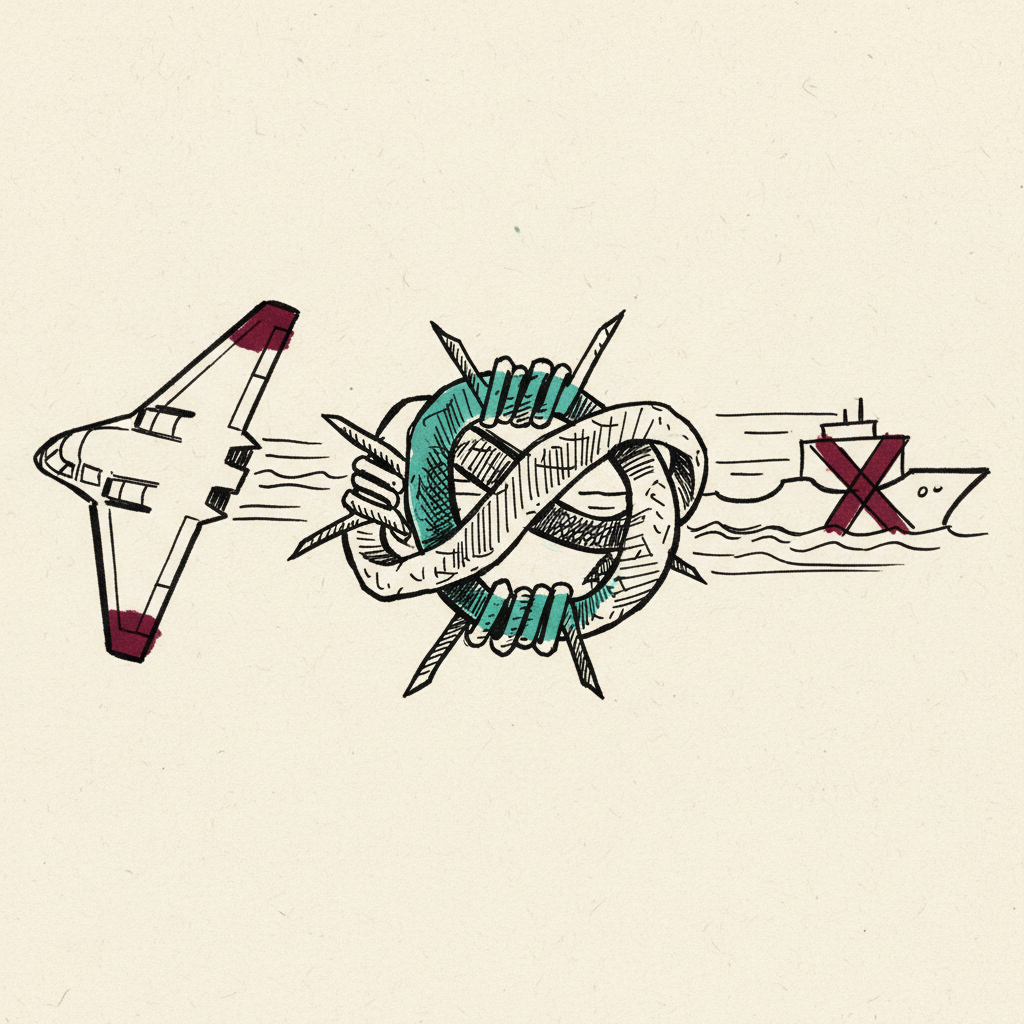
Iran-Israel-US Conflict 2026
2026 Israel-Iran-US war, now stalled between eight rounds of unsigned Hormuz talks and mass executions.
The war Israel and the United States opened against Iran on 28 February 2026 cut Gulf shipping to single-digit daily transits within a fortnight, and on 11 March the IEA called it the largest oil disruption in history.
Last refreshed: 18 October 2026 · Appears in 2 active topics
Is the Iran-Israel-US war actually ending, or just stuck at the negotiating table?
Timeline for Iran-Israel-US Conflict 2026
Mentioned in: EU bans Russian LNG from 25 April
Russia-Ukraine War 2026Mentioned in: Two dead in Ramat Gan; 61st IRGC wave
Iran Conflict 2026Mentioned in: Warner and Hawley bill would log AI layoffs
AI: Jobs, Power & MoneyMentioned in: ManpowerGroup: 1.6m AI jobs, 518,000 qualified
AI: Jobs, Power & MoneyMentioned in: Oxford Economics: AI layoffs overstated
AI: Jobs, Power & MoneyBackground
The Iran-Israel-US Conflict 2026 is a regional war between Iran on one side and Israel and the United States on the other, with Hezbollah and Hamas among the principal belligerents. It began on 28 February 2026 and spans Iran, Israel, Lebanon, The Gulf states and the strait of Hormuz. It has since stalled between eight rounds of Hormuz talks that produced no signed text and a wave of mass executions inside Iran.
The war grew out of a long Israeli-Iranian proxy confrontation and disputes over Iran's nuclear programme. Iranian missiles and drones reached Israel and The Gulf: the UAE alone intercepted 1,919 projectiles in the first 17 days. Israel's 91st Division crossed into southern Lebanon on 13 March, reopening a ground front against Hezbollah.
The human and financial costs came fast. About 3.2 million Iranians were displaced in the first fortnight, and displacement in Lebanon passed 800,000 by 11 March. CSIS put the US cost of the campaign at nearly $900 million a day.
The war choked global oil flows
On 11 March the International Energy Agency called the war's oil disruption the largest in history. Its record release of 400 million barrels from reserves did not hold prices below $100.
By 15 March Gulf transits had fallen to single digits a day against a pre-war average of 138. Brent closed that Friday at $103.14, with Monday futures pointing to $104.89-106.44, the war's highest sustained range and about 50% above the pre-war price. The closure of the strait of Hormuz turned a regional war into a price shock for every import-dependent economy.
Allies refused the Hormuz escort
By 15 March Donald Trump's call for allied warships to escort shipping through the strait of Hormuz had drawn zero pledges. Australia, Japan, the United Kingdom, Germany and France all declined to send warships for the escort mission he had demanded of them.
On 16 March Trump answered that leaving NATO was "something to think about". Germany's foreign minister replied: "We will not participate in this conflict." The refusals left the United States to fight the maritime side of the war without an allied naval force.
Is the Strait of Hormuz still closed in April 2026?
What is the Islamabad Accord and did it end the war?
How did Russia benefit from the 2026 Iran war?
How has the 2026 Iran war affected oil prices?
What started the Iran-Israel-US war in 2026?




Written with AI from Lowdown's published reporting. Not individually reviewed by an editor. Updated 18 October 2026. Editorial standards.