Skip to content
Briefings are running a touch slower this week while we rebuild the foundations.See roadmap
US Midterms 2026
28APR

189 Days to Go: 189 Days to Go: Calendar versus court

4 min read
16:18UTC

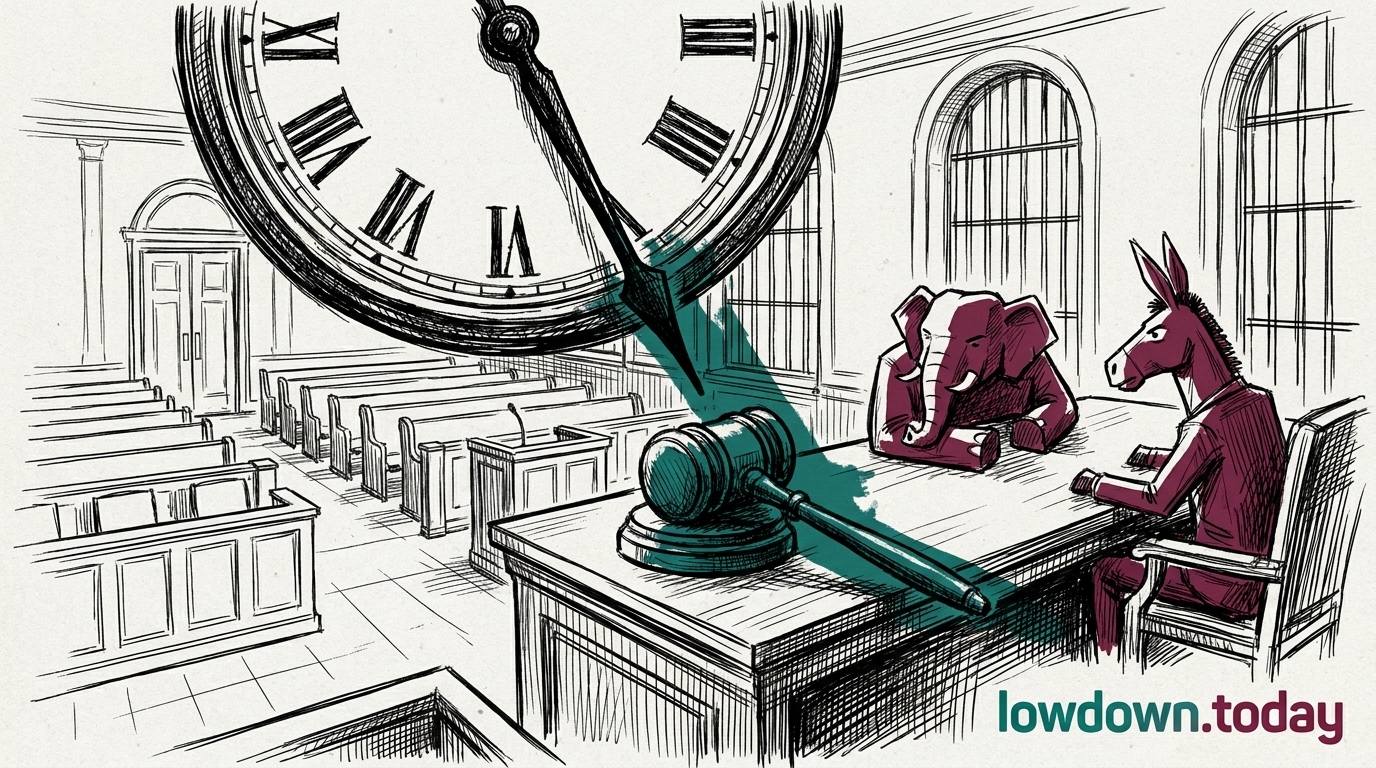
Virginia voters approved mid-decade redistricting 50.7-49.3% on Tuesday 21 April; a state judge nullified the result the next day. The Virginia Supreme Court has 28 days to rule before the 25 May filing deadline decides for it. Both parties' election-machinery programmes now run on external calendars they do not control.

Key takeaway

Three external clocks in May will determine the structural rules for 189 days of campaigning.

This briefing mapped
Loading map…
Legal
Competitive
Domestic
Regulatory

Virginia voters approved mid-decade redistricting 50.7-49.3% on Tuesday 21 April; Judge Hurley nullified the result the next morning, ruling the authorising House bill void ab initio.

Sources profile:This story draws on neutral-leaning sources

Virginia voters approved a mid-decade redistricting referendum 50.7 to 49.3 percent on 21 April, but Judge Hurley voided the result within 24 hours, ruling the House bill that put the question on the ballot was legally invalid from the start.

The Virginia Supreme Court heard the case on 27 April without ruling. If no decision arrives before the 25 May candidate filing deadline, the existing Republican-leaning map stays in place and Democrats lose their last redistricting track for the 2026 cycle. 

The Virginia Supreme Court heard oral arguments in Scott v. McDougle on Monday 27 April but issued no ruling and set no timeline, leaving the 25 May congressional filing deadline as the binding constraint.

Sources profile:This story draws on neutral-leaning sources

Virginia's Supreme Court heard the redistricting appeal on 27 April but did not say when it would rule. Candidates must file for Congress by 25 May, just 28 days away.

If no ruling arrives by then, candidates will sign up under the existing Republican-leaning map and the new district plan becomes irrelevant to the 2026 election, whatever the court eventually decides. 

Cook Political Report shifted five Virginia House districts toward Democrats around Monday 27 April, pricing in a referendum result that Judge Hurley has voided and the Virginia Supreme Court has not validated.

Sources profile:This story draws on neutral-leaning sources

Cook Political Report moved five Virginia congressional seats toward Democrats on 27 April, assuming the redistricting referendum will ultimately survive the legal challenge. Sabato's Crystal Ball made a similar move on 21 April.

Both organisations stated the ratings are conditional on the referendum surviving Judge Hurley's block. If the Virginia Supreme Court upholds the injunction, all five ratings reverse before a single candidate has filed. 

Federal courts in California, Michigan, Oregon, and Rhode Island dismissed DOJ voter-data lawsuits between 9 and 17 April, all relying on the procedural reasoning the Massachusetts court established earlier in the month.

Sources profile:This story draws on neutral-leaning sources

Common Cause filed a federal lawsuit on Tuesday 21 April challenging the entire DOJ national voter-database architecture, opening a parallel legal track to the 24 active state-level defences.

Sources profile:This story draws on neutral-leaning sources

Common Cause, a nonpartisan good-government group, filed a federal lawsuit on 21 April targeting the entire system the Department of Justice built to collect and centralise voter data. The state cases challenge individual document demands; this one challenges the database itself.

A Common Cause win would shut down the national data collection programme regardless of what happens in the 24 remaining state-level cases. A standing dismissal would confirm the state-level route as the only viable challenge to the programme. 

Governor Ron DeSantis sent a proposed 24R-4D congressional map to the Florida legislature on Monday 27 April, ahead of Special Session D opening Tuesday 28 April without the Louisiana v. Callais ruling.

Sources profile:This story draws on neutral-leaning sources

Governor DeSantis submitted a proposed map on 27 April that would give Republicans 24 of Florida's 28 congressional seats, up from 20 currently. The session opened the next day without waiting for a Supreme Court ruling on minority voting rights that could invalidate the map.

The plan faces two separate legal challenges: the federal voting rights question before The Supreme Court, and Florida's own constitution, which voters approved in 2010 specifically to ban partisan gerrymandering. 

Analilia Mejia, the former co-executive director of the Center for Popular Democracy, won the NJ-11 special election 60-40 over Republican Joe Hathaway on Thursday 16 April with 77,620 votes against 52,122.

Sources profile:This story draws on left-leaning sources from United States
United States
LeftRight

Analilia Mejia won New Jersey's 11th congressional seat 60-40 on 16 April, filling the vacancy left by Governor Mikie Sherrill. The 20-point margin matches the district's baseline rather than replicating the 25-point swing recorded in Georgia's 14th.

House composition narrows to 217 Republicans and 214 Democrats, leaving Republican leaders a margin of three seats for any party-line vote through November. 

Sources:CNN
1 CNN

Silver Bulletin's generic-ballot average reached D+5.8 on Tuesday 28 April, the first reading at that level this cycle and a 9.1-point cumulative swing from R+3.3 in January 2025.

Sources profile:This story draws on neutral-leaning sources

Silver Bulletin's polling aggregate reached D+5.8 on 28 April, the highest reading this cycle and a 9.1-point swing from Republicans leading by 3.3 points in January 2025.

Historically, a swing this size at this stage has preceded large midterm seat changes. Brookings Institution models it as 12 to 20 Republican losses; the actual number depends on how efficiently Democratic votes translate into seats on the current gerrymandered map. 

Senator John Kennedy's motion to attach SAVE Act elements to the reconciliation package failed 48-50, with Republican senators Collins, Murkowski, Tillis, and McConnell voting against.

Sources profile:This story draws on centre-left-leaning sources from United States
United States

Senator John Kennedy's attempt to attach the SAVE Act's voter-ID requirements to the Senate budget package failed 48 to 50 on 27 April, with Republican senators Collins, Murkowski, Tillis, and McConnell all voting against.

The bill cannot pass through normal channels either, needing 60 votes to overcome a filibuster with only 53 Republicans. SAVE Act floor time now generates campaign advertising material from forced votes, not legislation. 

Sources:The Hill

The Senate confirmed Justin D. Smith to the 8th Circuit by unanimous consent on Monday 20 April, bringing Trump's Article III judicial confirmation total to 271 with 11 nominations remaining.

Sources profile:This story draws on neutral-leaning sources

The Senate confirmed Justin D. Smith to the 8th Circuit Court of Appeals by unanimous consent on 20 April, bringing Donald Trump's total of lifetime federal judicial appointments to 271, with 11 nominations left to process.

The pipeline is nearing its arithmetic limit: there are almost no vacancies left to fill. A Democratic Senate after November would close the window on the remaining 11, making those the precise stakes of the November election for the federal judiciary. 

Fellowship PAC's reported $1.75 million Paxton advertisement never aired, according to GNCrypto News, drawing Republican leadership inquiries directed at Commerce Secretary Howard Lutnick.

Sources profile:This story draws on neutral-leaning sources

Crypto super PACs have spent over $28 million in the 2026 election cycle. Fellowship PAC's reported $1.75 million advertisement supporting Texas Attorney General Ken Paxton apparently never ran, drawing questions from Republican leaders directed at Commerce Secretary Howard Lutnick.

Fellowship disclosed only $11 million in its Q1 filing against a publicly claimed $100 million war chest. Its accounting problems are now drawing more attention than the candidates it is trying to support. 

Steve Daines withdrew from the Montana Republican Senate primary; independent candidate Seth Bodnar leads Q1 fundraising in the state's first open Senate race since 1976.

Sources profile:This story draws on neutral-leaning sources

Steve Daines dropped out of the Montana Republican Senate primary, opening the state's first competitive Senate race since 1976. Independent Seth Bodnar, a former university president, leads first-quarter fundraising.

Montana backed Trump by 20 points in 2024, so Republicans should hold comfortably. But with no incumbent and an independent leading on money, the race is harder to forecast than the presidential margin implies. Cook Political Report has not yet moved its rating from Safe Republican. 

The 9th Circuit is scheduled to hear oral argument in the Oregon DOJ voter-data appeal on Tuesday 19 May, the first appellate test of the portable Massachusetts dismissal reasoning.

Sources profile:This story draws on neutral-leaning sources

The 9th Circuit Court of Appeals is scheduled to hear arguments on 19 May about whether the Department of Justice's voter data demands were legally valid. Five lower courts have already dismissed DOJ suits, all citing the same problem: the government's lawyers did not properly specify which law authorised their demands.

A ruling upholding the lower courts would bind the western states of the circuit to that reasoning. A ruling in the DOJ's favour could revive the programme nationally and push the dispute toward The Supreme Court

Closing comments

Trajectory consolidating rather than escalating, with two hard May 2026 deadlines: the 9th Circuit Oregon hearing on 19 May, and Virginia's candidate filing deadline on 25 May. A 9th Circuit affirmance converts five trial-court dismissals into binding western-circuit precedent, raising DOJ refiling cost substantially. A Virginia ruling after 25 May is operationally moot regardless of outcome. The Supreme Court's Louisiana v. Callais ruling carries the largest downstream consequence, with Black Voters Matter Fund estimating a Section 2 strike at 27 additional safe Republican House seats nationally.

Different Perspectives
Trump administration / DOJ (Pam Bondi)
Attorney General Pam Bondi frames the five voter-data dismissals as procedural defects curable on refiling, not substantive losses. The department is appealing California, Michigan, and Oregon; it treats the Massachusetts reasoning as a drafting correction, not a legal constraint on the programme. The 9th Circuit's 19 May hearing is the first appellate test of that posture.
V-Dem Institute
V-Dem Institute
V-Dem's executive-aggrandisement-then-judicial-capture pattern fits the current US trajectory: seven voting EO provisions enjoined, operational focus shifted to 271 lifetime Article III appointments, DOJ litigation substituting for blocked executive action. V-Dem's 2026 index downgraded the US to electoral democracy; a voter-approved referendum nullified on procedural grounds in 24 hours is a textbook indicator in that framework.
Canadian government (USMCA watch)
Ottawa watches the D+5.8 generic ballot and Brookings Institution's 12-to-20-seat loss projection as a signal that Democratic trade-committee chairs may return from January 2027. The Q1 GDP contraction of -0.3 percent adds a US recession scenario to USMCA renegotiation modelling; a second negative quarter, due in late July, would confirm the sequence.
Chatham House / LSE US Politics Blog
UK-based analysts identify the void-ab-initio doctrine applied to the Virginia referendum as the most novel procedural development: it treats the authorising legislation as if it never existed, removing the standard remedy of a corrected re-run. Chatham House notes the pattern is distinct from executive overreach; it originates in state judiciary, which makes it harder to reverse through political pressure.
Mexican government trade officials
Mexico, the United States' largest trading partner, tracks the 9.1-point generic ballot swing as a medium-term tariff signal. A Democratic House after November 2026 would shift trade-committee control and create political pressure to renegotiate tariff structures that have compressed cross-border manufacturing margins since 2025.
