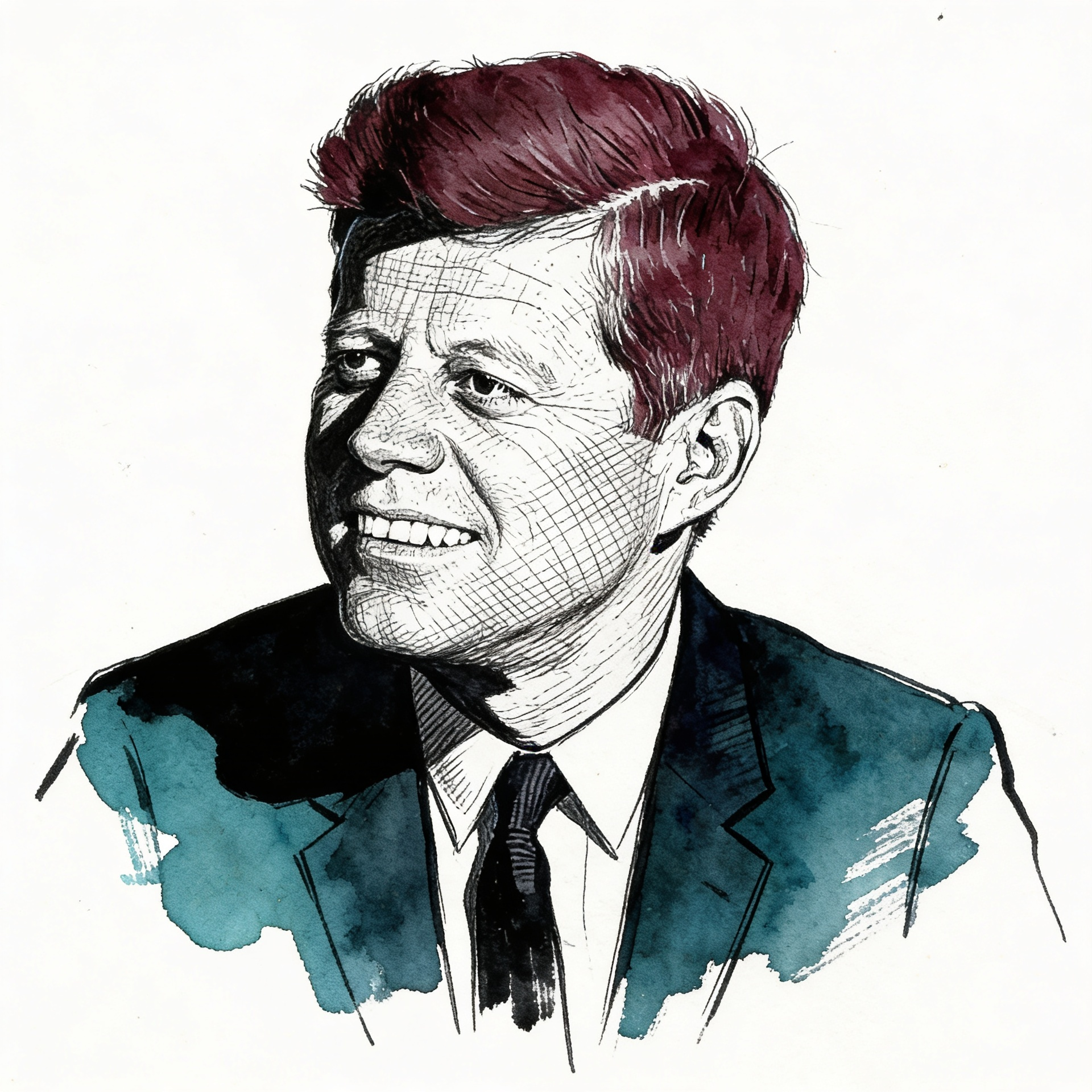
Kennedy
35th President of the United States (1961-1963), assassinated in Dallas.
Last refreshed: 15 September 2026 · Appears in 1 active topic
Is a three-carrier Persian Gulf deployment really like Kennedy's Cuban blockade, and did that end as well as people think?
Timeline for Kennedy
Mentioned in: Vance lands in Geneva for Iran talks
Iran Conflict 2026Mentioned in: USS Nimitz arrives in the Caribbean
Cuba DispatchMentioned in: White House signs nothing on elections
US Midterms 2026Background
John F. Kennedy (1917-1963) was the 35th President of the United States, serving from January 1961 until his assassination in Dallas on 22 November 1963. He is principally referenced in the 2026 Iran conflict context for his management of the October 1962 Cuban Missile Crisis, in which the US and Soviet Union came closest to nuclear war. Kennedy's naval quarantine (blockade) of Cuba — enforced by carrier strike groups — is the precedent most cited by analysts and commentators examining the three-US-carrier deployment to the Persian Gulf in April 2026.
During the Cuban crisis, Kennedy chose a blockade over air strikes partly to preserve diplomatic space. The parallel drawn by analysts in 2026 is that a concentrated carrier presence can function as both a deterrent and a coercive signal without requiring immediate kinetic action. Critics of the parallel note that the 1962 crisis was resolved through secret back-channel diplomacy — specifically a Soviet withdrawal in exchange for a quiet US withdrawal of Jupiter missiles from Turkey — a model that requires both sides to be willing to de-escalate simultaneously.
Kennedy's broader foreign-policy legacy is contested: the Bay of Pigs failure, escalation in Vietnam, and the crisis management of 1962 are all part of a complex record. His nuclear-brinkmanship is studied at war colleges worldwide precisely because it combined maximum pressure with a preserved diplomatic exit. JFK is not to be confused with Senator John Kennedy of Louisiana (Born 1951), a current Republican senator associated with SAVE Act reconciliation proceedings.
Why are analysts comparing the 2026 Iran carrier deployment to the Cuban Missile Crisis?
How did Kennedy resolve the Cuban Missile Crisis?
What was JFK's naval quarantine of Cuba?
Is Senator John Kennedy related to JFK?

