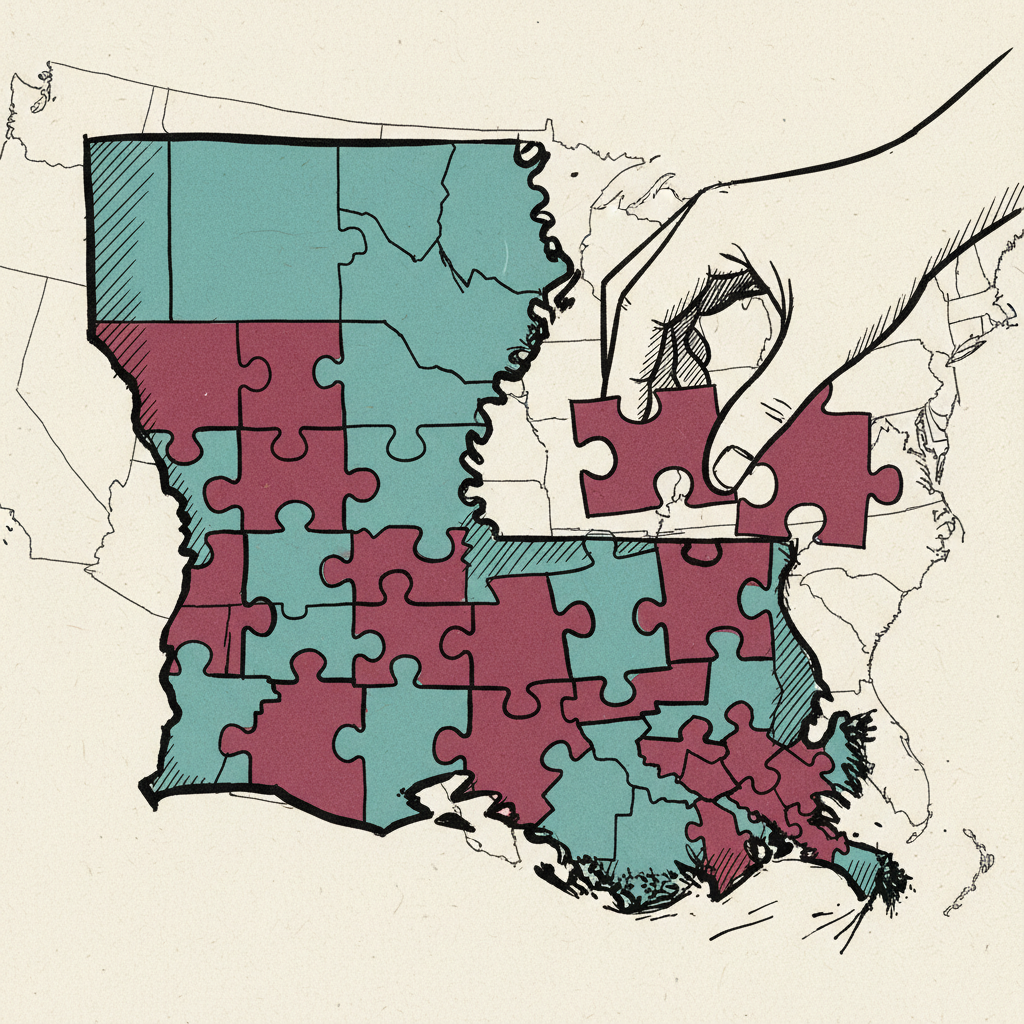
Louisiana v. Callais
SCOTUS ruling requiring Section 2 majority-minority remedies to survive strict scrutiny, not just VRA compliance.
Louisiana v. Callais took effect at once on 4 May 2026, when the Supreme Court issued its judgment forthwith; within weeks Tennessee, Alabama and Louisiana had redrawn congressional maps that erased majority-Black seats.
Last refreshed: 1 October 2026 · Appears in 1 active topic
With Alabama voiding primaries and South Carolina stalled, how many post-Callais seats will Republicans actually bank?
Timeline for Louisiana v. Callais
Mentioned in: Missouri map suspended, sent to voters
US Midterms 2026Georgia keeps its maps after remand
US Midterms 2026Mentioned in: Silver Bulletin puts Trump net approval at -20.6
US Midterms 2026Mentioned in: Tennessee map survives its first test
US Midterms 2026Mentioned in: Colorado shuts last Democratic map route
US Midterms 2026Background
Louisiana v. Callais (No. 24-109) is the Supreme Court decision that ended the federal duty to draw majority-minority congressional districts. The dispute concerned Louisiana's second majority-Black district, drawn under court order for the 2024 election. On 29 April 2026 the Court ruled 6-3, Justice Samuel Alito writing, that Section 2 of the Voting Rights Act carries no such requirement, and it overturned Thornburg v. Gingles (1986).
The case completes a Roberts Court sequence on the Act. Shelby County v. Holder (2013) ended federal preclearance and Brnovich v. DNC (2021) narrowed vote-denial claims. Gingles had governed Section 2 districting suits for forty years.
Its reach depends on what it left standing. Map challenges now turn on state constitutions, or on proof that race rather than party drove the lines. On 23 July a federal panel let Tennessee's division of Memphis stand because the state pleaded partisan advantage, a defence that Rucho v. Common Cause allows.
The ruling erased majority-Black seats
Decided 6-3 on 29 April 2026, with Justice Samuel Alito writing, the case held that Section 2 of the Voting Rights Act does not oblige states to draw majority-minority congressional districts. the Court issued its judgment forthwith on Monday 4 May, skipping the usual 32-day wait, so the new rule bound states while candidate filing was still open.
Tennessee moved first, splitting Memphis and its majority-Black 9th district three ways on 7 May. On 11 May, in Allen v. Caster, the Supreme Court vacated the order that had kept Alabama's second majority-Black district, leaving that state's 19 May congressional primaries void. Louisiana's own new map, reported on 4 June, drew out Representative Cleo Fields. Lower courts are now applying the case on remand: the Eleventh Circuit sent Georgia's maps back for reconsideration on 25 August.
A state map waited on the ruling
Florida built its redistricting around the case. Governor Ron DeSantis timed his special session so the decision could arrive first, and his 24R-4D draft was submitted on 27 April, two days before the ruling. He signed the map on 4 May, the day the judgment issued.
Challengers turned to the state's 2010 Fair Districts Amendment, a ban on partisan gerrymanders that the federal ruling leaves untouched. At a hearing on 15 and 16 May the governor's lawyers argued that Callais nullified that amendment too. Judge Joshua Hawkes left the map in place on 26 May, and the Florida Supreme Court declined to step in on 10 June, so the state votes in November on lines drafted to follow the decision.