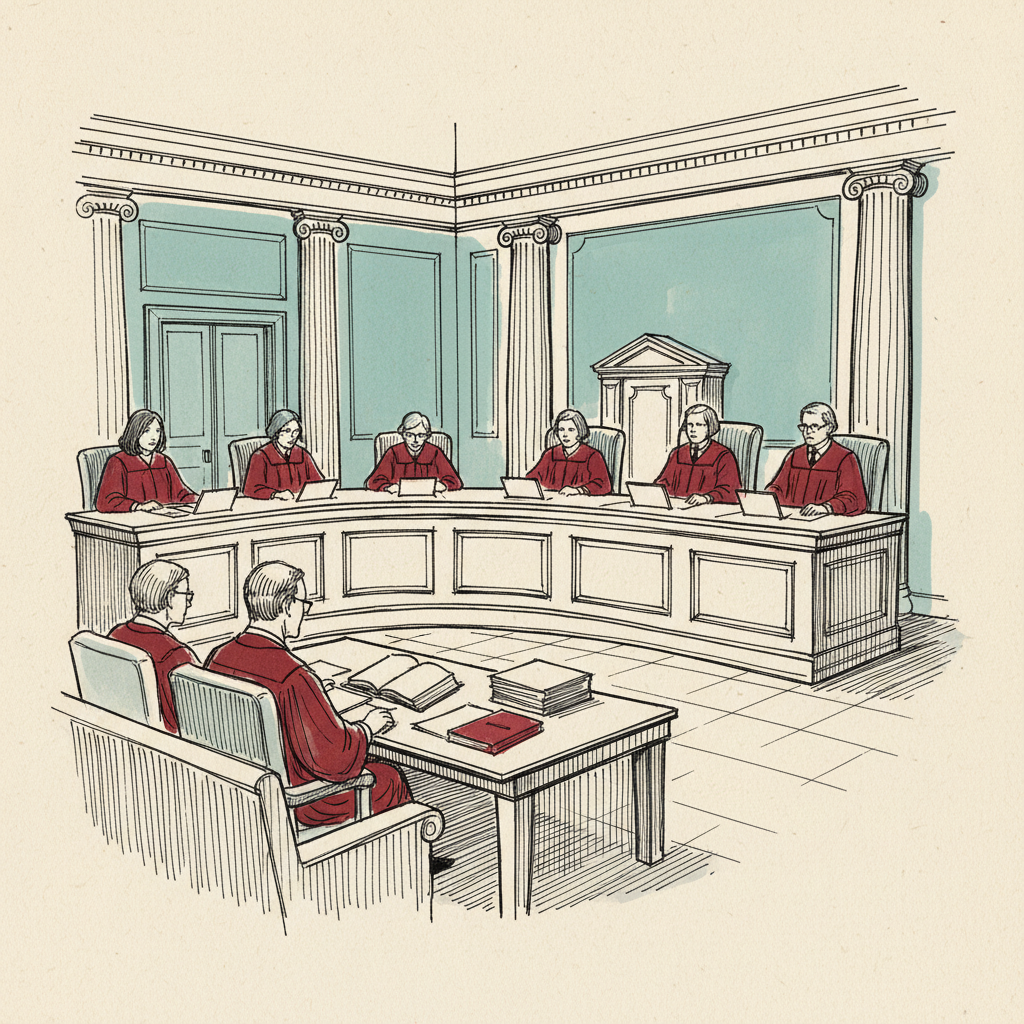
Virginia Supreme Court
Virginia's apex court; struck down 2026 redistricting amendment 4-3 on 8 May, ending Democratic map track.
Last refreshed: 19 May 2026 · Appears in 1 active topic
Did Virginia's court close the last Democratic redistricting route for 2026?
Timeline for Virginia Supreme Court
Mentioned in: Florida map upheld; every 2026 House map locked
US Midterms 2026Struck down mid-decade redistricting amendment 4-3 on intervening-election grounds
US Midterms 2026: Virginia court kills Democrats' last 2026 trackMentioned in: Cook moves 5 Virginia seats on a voided map
US Midterms 2026Virginia high court hears, sets no clock
US Midterms 2026Virginia map vote passes, then voided
US Midterms 2026Background
The Virginia Supreme Court is the state's court of last resort, with seven justices appointed by the General Assembly for 12-year terms. It became a critical 2026 midterm actor when it agreed to hear oral arguments in Scott v. McDougle on 27 April 2026 — the challenge to the redistricting referendum that Virginia voters approved 50.7-49.3% on 21 April, before a federal judge voided the authorising legislation the following day.
the Court heard arguments on 27 April 2026 but issued no ruling and, critically, set no deadline for a decision. The 25 May 2026 candidate filing Deadline for Virginia's congressional races is now the binding operational constraint: if the Court does not act before that date, the practical effect is that candidates file under the existing district lines.
the Court's timeline is particularly significant because Cook Political Report has already moved five Virginia House seats toward Democrats on the assumption the new redistricting map would take effect — projections that unravel if the Court delays past May.
The Virginia Supreme Court issued a 4-3 ruling on 8 May 2026 striking down the redistricting amendment that Virginia voters had approved 50.7-49.3% in April. The majority applied the intervening-election rule, holding that a constitutional amendment passed at one election cannot take effect before the next general election in which the legislature's composition may have changed. Because the referendum was approved mid-legislative-term, the Court ruled it void as applied to the 2026 cycle.
The three dissenting justices argued the intervening-election rule does not extend to voter-initiated redistricting amendments, and that the majority's reasoning disenfranchises voters WHO approved the map with knowledge of the 2026 calendar. Following the ruling, the SCOTUS declined an emergency application to intervene, leaving the Virginia Supreme Court's decision as final.
The practical effect is that every Democratic redistricting track for 2026 is now closed: the federal VRA Section 2 route was eliminated by Callais, the state constitutional route was closed by the Virginia Supreme Court ruling, and SCOTUS declined to intervene at either level. Cook Political Report has reversed its five-seat shift toward Democrats in Virginia, restoring the prior Republican-leaning baseline for the cycle.