Skip to content
Briefings are running a touch slower this week while we rebuild the foundations.See roadmap
Iran Conflict 2026
16MAY

Seven Gulf states back offensive action

3 min read
12:41UTC

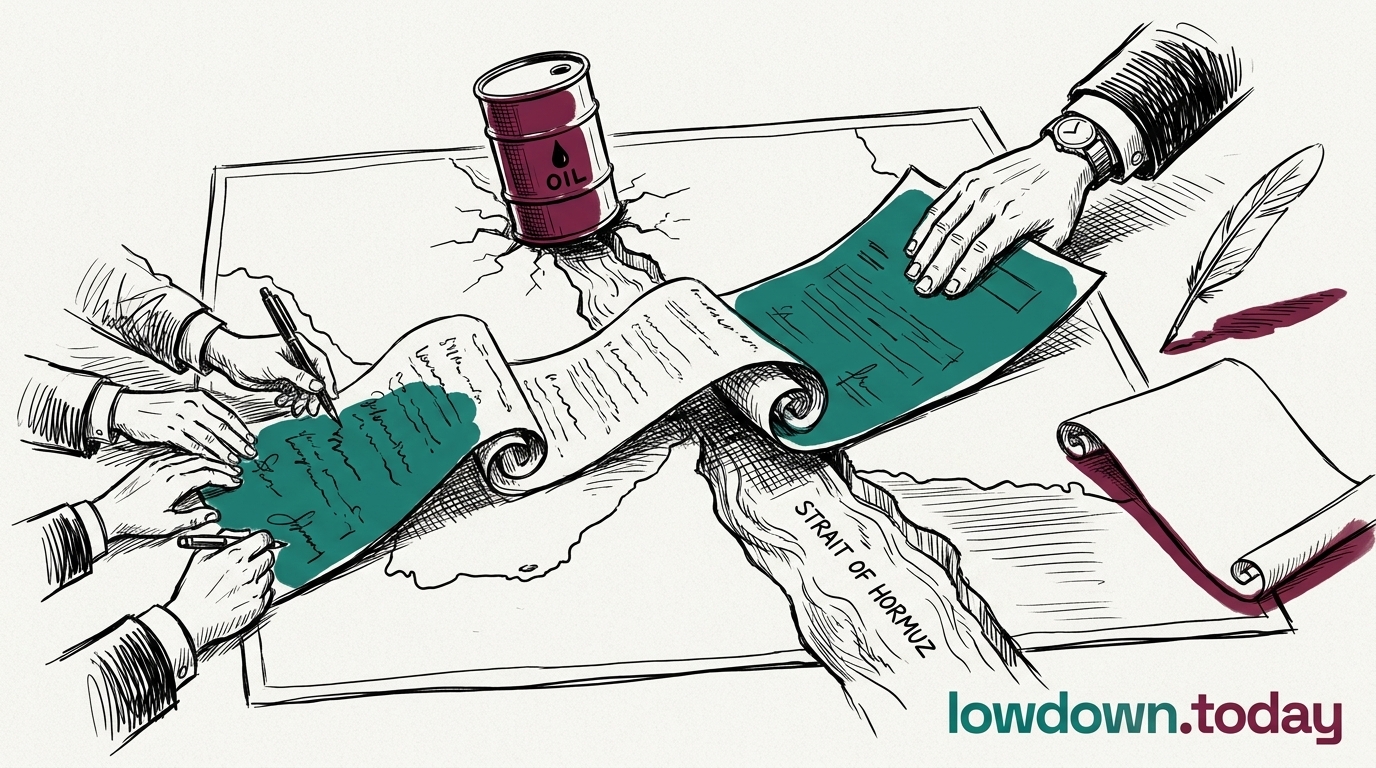
The United States and six Arab states jointly reserved 'the option of responding' to Iranian attacks — the first written multilateral framework for potential offensive action against Iran.

ConflictDeveloping
Key takeaway

Oman's deliberate exclusion from the coalition statement simultaneously formalises the anti-Iran posture and structurally protects the only active diplomatic back-channel — a bifurcation that serves both escalation and de-escalation functions at once.

The United States, Bahrain, Jordan, Kuwait, Qatar, Saudi Arabia, and the UAE issued a joint State Department statement overnight condemning Iranian attacks on Gulf territory and reserving "the option of responding to the aggression." None of these states has previously committed, in a joint written document, to potential offensive action against Iran.

The word "option" is deliberately elastic — it preserves ambiguity short of a commitment to strike. But the document itself is the development. Axios had reported that the UAE and Saudi Arabia were actively considering direct strikes on Iranian missile launch sites , driven by the cumulative volume of ordnance both countries have absorbed. This statement gives that reported consideration a multilateral framework and a public record. What was a bilateral discussion between two Gulf capitals is now a seven-nation position with Washington's imprimatur.

The signatories arrived at this statement through different accumulations of cost. Qatar has absorbed Iranian drone strikes on Ras Laffan and Mesaieed , the world's largest LNG export complex, but has not publicly joined the US-Israeli campaign. Kuwait has intercepted 97 ballistic missiles and 283 drones and lost an eleven-year-old girl to shrapnel. The UAE's intercept count stands at 165 ballistic missiles, 2 cruise missiles, and 541 drones , with the Burj Al Arab now damaged. Each signatory's threshold for moving from "option" to action differs, but the framework for collective action now exists on paper.

Saudi Arabia's signature carries the heaviest diplomatic cost. Riyadh's 2023 China-brokered normalisation agreement with Iran was Beijing's highest-profile diplomatic achievement in the Middle East. China has already escalated from general calls for restraint to direct negotiations with Tehran over specific infrastructure targets . If Saudi Arabia acts on the option this statement reserves, it voids the normalisation, and Beijing loses its credibility as guarantor. The statement forces a choice that Riyadh has spent three years avoiding: alignment with Washington's military campaign or preservation of Beijing's diplomatic architecture. That choice is now formalised.

Deep Analysis

In plain English

Eight countries have signed a joint document saying they might strike back at Iran — the first time this group has put that in writing together. The key word is 'option': this is a formal warning, not a declaration of intent. What the body does not highlight is who is missing: Oman, which hosts the only active diplomatic channel between Iran and the West, was not part of this statement. Gulf states appear to be deliberately keeping one door open while publicly hardening their collective posture through another.

Deep Analysis
Synthesis

China's 2023 Iran-Saudi normalisation deal explicitly positioned Beijing as the Gulf's preferred security guarantor over Washington. Saudi Arabia's co-signature on a statement reserving offensive action against Iran effectively nullifies that arrangement and signals that, under existential pressure, Gulf states revert to the US security umbrella — a significant geopolitical setback for Beijing whose implications extend well beyond this conflict's duration.

Root Causes

Gulf states face a structural dilemma: security dependence on the US requires visible solidarity with the US-Israeli operation, while economic vulnerability — all Gulf sovereign wealth funds, oil revenues, and critical infrastructure sit within Iran's missile range — creates strong incentives to limit actual military participation. The joint statement resolves this domestically by maximising political commitment while minimising operational exposure.

Escalation

The statement's primary escalatory risk is not independent Gulf military action — none of the signatories maintains a sustained strike capability against hardened Iranian targets without US intelligence, targeting, and logistical support. The more immediate risk is that it provides political cover for the US to broaden its own target set, framing expanded strikes as coalition-endorsed rather than unilateral American action.

What could happen next?
  • Risk

    Saudi or Emirati participation in offensive operations against Iran would bring Aramco and ADNOC infrastructure within the scope of legitimate Iranian retaliation, creating a secondary oil supply shock distinct from and potentially larger than the Hormuz closure.

    Short term · Assessed
  • Consequence

    China's credibility as a Gulf security guarantor — established through the 2023 Iran-Saudi normalisation it brokered — is materially damaged by Saudi Arabia's co-signature on a statement committing to potential offensive action against Tehran.

    Medium term · Assessed
  • Precedent

    The joint statement establishes the first written multilateral framework for potential Gulf offensive action against Iran, lowering the political threshold for future collective responses regardless of whether action follows in this conflict.

    Long term · Assessed
  • Meaning

    Oman's exclusion from the statement is a deliberate structural choice preserving the Muscat diplomatic channel as a parallel track, signalling that de-escalation optionality is being consciously maintained even as coalition posture hardens.

    Immediate · Assessed
First Reported In

Update #20 · Hormuz sealed; Senate war powers bill fails

Axios· 5 Mar 2026
Read original
Causes and effects
This Event
Seven Gulf states back offensive action
First joint written commitment by the US, Bahrain, Jordan, Kuwait, Qatar, Saudi Arabia, and the UAE to potential offensive action against Iran. Converts an implicit coalition posture into a formal multilateral position that could provide political cover for direct Gulf strikes on Iranian territory.
Different Perspectives
India (BRICS meeting host, grey-market beneficiary)
New Delhi hosted the BRICS foreign ministers' meeting on 14 May that Araghchi attended under the Minab168 designation, giving India a front-row seat to Iran's diplomatic positioning. India's state refiners have been absorbing discounted Iranian crude through grey-market routing since April; Brent at $109.30 means every barrel sourced outside the formal market generates a structural saving.
Hengaw / Kurdish human rights monitors
Hengaw's daily reports from Iran's Kurdish provinces remain the sole independent cross-check on Iran's judicial activity during the conflict. Two executions across Qom and Karaj Central prisons on 15 May and five Kurdish detentions on 15-16 May indicate the wartime judicial pipeline is operating independently of military tempo.
Pakistan (mediator and bilateral partner)
Islamabad spent its diplomatic capital as the US-Iran MOU carrier to secure LNG passage for two Qatari vessels through a bilateral Pakistan-Iran agreement, spending its mediation credit for direct economic gain. China's public endorsement of Pakistan's mediatory role on 13 May is the structural reward.
China and BRICS bloc
Beijing endorsed Pakistan's mediatory role on 13 May, one day after the BRICS foreign ministers' meeting in New Delhi. Chinese state banks are processing PGSA yuan toll payments; China has not commented on its vessels' continued Hormuz passage, but benefits structurally from a non-dollar toll system it did not design.
Iraq (bilateral passage partner)
Baghdad negotiated a 2-million-barrel VLCC transit without paying PGSA yuan tolls, offering political alignment in lieu of cash. Iraq's position inside Iran's adjacent bloc makes it the natural first bilateral partner and a template for how Tehran structures passage deals with states that cannot afford Western coalition membership.
Bahrain and Qatar (Gulf signatories)
Both signed the Western coalition paper while hosting US Fifth Fleet and CENTCOM's Al Udeid base, respectively. Qatar occupies the sharpest contradiction: it is on coalition paper while simultaneously receiving LNG passage through the bilateral Iran-Pakistan track, a position Doha has tacitly accepted from both sides.