Skip to content
Briefings are running a touch slower this week while we rebuild the foundations.See roadmap
Iran Conflict 2026
1MAY

Trump's toll-payer order targets allied ships

3 min read
10:38UTC

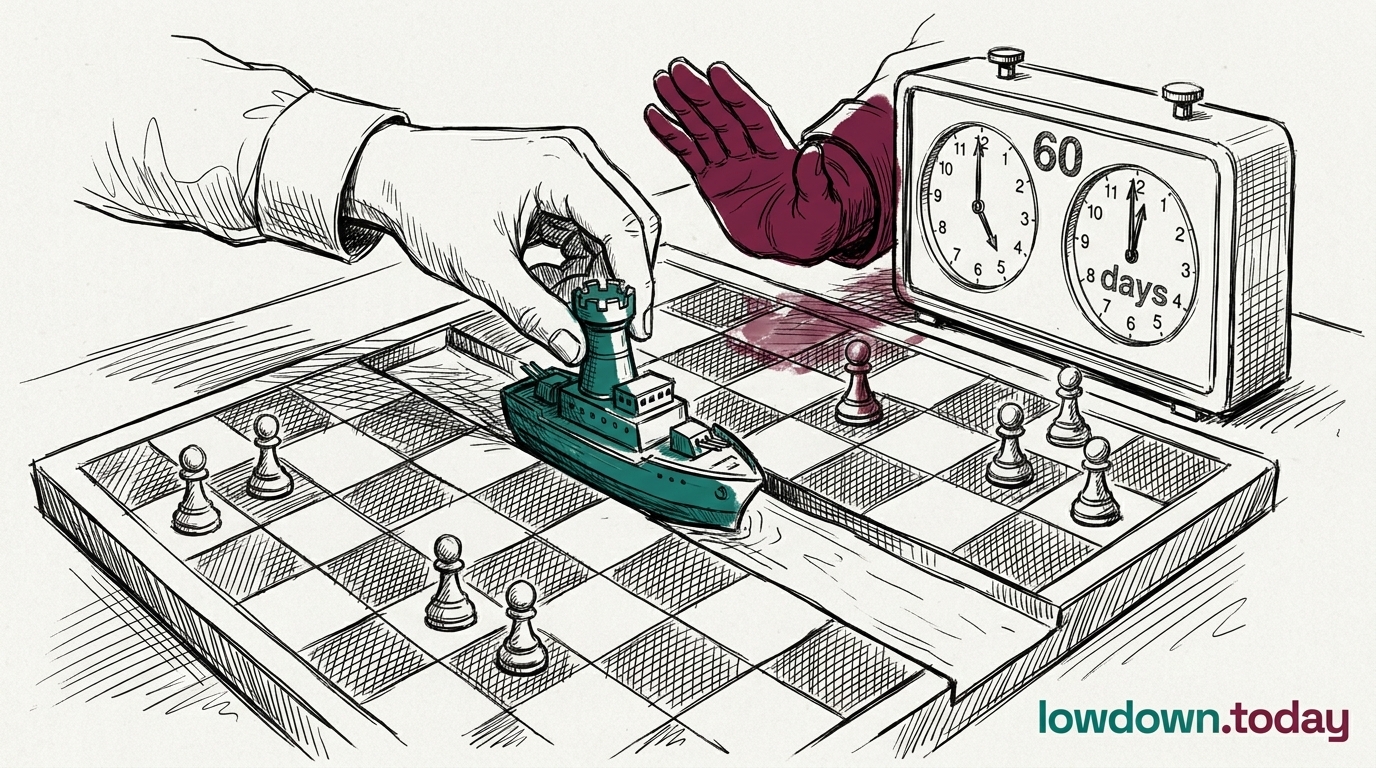
Trump ordered the Navy to stop any vessel that paid Iran's Hormuz toll, a list that includes French and Japanese ships whose governments refused to join the blockade.

ConflictDeveloping
Key takeaway

The blockade threatens to interdict vessels from allies who refused to join it.

France's CMA CGM Kribi and Japan's Mitsui OSK both paid Iran's Hormuz toll in yuan in early April. Under Trump's toll-interdiction order, both vessels, and potentially others from the Philippines and UAE, are targets for US Navy interception in international waters.

CENTCOM's operational order does not include this provision. Whether that reflects a deliberate decision to avoid the most explosive implications of the tweet, or a narrower military reading of the order, is unknown. The gap creates daily legal exposure: any officer who intercepts a French or Japanese vessel under the presidential order, or any officer who does not, acts without clear authority.

The blockade was designed to pressure Tehran. It has instead handed Paris and Tokyo a grievance against Washington . The EU had already rejected Trump's suggestion of a US-Iran "joint venture" on toll collection, citing UNCLOS transit passage rights. France and Japan are now members of the UK's reopening coalition while also appearing on the US interception list for having paid Iran's fees.

Deep Analysis

In plain English

Iran has been charging ships a fee , called a toll , to pass through the Strait of Hormuz. Some European and Asian companies paid this toll to keep their goods moving, including a French shipping company (CMA CGM) and a Japanese energy firm (Mitsui OSK). Trump's social media post said the US Navy should stop any ship that had paid Iran this toll , which would include those French and Japanese vessels. France and Japan are US allies who refused to join the blockade. CENTCOM's actual military order did not include this instruction. So right now, there is a gap between what Trump said should happen to allied ships and what the US military is actually doing. That gap has not been publicly resolved.

What could happen next?
  • Risk

    France could invoke UNCLOS Article 300 (good faith obligations) and file immediate ITLOS proceedings if a CMA CGM vessel is stopped, creating an international court process that would take months but generate immediate diplomatic crisis.

    Short term · 0.72
  • Consequence

    CENTCOM's omission of the toll-interdiction provision from its operational order leaves a daily decision gap: every officer on patrol near a toll-paying allied vessel must choose which authority to obey without clear guidance.

    Immediate · 0.88
  • Risk

    If France and Japan are both targeted as toll-payers and members of the UK's 40-nation reopening coalition, the US blockade and the UK coalition are in direct operational conflict over the same vessels in the same waterway.

    Immediate · 0.8
First Reported In

Update #67 · Trump blockades Iran on a tweet

CENTCOM / Al Jazeera· 13 Apr 2026
Read original
Different Perspectives
Oil markets
Oil markets
Brent fell $1.05 to $106.0 on summit Day 1 but remains $5-7 above the post-ceasefire equilibrium analysts modelled in March; the market is pricing a holding pattern, not a breakthrough. OilPrice.com and Aramco CEO Nasser converge on buffer-exhaustion before Hormuz reopens if the blockade extends past mid-June.
Iranian dissidents and human rights monitors
Hengaw documented a five-prison simultaneous execution cluster on 13 May, with Gorgan appearing for the first time in the wartime register. Espionage charges framed as Israel-linked moharebeh now extend across Mashhad, Karaj, and Gorgan, using the war as judicial cover for protest-era detainees.
BRICS / Global South
Araghchi's Delhi appearance positioned Iran as a victim of US aggression before non-Western foreign ministers, with Deputy FM Bagheri Kani calling on BRICS to act against US aggression. India, as the largest non-Chinese user of Iranian-routed crude, faces pressure to balance bloc solidarity against its own shipping and sanctions exposure.
China
China
Beijing accepted the Nvidia chip clearance on summit Day 1 and gave Rubio verbal acknowledgement of Iran as an Asian stability concern, having already put Pakistan on paper as the mediatory channel on 13 May (ID:3253), deflecting the US ask for direct Chinese action without refusing it.
Iran (government and civilian diplomatic track)
Araghchi denied any Hormuz obstruction at BRICS Delhi on 14 May while Iran's SNSC had finalised a Hormuz security plan the day before. Israel Hayom's single-sourced 15-year freeze offer gives Tehran a deployable figure in non-Western forums regardless of corroboration; the state attributed 3,468 wartime deaths with no independent verification.
United States (Trump administration and Senate moderates)
Trump signed a chip clearance for 10 Chinese firms on summit Day 1 and zero Iran instruments across 76 days; Rubio and Vance made verbal Iran asks without paper. Murkowski voted yes on the 49-50 war-powers resolution after Hegseth told the Senate that Article 2 makes an AUMF unnecessary.