Skip to content
Briefings are running a touch slower this week while we rebuild the foundations.See roadmap
Iran Conflict 2026
1MAY

France and Japan file flag-state protests

2 min read
10:38UTC

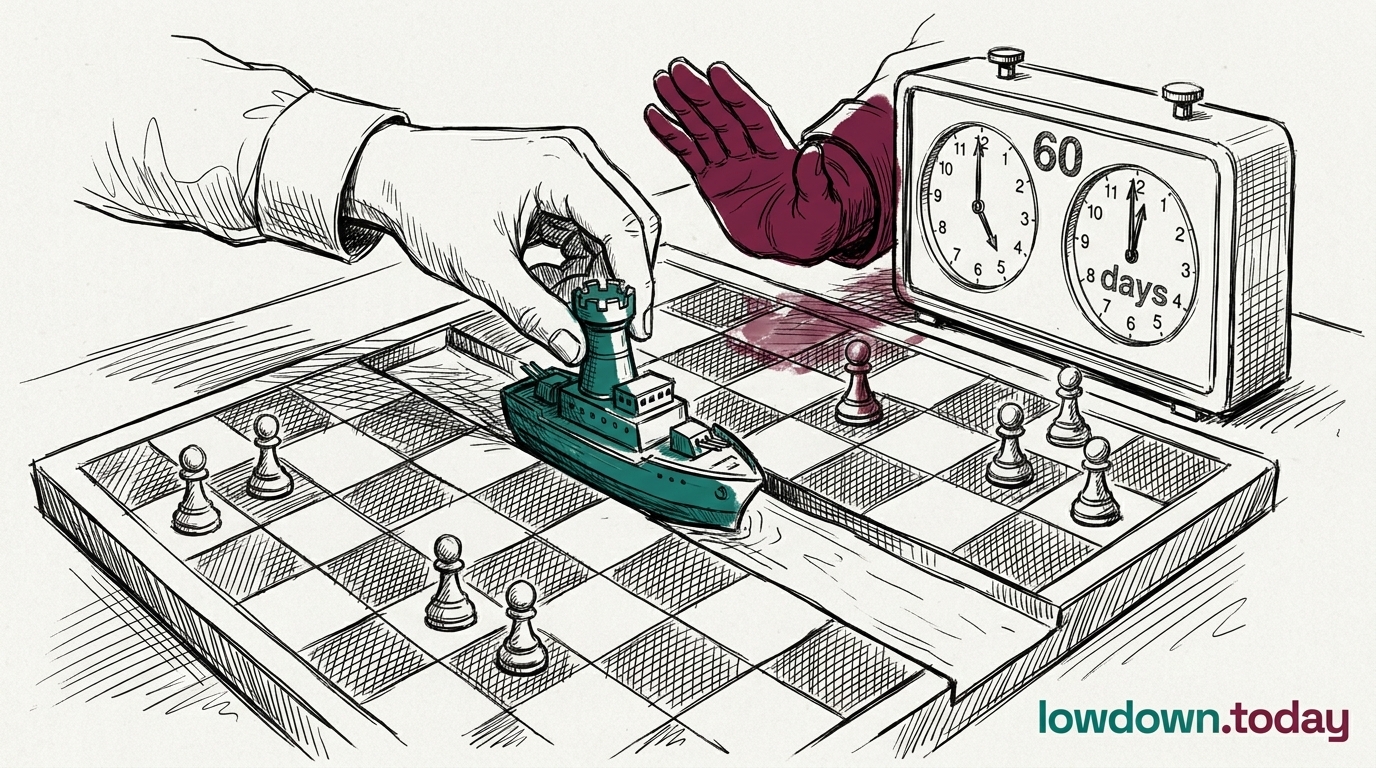
France and Japan lodged formal flag-state protests after CMA CGM Kribi and Mitsui OSK Sohar LNG appeared on Trump's 12 April toll-interdiction list, a provision CENTCOM left out of its operational order.

ConflictDeveloping
Key takeaway

Two G7 allies are formally protesting a presidential post CENTCOM has already chosen not to enforce.

France and Japan lodged formal flag-state protests after the French-flagged CMA CGM Kribi and the Japanese-flagged Mitsui OSK Sohar LNG appeared on Donald Trump's 12 April toll-interdiction list . Both vessels had previously paid Iran's Hormuz toll in yuan, which was the trigger for their inclusion on the list. CENTCOM's operational order for the 13 April blockade omitted the toll-interdiction provision entirely, leaving both vessels off the US Navy's target list despite their appearance on the president's.

That is the gap the protests sit in. France and Japan are treating a Truth Social post naming specific G7-flagged merchant vessels as a formal US position requiring a formal reply, because UNCLOS (United Nations Convention on the Law of the Sea) obliges the flag state to defend its registered ships against threats of boarding. The protests invoke the convention implicitly: the president has named their vessels for interdiction, the named vessels' flag states have an obligation to protest, and the formal protest goes onto the bilateral record regardless of whether CENTCOM is acting on the posted order.

The practical asymmetry is that Paris and Tokyo are responding to a document, the presidential post, that has no corresponding signed instrument and no implementing order from the commanding combatant command. French and Japanese diplomats are negotiating against a text the US executive branch has not formally produced. For the flag states, that is still the text they must answer. For CENTCOM, the operational order it self-generated continues to exclude toll-paying vessels from interdiction, and the diplomatic protests have no effect on the operational mandate because the mandate already omits the action being protested.

The instrument gap that defines the whole operation surfaces here with unusual clarity. Two G7 allies are in formal protest against an executive order that both exists (on Truth Social) and does not exist (as a signed presidential instrument), enforced by a command that has chosen not to implement its most aggressive provision. Each party is reading a different authoritative text. The protests are now on the bilateral record; the interdictions they protest have not happened; the social-media post that triggered them remains the only American document any party can cite.

Deep Analysis

In plain English

France and Japan have filed formal diplomatic complaints with the United States after two of their ships appeared on a list of vessels President Trump threatened to intercept. The two ships, the CMA CGM Kribi (French-flagged) and the Mitsui OSK Sohar LNG (Japanese-flagged), had previously paid Iran's transit toll to pass through the Strait of Hormuz. Trump posted on social media that all ships that had paid Iran's toll would be stopped by the US Navy. France and Japan, as the countries whose flags the ships fly, are legally required to defend their vessels under international maritime law, so they lodged formal protests. Here is the strange part: the US Navy never actually received orders to stop those ships. CENTCOM, the US military command running the blockade, left the toll-paying provision out of its orders entirely. So France and Japan are officially protesting against a presidential social-media post that the US military has already decided not to enforce. This shows, in the most concrete possible way, how the absence of a signed presidential order is creating confusion: two close US allies are in formal diplomatic dispute with America over an order that exists only as a post, enforced by a military that has chosen to ignore that particular part of it.

First Reported In

Update #68 · Sanctioned tankers slip the blockade

Reuters / Free Malaysia Today· 14 Apr 2026
Read original
Different Perspectives
Oil markets
Oil markets
Brent fell $1.05 to $106.0 on summit Day 1 but remains $5-7 above the post-ceasefire equilibrium analysts modelled in March; the market is pricing a holding pattern, not a breakthrough. OilPrice.com and Aramco CEO Nasser converge on buffer-exhaustion before Hormuz reopens if the blockade extends past mid-June.
Iranian dissidents and human rights monitors
Hengaw documented a five-prison simultaneous execution cluster on 13 May, with Gorgan appearing for the first time in the wartime register. Espionage charges framed as Israel-linked moharebeh now extend across Mashhad, Karaj, and Gorgan, using the war as judicial cover for protest-era detainees.
BRICS / Global South
Araghchi's Delhi appearance positioned Iran as a victim of US aggression before non-Western foreign ministers, with Deputy FM Bagheri Kani calling on BRICS to act against US aggression. India, as the largest non-Chinese user of Iranian-routed crude, faces pressure to balance bloc solidarity against its own shipping and sanctions exposure.
China
China
Beijing accepted the Nvidia chip clearance on summit Day 1 and gave Rubio verbal acknowledgement of Iran as an Asian stability concern, having already put Pakistan on paper as the mediatory channel on 13 May (ID:3253), deflecting the US ask for direct Chinese action without refusing it.
Iran (government and civilian diplomatic track)
Araghchi denied any Hormuz obstruction at BRICS Delhi on 14 May while Iran's SNSC had finalised a Hormuz security plan the day before. Israel Hayom's single-sourced 15-year freeze offer gives Tehran a deployable figure in non-Western forums regardless of corroboration; the state attributed 3,468 wartime deaths with no independent verification.
United States (Trump administration and Senate moderates)
Trump signed a chip clearance for 10 Chinese firms on summit Day 1 and zero Iran instruments across 76 days; Rubio and Vance made verbal Iran asks without paper. Murkowski voted yes on the 49-50 war-powers resolution after Hegseth told the Senate that Article 2 makes an AUMF unnecessary.