Skip to content
Briefings are running a touch slower this week while we rebuild the foundations.See roadmap
Iran Conflict 2026
4MAR

Day 5: First Iranian warship sunk since 1988

5 min read
11:29UTC

CENTCOM confirmed the sinking of Iranian frigate IRIS Dena off Sri Lanka — the first Iranian warship lost since 1988. Every major maritime insurer has withdrawn war risk cover from the Gulf effective midnight Thursday, and the US Navy lacks sufficient assets for the convoy escorts Trump promised. China shifted from general ceasefire calls to direct pressure on Tehran over Hormuz shipping lanes.

Key takeaway

Gulf energy exports face functional collapse from Thursday, driven by the intersection of systematic strikes on all export pathways, complete insurance withdrawal, and a convoy capability gap that no single actor can close in time.

This briefing mapped
Loading map…
Military
Economic
Legal

The IRIS Dena sank 40 nautical miles south of Sri Lanka — the first Iranian warship lost in combat since the US Navy destroyed the Sahand in Operation Praying Mantis. If confirmed as a submarine kill, Iran faces the same calculus that grounded Argentina's fleet during the Falklands.

Sources profile:This story draws on mixed-leaning sources from Netherlands and Saudi Arabia
NetherlandsSaudi Arabia

Iranian Navy frigate IRIS Dena sank approximately 40 nautical miles south of Galle, Sri Lanka. CENTCOM confirmed the sinking. Sri Lanka launched a rescue operation and recovered 32 critically wounded sailors; the fate of approximately 148 remaining crew is unknown. Sri Lanka's defence officials stated the attack profile is consistent with a submarine strike. Neither the US nor Iran has formally attributed the method. This is the first Iranian Navy surface combatant sunk in action since Operation Praying Mantis in April 1988.

The Dena's sinking extends the conflict's operational geography to the Indian Ocean — the fourth body of water in five days — and demonstrates that Iran's surface fleet can be engaged far beyond its shore-based missile defences. The location, astride the shipping corridor carrying 60 per cent of Gulf oil exports to Asia, compounds the commercial disruption already created by insurance withdrawal and Hormuz closures. 

Briefing analysis

The last Iranian warship sunk in combat was the frigate Sahand, destroyed by the US Navy during Operation Praying Mantis on 18 April 1988 — itself a response to the mining of the USS Samuel B. Roberts. That single-day engagement remained the US Navy's largest surface action since the Second World War. The Dena's sinking 40 nautical miles off Sri Lanka, far from the Persian Gulf, has no parallel in any prior US-Iran confrontation.

The insurance withdrawal echoes the 1984–1988 Tanker War, when Lloyd's raised Gulf war risk premiums to prohibitive levels after Iraq and Iran attacked over 400 commercial vessels. Kuwait requested US escorts in 1987 (Operation Earnest Will), reflagging tankers under the American flag — but that operation took months to organise and ran without state-backed insurance. The simultaneous withdrawal of all major P&I clubs within five days has no direct precedent in maritime insurance history.

Iran's national security chief becomes the first named official to flatly contradict Trump's claim of agreed talks — a rejection shaped more by Tehran's domestic crisis than by Washington's diplomacy.

Sources profile:This story draws on mixed-leaning sources from Qatar and United Kingdom
QatarUnited Kingdom

Ali Larijani, described as Iran's national security chief, publicly stated 'We will not negotiate with the United States,' becoming the first named senior official to directly contradict President Trump's claim in The Atlantic that he had agreed to speak with Iran's new leadership.

Larijani's statement closes the visible US-Iran diplomatic track and directly contradicts the White House's public claim of Iranian willingness to negotiate. It follows Tehran's stated assessment that the June 2025 ceasefire was a strategic error, hardening the domestic political case against any pause. 

Hours after Iran publicly refused to negotiate, its foreign minister told Oman he is open to 'serious efforts' to stop the escalation. The gap between Tehran's public posture and private signalling is the only diplomatic space this conflict has left.

Sources profile:This story draws on mixed-leaning sources from Israel and Saudi Arabia
IsraelSaudi Arabia
LeftRight

Oman's foreign minister Badr Albusaidi spoke directly with Iran's FM Abbas Araghchi on Wednesday. Oman's foreign ministry stated Albusaidi affirmed the Sultanate's continued call for a ceasefire. Araghchi stated Iran was 'open to any serious efforts that contribute to stopping the escalation.'

The Omani channel is the sole functioning diplomatic mechanism between Iran and the outside world. Araghchi's language — 'open to any serious efforts that contribute to stopping the escalation' — delivered through the intermediary that has historically facilitated every major US-Iran negotiation, is a standard diplomatic signal of continued willingness to engage. 

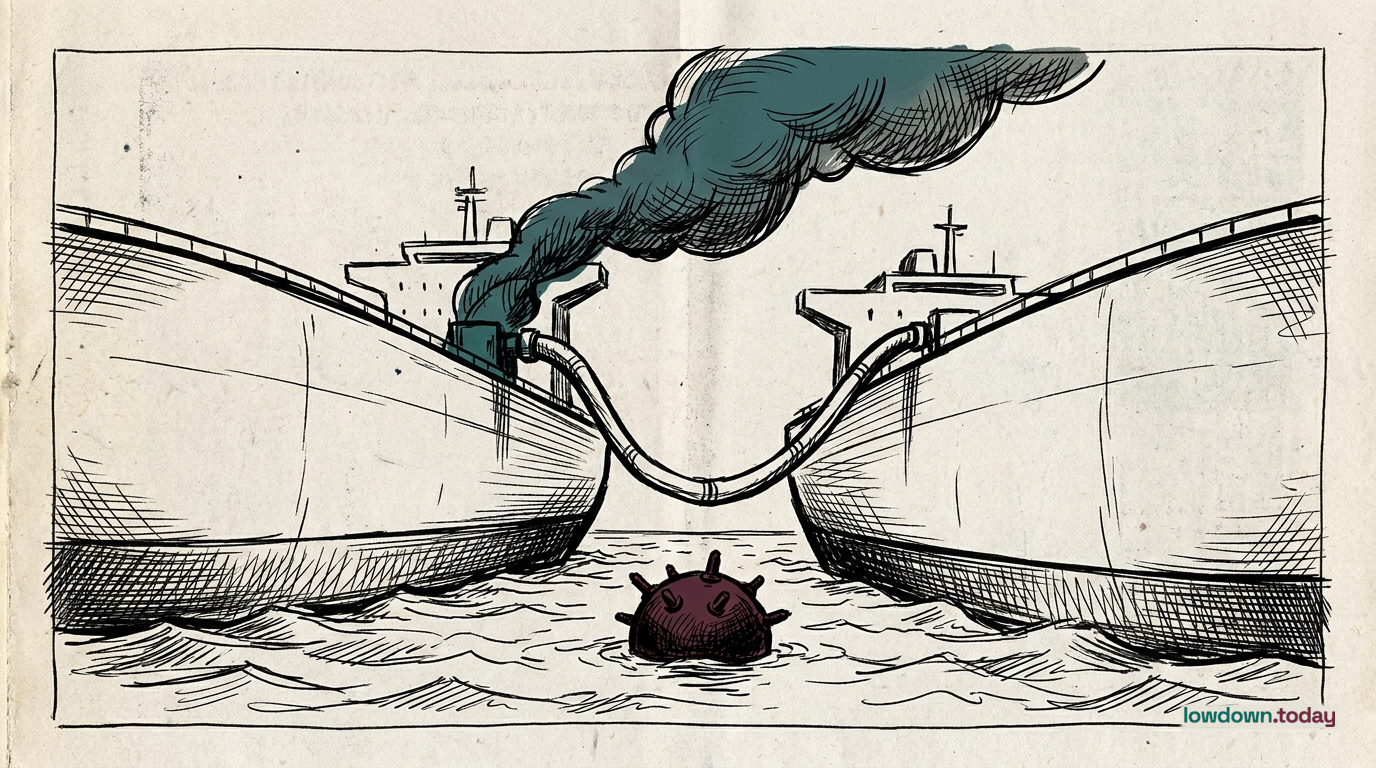
Every major Protection & Indemnity club has cancelled war risk cover for the Gulf. After midnight Thursday, no internationally insured vessel can legally transit the Strait of Hormuz.

Sources profile:This story draws on neutral-leaning sources from United States and United Kingdom
United StatesUnited Kingdom

Gard and NorthStandard — the two largest P&I clubs by tonnage — issued cancellation notices for The Gulf, Hormuz, and Iranian waters. Combined with three clubs that withdrew earlier in the week, every major Protection & Indemnity club has now cancelled war risk cover, effective midnight Thursday 5 March. Lloyd's separately listed Iran, The Gulf, and parts of The Gulf of Oman as high-risk zones.

P&I insurance is the legal and financial precondition for commercial shipping — without it, vessels cannot enter ports, secure financing, or operate under any major flag state. The complete withdrawal converts a military conflict into a de facto commercial blockade of the world's most important oil chokepoint, with no precedent in the modern maritime insurance market. 

The US Navy privately told shipping industry leaders it cannot run regular convoys through the Strait of Hormuz — two days after the President promised exactly that.

Sources profile:This story draws on mixed-leaning sources from United States
United States

The US Navy told industry leaders it does not currently have sufficient assets to run a regular convoy programme through the strait of Hormuz, undermining President Trump's announced government-backed shipping insurance and Navy escort plan.

The gap between the political announcement and operational capacity means the government-backed insurance and escort programme cannot function before the P&I deadline at midnight Thursday. Without confirmed escort availability, no tanker captain will commit to a Hormuz transit, rendering the President's pledge inoperative on the timeline that matters. 

A strike on Fujairah port shut down the Habshan–Fujairah pipeline — Abu Dhabi's $3.29 billion insurance policy against a Hormuz closure. Iran has now struck every Gulf oil export route.

Sources profile:This story draws on centre-left-leaning sources from Qatar
Qatar

A strike hit Fujairah port on the UAE's eastern coast overnight. Fujairah is The Gulf's primary ship-to-ship fuel bunkering hub and the exit point for the Habshan-Fujairah pipeline, which carries 750,000 barrels per day and was built specifically to bypass the strait of Hormuz. The strike closes the overland bypass as well as the waterway. Iran has now struck every major Gulf energy export pathway: production at Ras Laffan, refining at Ras Tanura, transit through Hormuz, and the overland bypass at Fujairah.

The Habshan–Fujairah pipeline was built specifically to bypass the strait of Hormuz. Its closure means no remaining route — maritime or overland — exists through which Gulf oil can reach global markets without passing through areas under active Iranian fire. Iran has methodically struck production, refining, maritime transit, and the overland bypass in five days. 

Sources:Al Jazeera

Iran's Revolutionary Guard formally took ownership of Tuesday's attack on the US consulate in Dubai, specifying 20 drones and three missiles — making it the first publicly claimed Iranian strike on American diplomatic infrastructure.

Sources profile:This story draws on centre-left-leaning sources from Qatar and United States
QatarUnited States

The IRGC issued a formal claim for Tuesday's drone strike on the US consulate in Dubai, stating the attack involved '20 drones and three missiles striking their intended targets.'

The formal claim converts an attributed-but-deniable attack into declared Iranian state policy. Tehran is signalling it will accept the legal and escalatory consequences of publicly owning strikes on diplomatic facilities — a calculation that any pretence of restraint costs more domestically than the international consequences of admission. 

Sources:Al Jazeera·Time

The UAE and Kuwait disclosed for the first time that they have intercepted a combined 262 ballistic missiles and 824 drones in five days — a sustained rate that exceeds what most pre-war assessments projected Iran could maintain beyond 72 hours.

Sources profile:This story draws on mixed-leaning sources from Saudi Arabia and Qatar
Saudi ArabiaQatar

UAE and Kuwaiti defence ministries released cumulative intercept figures for the first time since the conflict began. UAE: 165 ballistic missiles, 2 cruise missiles, 541 drones intercepted. Kuwait: 97 ballistic missiles, 283 drones intercepted. The cumulative totals imply a sustained Iranian salvo rate that exceeds most open-source projections of Iran's capacity beyond 72 hours.

The intercept figures — from just two of several targeted states, and excluding every projectile that hit its target — force a reassessment of Iran's arsenal depth and the sustainability of Gulf air defence at current consumption rates. The cost asymmetry between cheap Iranian drones and multi-million-dollar interceptors is compounding daily. 

China moved from general calls for restraint to direct negotiations with Tehran, pressing Iran not to attack oil tankers, gas carriers, or Qatari LNG facilities — the infrastructure that feeds 30% of China's imported natural gas.

Sources profile:This story draws on mixed-leaning sources from United States and China (includes China state media)
United StatesChina

Bloomberg reported that China entered direct negotiations with Tehran, pressing Iran specifically not to attack oil tankers, gas carriers, or Qatari LNG export facilities in the strait of Hormuz. China's MFA spokesperson Mao Ning stated Beijing urges all parties to stop military operations, avoid escalation, keep Hormuz shipping routes safe, and prevent further economic impact. Qatar supplies approximately 30% of China's imported LNG. This represents a qualitative shift from general Chinese calls for restraint to direct pressure on Iran regarding specific infrastructure.

China's intervention changes the conflict's diplomatic structure. Beijing is Iran's largest oil customer, purchasing an estimated 1.2 to 1.5 million barrels per day through intermediaries that circumvent Western sanctions. That economic relationship — never previously deployed to constrain Iranian military operations in real time — is now being leveraged with specificity that amounts to a conditional threat. 

The Senate voted on the Kaine–Paul War Powers Resolution five days into an undeclared conflict. No tally was released, and the resolution faces certain defeat or presidential veto.

Sources profile:This story draws on centre-left-leaning sources from United States and France
United StatesFrance

The Senate voted Wednesday on the Kaine-Paul War Powers Resolution requiring congressional approval for further military action in Iran. No official tally was available as of 11:29 UTC. Speaker Mike Johnson stated the House 'has the votes to defeat the measure' when it votes Thursday. Even if both chambers passed, a presidential veto is near-certain.

Creates a formal congressional record of dissent on military action launched without legislative authorisation, establishing that the war's legal basis is contested at the highest levels of intelligence oversight — a record with legal and political implications if the conflict expands to ground operations. 

Closing comments

The conflict's geographic expansion to the Indian Ocean south of Sri Lanka removes the implicit containment that limited prior US-Iran confrontations to the Persian Gulf and its approaches. If the Dena was sunk by a submarine, it signals that Iranian naval assets can be engaged in any waters — eliminating the option of repositioning ships outside the Gulf to preserve them. For Iran, this transforms the strategic calculus: its entire surface fleet is now at risk, not just vessels in the combat zone. The combination of Chinese pressure and Omani mediation offers the only visible de-escalation track, but the IRGC's demonstrated ability to sustain fire rates beyond 72-hour projections — confirmed by UAE and Kuwaiti intercept figures — suggests the military command has pre-positioned sufficient munitions to continue regardless of any diplomatic signals from Tehran's civilian leadership.

Emerging patterns

  • US extending engagement of Iranian naval assets beyond Gulf and Arabian Sea into Indian Ocean shipping lanes, demonstrating ability to strike Iranian surface fleet at global range
  • Iranian public posture hardens against direct US engagement even as backchannel signals remain open through intermediaries
  • Omani backchannel remains functional with Iran signalling openness to mediated de-escalation while publicly rejecting direct US talks — dual-track diplomacy
  • Complete withdrawal of commercial insurance infrastructure from Gulf waters — transition from elevated risk pricing to total market exit, creating hard deadline for commercial shipping cessation
  • Gap between political commitments and operational capacity — government insurance pledge without deliverable military escort renders the scheme non-functional for commercial shipping decisions
  • Systematic Iranian targeting of every Gulf energy export pathway — production, refining, maritime transit, and now overland bypass — constituting comprehensive energy export denial strategy
  • IRGC moving from ambiguous attribution to formal claims on strikes against US diplomatic facilities, escalating public ownership of attacks on American targets
  • Iranian sustained-fire capacity exceeding pre-war open-source estimates, confirming constant-rate dispersed strike posture can be maintained beyond initial 72-hour window
  • China shifting from rhetorical neutrality to active leverage on Iran driven by direct economic exposure — particularly LNG dependence on Qatar — marking Beijing's entry as a coercive diplomatic actor in the conflict
  • Congressional war powers challenge proceeding to formal vote stage but facing structural defeat through House opposition and presidential veto — function remains creation of legislative record of dissent
Different Perspectives
China
China
Entered direct negotiations with Tehran pressing Iran not to attack oil tankers, gas carriers, or Qatari LNG facilities — moving from general statements to specific infrastructure demands for the first time during the conflict.
US Navy
US Navy
Told shipping industry leaders it does not currently have sufficient assets for a regular convoy programme through the Strait of Hormuz, contradicting the president's announced escort plan days earlier.
Gard and NorthStandard
Issued cancellation notices completing the withdrawal of every major P&I club from Gulf war risk cover, creating a hard midnight Thursday deadline after which commercial Hormuz transit ceases to be legally operable under the international insurance system.
IRGC
IRGC
Issued a formal operational claim for Tuesday's Dubai consulate strike, specifying '20 drones and three missiles striking their intended targets' — the first detailed munitions accounting for a strike on US diplomatic infrastructure.

