Skip to content
Briefings are running a touch slower this week while we rebuild the foundations.See roadmap
Iran Conflict 2026
4MAR

Day 5: IRGC installs Khamenei's son as leader

5 min read
04:21UTC

Iran's Assembly of Experts elected Mojtaba Khamenei — the assassinated Supreme Leader's son — in an IRGC-engineered succession overnight, breaking the Islamic Republic's foundational prohibition on dynastic rule. A drone struck the US consulate in Dubai, and the Trump administration announced government-backed war risk insurance for Gulf shipping at a scale not deployed since the First World War.

Key takeaway

The IRGC now controls both Iran's military operations and its political succession, and Washington's response — reading this as an opening while deploying a Western-only shipping insurance scheme — risks driving Asian oil importers toward independent arrangements with Tehran.

This briefing mapped
Loading map…
Domestic
Military
Humanitarian
Economic

The IRGC pressed, the Assembly ratified, and Iran's new Supreme Leader owes his office to the military — not the clergy the constitution requires.

Sources profile:This story draws on mixed-leaning sources from United Kingdom, India and 1 more
United KingdomIndiaHong Kong SAR China
LeftRight

The Assembly of Experts confirmed Mojtaba Khamenei (56), son of Ali Khamenei, as Iran's new Supreme Leader overnight. Iranian state media described it as 'divine will.' Mojtaba lacks the senior theological credentials and marja status constitutionally required for the position; his power base is the IRGC and Basij paramilitary. The IRGC pressed for Mojtaba and the election occurred faster than any constitutional process would normally permit.

The IRGC has formalised its control of Iran's highest constitutional office, replacing clerical authority with military power at the apex of the state. This restructures the internal power dynamics that any negotiating partner must engage with. 

Briefing analysis

When Hafez al-Assad died in June 2000, Syria's parliament lowered the presidential age minimum from 40 to 34 within hours to accommodate his son Bashar — constitutional machinery bent to fit a dynastic outcome. Iran's Assembly of Experts has done the equivalent: confirming a candidate who lacks the theological credentials the constitution explicitly requires.

The Pahlavi parallel is more direct. The Islamic Republic was founded in 1979 specifically to end hereditary rule under the Shah; 47 years later, it has produced father-to-son succession. Bashar al-Assad's inherited legitimacy eroded over 24 years until his government fell in December 2024.

The IDF hit the Assembly of Experts headquarters while the body chose Ali Khamenei's successor. Members of the constitutional body were among the casualties.

Sources profile:This story draws on mixed-leaning sources from Israel and United Kingdom
IsraelUnited Kingdom

The IDF struck the Assembly of Experts headquarters in Qom on Tuesday while the body was meeting to choose a successor to Ali Khamenei. Multiple members were killed or wounded, according to Israel Hayom and Middle East Eye. Iranian state media claimed the Building had been evacuated before the strike. Whether the vote occurred before the strike, in its aftermath, or in a dispersed emergency session remains unclear and cannot be independently verified during Iran's ongoing internet blackout.

The body constitutionally responsible for selecting Iran's Supreme Leader was struck mid-session during the first leadership transition in 35 years. The vote's timeline and legitimacy cannot be independently verified during a communications blackout now in its sixth day. 

Mojtaba Khamenei survived the strike that killed his father. His wife and sister did not.

Sources profile:This story draws on mixed-leaning sources from United Kingdom, India and 1 more
United KingdomIndiaHong Kong SAR China
LeftRight

Mojtaba Khamenei's wife and sister were reported killed in the 28 February strike on Ali Khamenei's compound. Mojtaba survived. Reports on whether his mother survived remain conflicting.

Iran's new Supreme Leader lost his wife and sister in the strike campaign that killed his father and triggered the succession. He assumes authority over decisions of war and negotiation as a bereaved combatant, not a detached arbiter. 

A strike on the US consulate in Dubai destroys the last commercial buffer between Iran and the UAE — and puts hundreds of billions in multinational exposure at direct risk.

Sources profile:This story draws on mixed-leaning sources from United States and United Arab Emirates
United StatesUnited Arab Emirates
LeftRight

A drone struck the parking area adjacent to the US consulate in Dubai late Tuesday. Fire broke out; no injuries reported. Secretary Rubio confirmed all personnel accounted for. UAE authorities confirmed the strike but have not formally attributed it to Iran. Dubai is the third Gulf location — after Riyadh and Duqm — to absorb strikes on US diplomatic or allied infrastructure in four days. The June 2025 Twelve-Day War left UAE-Iran commercial channels intact; this strike ends any pretence of that buffer holding through a second round.

Dubai is The Gulf's financial centre and hosts the largest Iranian diaspora community outside Iran. The strike ends the commercial neutrality that survived the June 2025 Twelve-Day War, directly threatening the economic infrastructure through which China and India conduct much of their Gulf trade. 

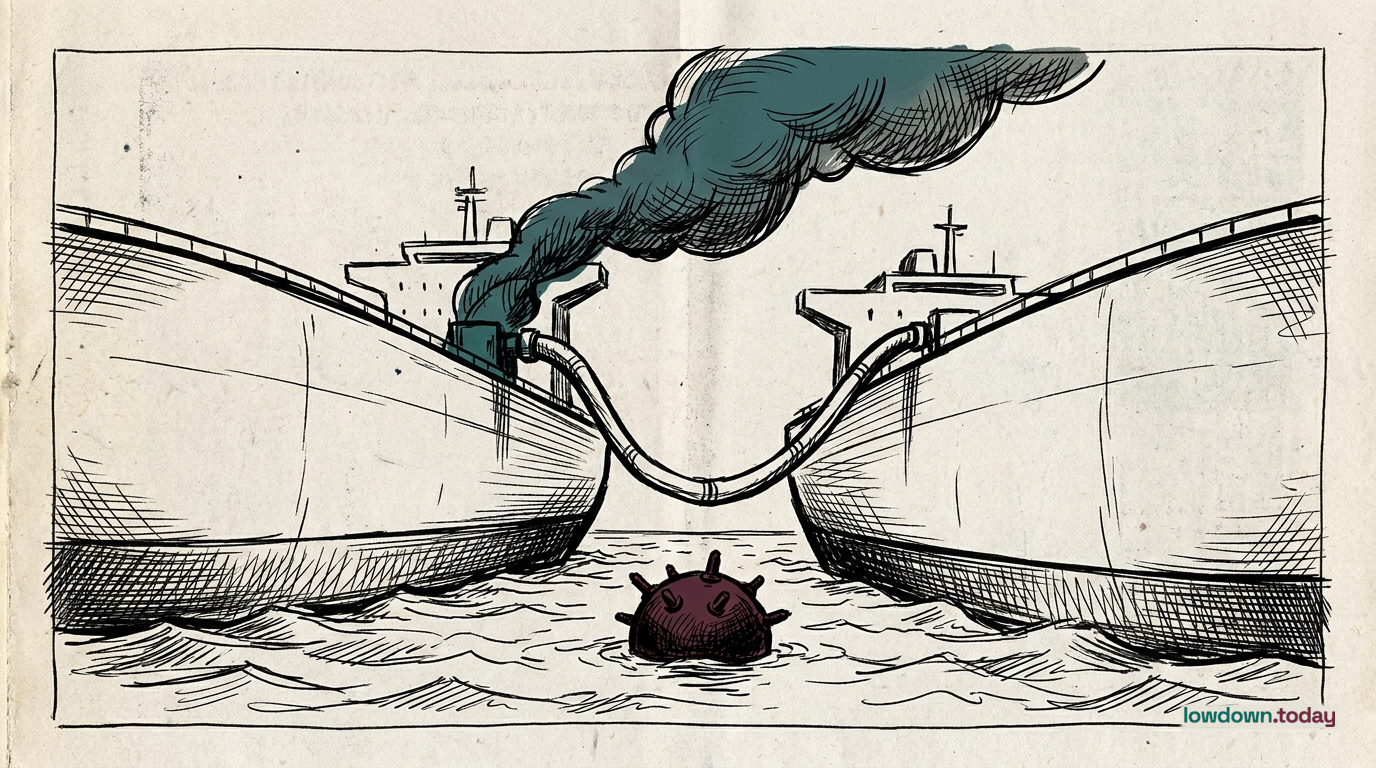
The US revives a wartime insurance mechanism last used in 1914 to reopen Gulf shipping lanes. The catch: 60% of the oil that transits Hormuz flows to countries excluded from the scheme.

Sources profile:This story draws on centre-left-leaning sources from United States and Qatar
United StatesQatar

President Trump announced the US Development Finance Corporation will provide political risk insurance for all maritime trade in The Gulf, with Navy escorts through the strait of Hormuz if required. Government-backed War risk coverage for commercial shipping at this scale has not been deployed since the US war risk insurance Act of 1914. Operation Earnest Will (1987–88) used Navy escorts during the Iran-Iraq tanker war but without state insurance; the combination of state insurance and military escort is historically unprecedented. The coverage applies only to US-aligned shipping under US or allied flags; Chinese, Russian, and Indian tankers operating under separate commercial arrangements are not automatically included. Roughly 60% of Gulf oil exports flow to Asia. Oil prices initially fell on the announcement.

The announcement addresses the insurance vacuum that shut the strait of Hormuz more effectively than Iranian missiles. But by covering only US-aligned shipping, it creates a two-tier maritime order that excludes the Asian economies most dependent on Gulf oil — a structural tension with no precedent in modern energy markets. 

Additional European warships head for the Mediterranean as NATO allies begin positioning to support Washington's effort to reopen the Strait of Hormuz — driven less by solidarity than by the threat of a second winter energy crisis.

Sources profile:This story draws on neutral-leaning sources from United States
United States

USNI News reported additional European warships en route to the Mediterranean, coinciding with the US announcement of government-backed Gulf shipping insurance and Navy escorts.

The deployment signals that Gulf shipping protection is becoming a multilateral military commitment. For European governments already managing surging gas prices from disrupted Qatari LNG, the calculus is direct: the alternative to escort duty is energy rationing. 

Sources:USNI News
Closing comments

The Dubai consulate strike crosses a qualitative threshold. Previous Iranian attacks targeted military installations, energy infrastructure, and diplomatic missions in countries actively hosting US forces. Dubai is a commercial centre with no military role in the conflict. The pattern across four days — Riyadh embassy, Duqm port, Dubai consulate — shows Iran systematically closing the space where non-combatant commercial activity can continue. The US insurance scheme, by implying Washington expects maritime disruption to persist long enough to require structural state intervention rather than a short-term market correction, signals neither side anticipates near-term resolution. The structural conditions for de-escalation — a counterpart with both the authority and the willingness to negotiate — are harder to identify after this update than before it: Mojtaba's authority is unclear, Iran's foreign minister signals through Oman while Larijani rejects direct engagement, and the IRGC's political consolidation removes the civilian interlocutors who might have had political incentive to negotiate.

Emerging patterns

  • Dynastic succession in a republic founded on overthrowing a dynasty; the IRGC chose and the Assembly of Experts ratified, reversing the constitutionally prescribed process
  • Systematic targeting of Iranian institutional infrastructure during active governance processes; second confirmed strike on this location after the campaign's opening-hours strike reported in existing event ID:590
  • Strikes on leadership compounds producing civilian family casualties
  • Escalating attacks on US diplomatic facilities across Gulf states following IRGC declaration of embassies as military targets; progressive geographic expansion from Riyadh to Duqm to Dubai
  • Two-tier maritime security architecture — insured Western-aligned lane vs uninsured Asian passage — creating immediate geopolitical friction with the importers who need Gulf oil most
  • European naval buildup in support of Gulf security corridor and potential escort operations
Different Perspectives
UAE authorities
UAE authorities
Confirmed the drone strike on the US consulate in Dubai but did not formally attribute it to Iran, maintaining diplomatic space despite being directly targeted.
Iran's foreign minister
Told his Omani counterpart that Tehran is 'open to any serious efforts for de-escalation' while Ali Larijani simultaneously rejected direct US engagement publicly — maintaining the distinction between refusing the American interlocutor and refusing mediated process.
Trump administration
Deployed government-backed political risk insurance for Gulf shipping through the US Development Finance Corporation, with Navy escorts if required — a shift from reliance on private maritime insurance markets to direct state underwriting of commercial trade. The coverage explicitly excludes non-allied flags, creating a Western-only insured shipping lane.
