Skip to content
You can now search across every topic, entity and event.What's new
Iran Conflict 2026
17JUN

Two sanctions clocks pull opposite ways

5 min read
09:37UTC

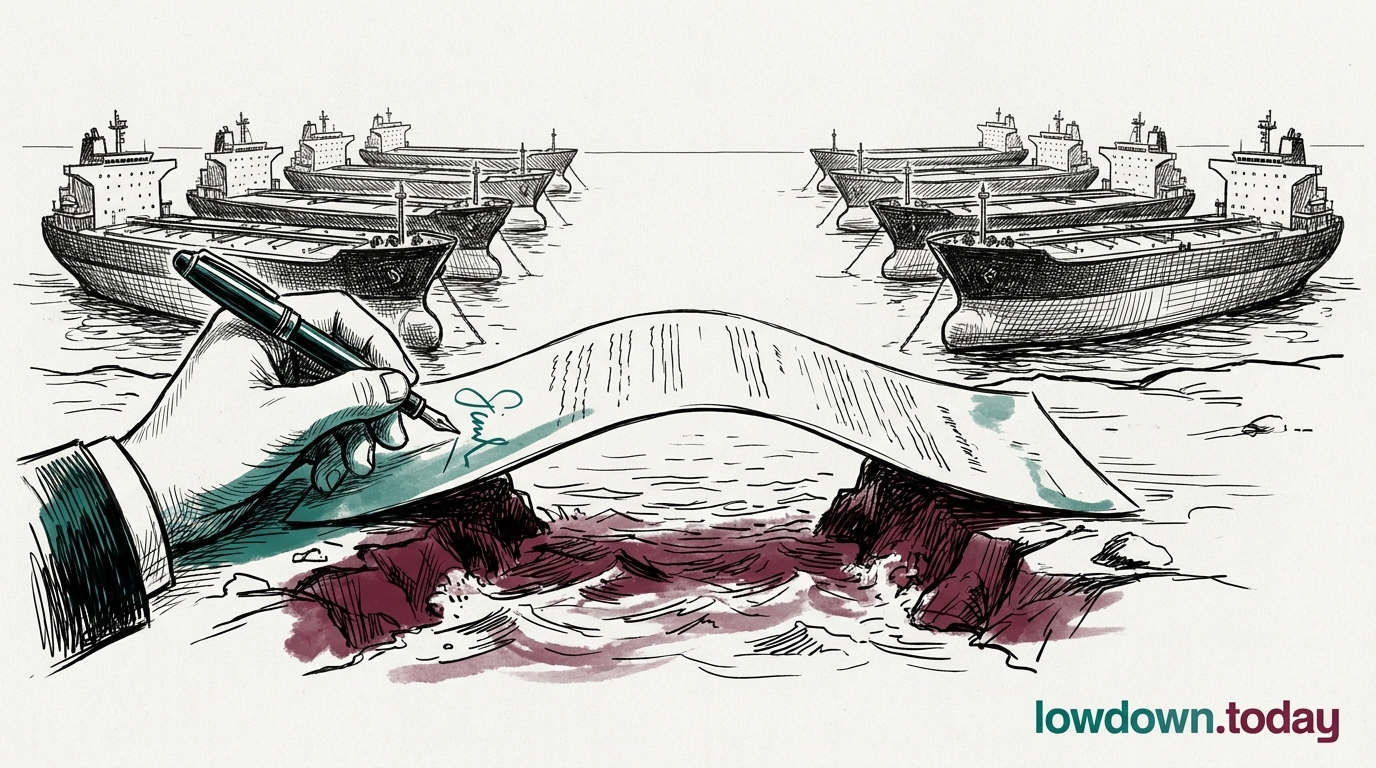
The G7 convened at Evian on Monday 15 June as two sanctions clocks ran in opposite directions: a US waiver lapse on 17 June tightens Russian seaborne crude, while an EU formula review on 15 July threatens to loosen it.

ConflictDeveloping
Key takeaway

Russian-crude policy is set by two automatic mechanisms moving in opposite directions inside one fortnight.

The G7 convened at Evian-les-Bains, the French Alpine spa town on Lake Geneva, from Monday 15 June, with Russian-crude policy on the agenda as two sanctions clocks ran down. OFAC, the US Treasury's Office of Foreign Assets Control, lets General License 134C lapse at 12:01 EDT on Wednesday 17 June, the summit's final day. GL 134C is the vessel-services umbrella, insurance, crewing, bunkering and salvage, that covers Russian crude loaded before 17 April; no successor GL 134D has been published, the outcome Rubio signalled when he said Washington wanted to end the waivers as soon as it could 1.

The European Union's 21st sanctions package, proposed by the European Commission on Tuesday 9 June, lists 30 more shadow-fleet vessels to push the total above 660 and targets banks and oil-trading entities, though the maritime-services ban remains blocked by Malta and Greece 2. Brussels is racing a different clock. It wants the package adopted to freeze the dynamic price cap at $44.10/bbl, set in January 2026, before the 15 July formula review 3. The formula sets the cap at 15% below the six-month average Urals price, the Russian export benchmark. With Urals now near $87 against $58 in February, the July review would auto-lift the cap toward ~$75/bbl, restoring margin to Russian sellers and compressing the very discount this desk is short.

Two forces now pull in opposite directions on Russian-crude availability inside one week. The US waiver lapse tightens it; the EU formula review threatens to loosen it. The cap was built to track the market so it would not need constant renegotiation, and that automation now cuts against the coalition: a lookback set during cheaper months mechanically loosens as the conflict premium feeds into the average. Evian is where the political weight tips between the two, which makes the summit, not the calendar, the live variable.

A third clock runs alongside. The Lukoil-ISAB transaction under General License 131F runs to 27 June against Italy's conditional Golden Power signal, Rome's strategic-veto mechanism over foreign energy deals , with no OFAC transaction licence behind it. Three separate instruments resolve inside a fortnight, each capable of moving the Urals discount and the Med feedstock cost the desk carries. No Northern relief offsets a tightening barrel either: Iraq's Kirkuk-Ceyhan throughput is stalled at 190kbd against its 770kbd target .


Deep Analysis

In plain English

Several US and European rules on Russian oil are expiring or changing at nearly the same time, and the timing matters. The US Treasury runs a system of "general licences", essentially temporary waivers that allow Western shipping companies to handle Russian oil cargoes without being penalised by US sanctions. One of those waivers, called GL 134C, expires on 17 June. Once it lapses, Western companies providing services like insurance and port handling can no longer legally serve ships carrying Russian oil. No replacement waiver has been announced. At the same time, European countries agreed to a formula for setting the maximum price at which Russian oil can be sold to Western buyers. That price was frozen in January at $44.10 per barrel. On 15 July, there is a scheduled review that would automatically reset the cap toward roughly $75 per barrel based on recent market prices, giving Russia significantly more revenue. The EU's latest set of sanctions, proposed on 9 June, is trying to lock the $44.10 freeze in place before that review date, but two EU countries, Malta and Greece, are blocking part of the package because their shipping industries benefit from handling Russian oil.

Deep Analysis
Root Causes

The 15 July formula-review crisis has a specific institutional origin: the January 2026 G7 agreement to freeze the cap at $44.10 was a political compromise between states that wanted a lower cap and states that feared supply disruption from over-tightening.

The freeze was written as temporary, with the formula review built in as a release mechanism. When Urals rose from ~$58 in February to ~$87 by June, driven in part by the Hormuz supply shock compressing global balances, the formula review date became a deadline the market priced for, not an administrative routine.

The Malta and Greece blocking of the maritime-services ban in the 21st package traces directly to their shipping sectors. Malta and Greece together account for roughly 55% of EU-flagged tanker capacity and a significant share of global shipping management.

A full maritime-services ban would remove their competitive advantage in servicing Russian cargoes through third-country intermediaries. Their veto is not geopolitical; it is commercial and protected by the EU's unanimity requirement for sanctions measures.

The Lukoil-ISAB clock (GL 131F to 27 June, no transaction licence) sits inside the same fortnight as GL 134C's lapse not by coincidence but because OFAC tends to cluster its Russia-programme licence decisions around G7 summit windows. The Évian summit (15-17 June) gives the US a multilateral cover for either extending or hardening both instruments.

What could happen next?
  • Risk

    GL 134C lapse on 17 June without a GL 134D successor removes vessel-services cover for roughly 15-20 Western-insured Russian tanker cargoes per month, creating an immediate Med feedstock shortfall for refiners without alternative crude contracts in place.

    Immediate · Assessed
  • Risk

    15 July formula review lifting the Urals cap from $44.10 toward ~$75 would convert the current operative price ceiling into a decorative one, effectively ending Western price-cap enforcement as a revenue constraint on Russia's oil exports.

    Short term · Assessed
  • Precedent

    Malta and Greece blocking the EU maritime-services ban sets a template for G7-coalition veto dynamics: any future tightening measure requiring EU unanimity faces the same 2-state block from shipping-sector commercial interests.

    Medium term · Assessed
  • Risk

    The Lukoil-ISAB (Priolo Gargallo, 320kbd) transaction remains in legal limbo: GL 131F authorises negotiation only to 27 June, Italy's Golden Power signal is conditional, and no OFAC transaction licence has been issued. A lapsed GL 131F without a successor would freeze the refinery's operational and ownership status indefinitely.

    Short term · Assessed
First Reported In

Update #8 · Longs rebuilt into an 8-week Brent low

Euronews· 15 Jun 2026
Read original
Different Perspectives
Lloyd's Market Association
War-risk underwriters price the Houthis' Red Sea attacks because the group announces its targets in advance, but the unclaimed Damietta drone gives insurers a hit with no author to price against. An attack nobody claims costs shipping more than one that is claimed, since premiums are set against a known pattern, not raw damage.
US Central Command
US Central Command
CENTCOM has announced no strike on Iran since resuming bombing on 30 July within hours of an IRGC salvo on Jordan, and centcom.mil did not respond to requests to confirm any pause. The command has gone quiet before while a larger operation was being weighed, so silence alone proves nothing about what it has or has not done.
Hengaw
Hengaw
Hengaw recorded at least 67 executions in Iran during July, of which the state acknowledged only eight, and reported the 1 August execution of protest detainee Arvin Kheirkhahan at Shahrud with no advance notice to his family. A family's first notice of a death sentence is now usually the instruction to collect a body.
Egypt
Egypt
Egypt's government asked media on 2 August to report the Damietta attack accurately, named no author, and said no findings will be published before its own investigation concludes. Cairo holds the debris and jurisdiction over an attack on its own soil, and naming a culprit now would pull it into a dispute it has avoided for five months.
Iran's Foreign Ministry
Araghchi called the Hormuz talks with Oman final-stage on 2 August, four days after his own deputy rejected Oman's lane proposal, and denied the Damietta drone strike as an Israeli false flag while two Iranian officials privately claimed it for Tehran. Iran's public position now contradicts itself on both files at once.
Bahrain and Kuwait
Bahrain and Kuwait
Bahraini and Kuwaiti aircraft flew their own strikes on Iranian depots in July with Emirati air cover behind them, and Ynetnews reports some Gulf capitals wanted the 2 August strike to proceed rather than stop. States that have already taken fire see a closing window on Iranian weakness, not a reason to pause.



