Skip to content
You can now search across every topic, entity and event.What's new
Iran Conflict 2026
17JUN

Iran offers Hormuz first; US rejects

4 min read
09:37UTC

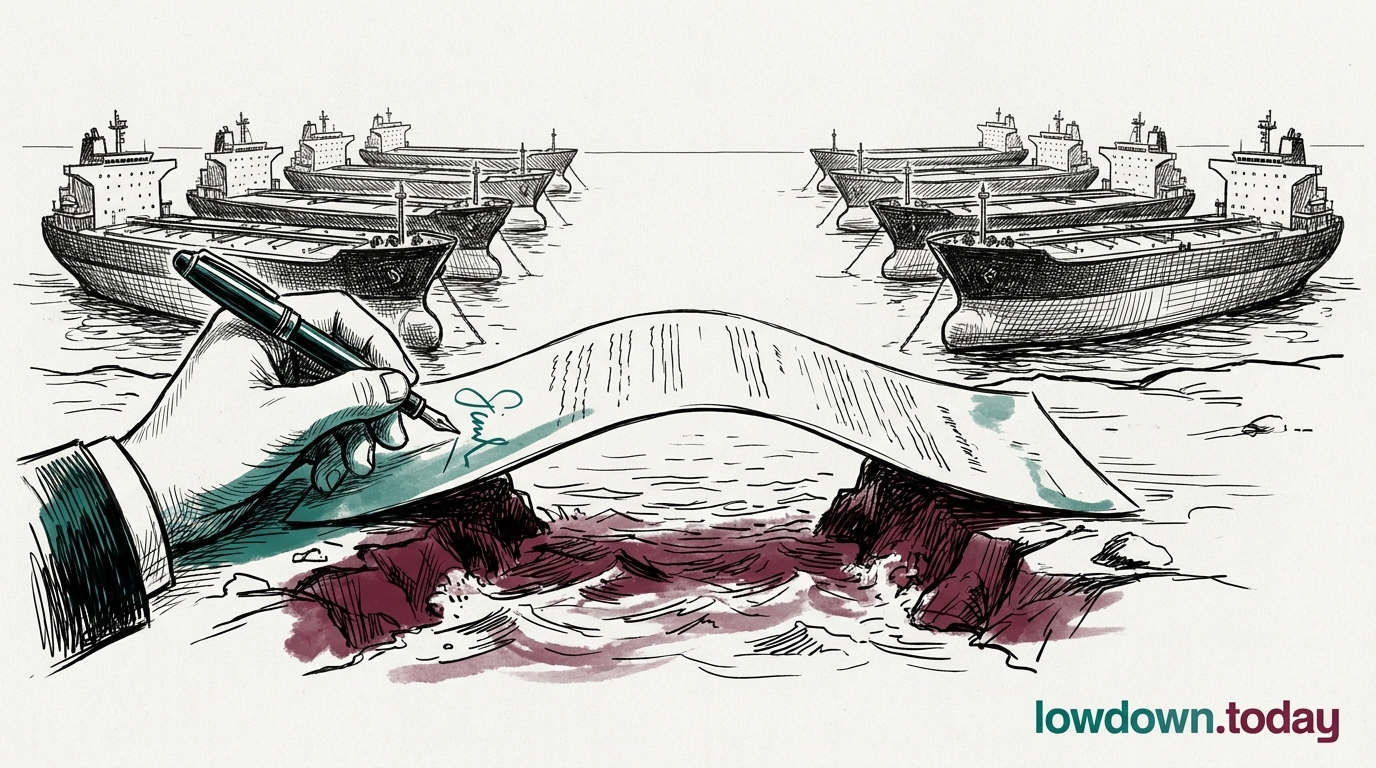
Foreign Minister Abbas Araghchi told Sultan Haitham in Muscat on Sunday and Vladimir Putin in St Petersburg on Monday that Tehran will reopen the Strait of Hormuz before any nuclear settlement. The Trump administration rejected the framing the same day.

ConflictDeveloping
Key takeaway

Iran offered Hormuz reopening before any nuclear deal; Washington rejected the framing and produced no counter-text.

Abbas Araghchi, Iran's Foreign Minister, told Sultan Haitham in Muscat on Sunday 26 April and Vladimir Putin in St Petersburg on Monday 27 April that Iran will reopen the Strait of Hormuz before any nuclear settlement, decoupling two tracks Tehran's prior position had bound together . The State Department rejected the framing the same day, with officials telling the Associated Press the Hormuz proposal 'doesn't address the core issue' of nuclear weapons 1. Pakistan now holds a written three-phase Iranian text that sequences Hormuz reopening and the lift of the US blockade first; nuclear talks come 'later' .

The Strait of Hormuz carries roughly a fifth of seaborne crude and a third of LNG; the blockade Tehran has run since the IRGC closure on Day 1 is what Brent has been pricing for sixty days. Tehran's prior position, held since the Islamabad round collapsed, bound the strait to nuclear so that any de-escalation produced both at once. The text now in Pakistan's hands separates them. Iran is offering to lift the blockade without first locking in the nuclear settlement Trump has named as his only public condition for ending the war.

The sequencing mirrors the Joint Plan of Action Iran and the P5+1 signed in November 2013, which front-loaded reversible enrichment caps so that an instrument could be signed without resolving final-status weapons questions; that architecture later ratified the 2015 deal. The 2026 offer has the same shape. The Trump administration has not staffed a final-status negotiating team, has signed no Iran executive instrument across sixty days and has produced no counterpart text. The War Powers Resolution clock corrected on 22 April runs out at 12:01 EDT on Friday 1 May; three days from close on Tuesday.

A counter-reading is worth flagging: the IRGC controls the strait, so the offer's operational delivery is uncertain and may be theatrical, designed to put rejection on Washington's record while protecting the nuclear file. The structural shift survives that critique. Iran's prior text linked the two files; the text now in Pakistan's hands separates them. Whether Tehran would deliver is one question; whether Tehran has rewritten the deal on offer is a separate one, and on the second question the answer is yes.


Deep Analysis

In plain English

Iran has offered to reopen the world's most important oil shipping lane without waiting for a nuclear deal first. Previously, Iran said nuclear talks and the strait had to be resolved together. The White House said no, because it wants the nuclear issue settled first. Three days remain on the legal clock that started the war.

Deep Analysis
Root Causes

The Hormuz-first offer emerged from a structural constraint inside Tehran, not from diplomatic generosity. Araghchi's civilian track cannot deliver nuclear concessions because nuclear authority sits with Mojtaba Khamenei and the IRGC. The Foreign Ministry can only offer what it controls: the diplomatic framing around Hormuz. Separating the strait from nuclear talks is therefore the only concession the Foreign Ministry can make unilaterally.

The White House rejection reflects a parallel structural constraint: without a staffed National Security Council Iran policy process , vacant since Witkoff and Kushner's Pakistan trip stood down on 25 April , accepting the Hormuz-first framing would require the President personally to sign an instrument with no interagency review behind it. The administration has not produced that kind of Iran paper in 60 days.

What could happen next?
  • Consequence

    Pakistan now holds a written three-phase Iranian ceasefire text with no US counterpart instrument to receive it; if 1 May passes empty, the text's value depreciates as a negotiating anchor.

    Immediate · 0.85
  • Risk

    European Northwood Hormuz framework becomes the operational default if no US instrument arrives before 1 May, embedding European legal preferences (UNCLOS transit passage, NATO proportionality doctrine) as the baseline.

    Short term · 0.75
  • Precedent

    Iran's written separation of Hormuz from nuclear tracks gives any future US administration a structurally easier entry point: accept the 2026 text as the interim phase rather than reopening from zero.

    Medium term · 0.7
First Reported In

Update #82 · Iran writes Phase 1; Washington still has no pen

PBS NewsHour· 28 Apr 2026
Read original
Different Perspectives
Lloyd's Market Association
War-risk underwriters price the Houthis' Red Sea attacks because the group announces its targets in advance, but the unclaimed Damietta drone gives insurers a hit with no author to price against. An attack nobody claims costs shipping more than one that is claimed, since premiums are set against a known pattern, not raw damage.
US Central Command
US Central Command
CENTCOM has announced no strike on Iran since resuming bombing on 30 July within hours of an IRGC salvo on Jordan, and centcom.mil did not respond to requests to confirm any pause. The command has gone quiet before while a larger operation was being weighed, so silence alone proves nothing about what it has or has not done.
Hengaw
Hengaw
Hengaw recorded at least 67 executions in Iran during July, of which the state acknowledged only eight, and reported the 1 August execution of protest detainee Arvin Kheirkhahan at Shahrud with no advance notice to his family. A family's first notice of a death sentence is now usually the instruction to collect a body.
Egypt
Egypt
Egypt's government asked media on 2 August to report the Damietta attack accurately, named no author, and said no findings will be published before its own investigation concludes. Cairo holds the debris and jurisdiction over an attack on its own soil, and naming a culprit now would pull it into a dispute it has avoided for five months.
Iran's Foreign Ministry
Araghchi called the Hormuz talks with Oman final-stage on 2 August, four days after his own deputy rejected Oman's lane proposal, and denied the Damietta drone strike as an Israeli false flag while two Iranian officials privately claimed it for Tehran. Iran's public position now contradicts itself on both files at once.
Bahrain and Kuwait
Bahrain and Kuwait
Bahraini and Kuwaiti aircraft flew their own strikes on Iranian depots in July with Emirati air cover behind them, and Ynetnews reports some Gulf capitals wanted the 2 August strike to proceed rather than stop. States that have already taken fire see a closing window on Iranian weakness, not a reason to pause.



