
Skip to content
Briefings are running a touch slower this week while we rebuild the foundations.See roadmap
Iran Conflict 2026
26MAY

Day 88: US strikes Bandar Abbas as deal talk stalls

3 min read
08:44UTC

CENTCOM bombed Iran's main naval base hours after Iranian negotiators met Qatari mediators in Doha, and on the day Tehran's foreign ministry called the deal 'not imminent'. Brent bounced 1.63% to $98.83 while Lloyd's held its Hormuz war-risk designation. Five Gulf states told the IMO to shun Iran's transit route, and the draft accord gained a Lebanon clause Netanyahu opposes.

Key takeaway

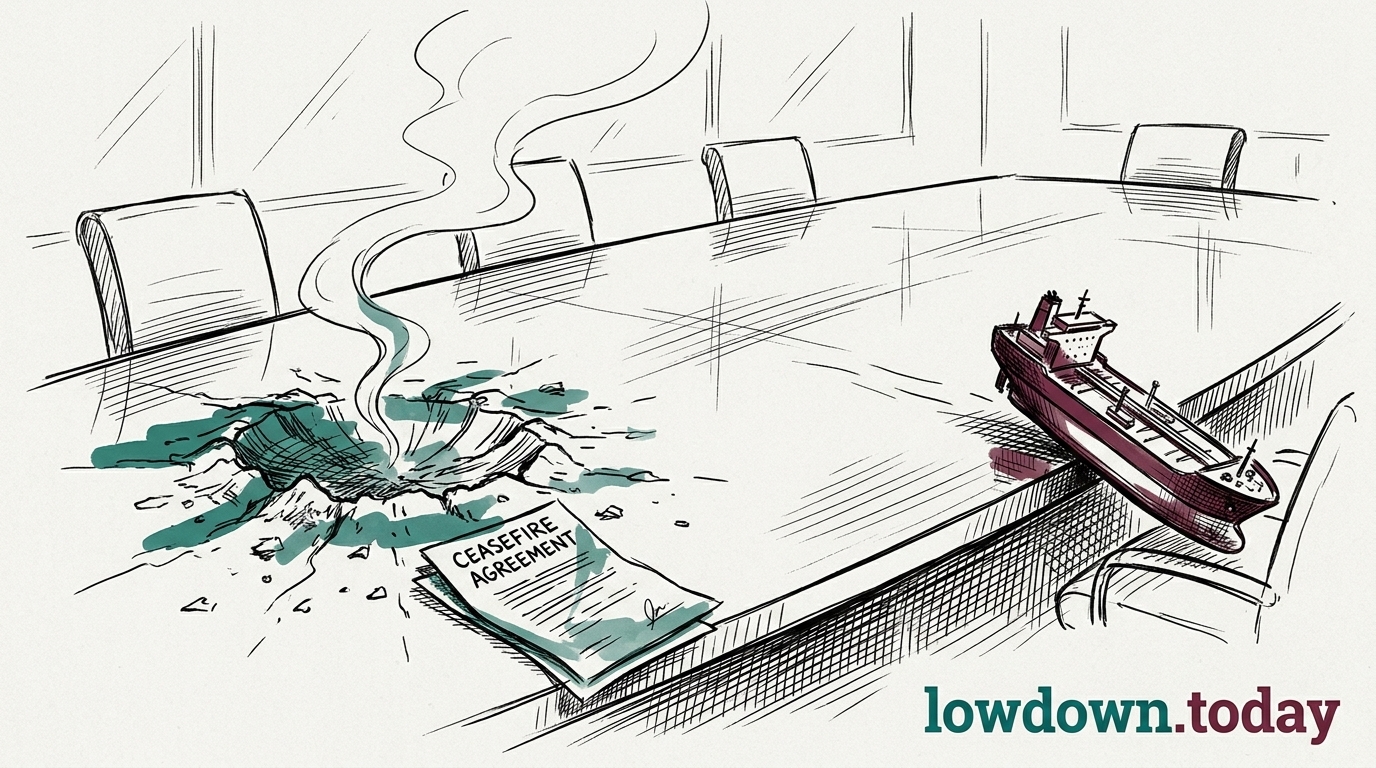
Strikes and talks ran simultaneously because neither government's military chain consults its own diplomats.

This briefing mapped
Loading map…
Military
Diplomatic
Economic
Domestic

CENTCOM struck Iran's largest naval base on Monday 25 May, eliminating two IRGC mine-laying boats in the Strait of Hormuz hours after Iranian negotiators sat with Qatari mediators in Doha.

Sources profile:This story draws on mixed-leaning sources from United States
United States
LeftRight

US forces struck Iran's Bandar Abbas naval base on 25 May. They destroyed two Islamic Revolutionary Guard Corps (IRGC) mine-laying boats in the strait of Hormuz and a surface-to-air missile battery. US Central Command called the action defensive. Ceasefire talks in Doha continued the same morning.

Iran's mine-laying boats answer to the IRGC chain; its diplomats answer to the Foreign Ministry. Both operated simultaneously because US Article 2 self-defence doctrine requires no signed ceasefire to authorise a strike. 

Iranian negotiators sat with Qatari mediators in Doha on Monday 25 May as Tehran's foreign ministry told reporters a deal was 'not imminent', the two messages arriving the same morning.

Sources profile:This story draws on mixed-leaning sources from United States
United States
LeftRight

Iranian negotiators met Qatari mediators in Doha on 25 May while foreign ministry spokesman Esmail Baghaei told reporters that a deal was not imminent. Both things were real: the talks continued as the Bandar Abbas strikes ran.

Iran runs two tracks by design. Baghaei's public denial managed domestic audiences who would read a rapid deal on the day the naval base was bombed as a humiliation. The Doha channel kept the option alive. 

Sources:CBS News·CNN

Brent crude rose 1.63% to $98.83 on Tuesday 26 May as the Bandar Abbas strike put a risk premium back into oil, while Lloyd's of London left its Hormuz war-risk designation unchanged.

Sources profile:This story draws on neutral-leaning sources

Brent Crude rose 1.63% to $98.83 on 26 May after the Bandar Abbas strikes repriced oil risk. Lloyd's of London kept the strait of Hormuz war-risk designation unchanged; Western ships still pay $10-14 million extra per voyage in insurance.

Futures traders reprice on headlines in minutes. Lloyd's Joint Hull Committee needs a signed government document or a UN Security Council resolution before it can act; neither exists for Hormuz. The insurance floor will not lift until someone signs. 

Bahrain, Kuwait, Qatar, Saudi Arabia and the UAE wrote formally to the UN's maritime regulator around 21 May, telling commercial vessels not to use Iran's Hormuz transit route.

Sources profile:This story draws on centre-left-leaning sources from United States
United States
Sources:Bloomberg

A clause ending the Israel-Hezbollah war in Lebanon entered the draft US-Iran accord, and Israeli Prime Minister Benjamin Netanyahu objected to it directly to Trump in a call on Sunday 24 May.

Sources profile:This story draws on left-leaning sources from United States
United States
LeftRight
Sources:CNN
1 CNN

Iran says it holds an initial draft accord relayed via Pakistan and is waiting on the United States' final counter-text, inverting the Western framing of who is holding up the deal.

Sources profile:This story draws on mixed-leaning sources from United States
United States

Iran told state-linked media on 26 May that it holds the initial draft peace agreement from Pakistan's mediation and awaits the US counter-text. Marco Rubio's earlier promise of "good news in hours" had slipped to "a couple of days".

By presenting itself as waiting, Iran assigns blame for any delay to Washington, exploiting Trump's claim that the deal was "largely negotiated". Pakistan's army-chief channel now carries the critical text, not the Doha civilian track. 

Sources:CBS News·SNN.ir

Marco Rubio publicly named the turnover of highly enriched uranium as a US deal criterion on Sunday 24 May; an Iranian official denied any such agreement the same day.

Sources profile:This story draws on mixed-leaning sources from United States
United States

Marco Rubio said on 24 May that Iran agreed to hand over its highly enriched uranium (HEU). An Iranian senior official denied it to Reuters the same day. A third US broadcaster reported Iran agreed in principle. Three accounts of one clause ran simultaneously.

The draft says Iran agreed to "negotiate" HEU removal. Rubio read that as removal agreed; Iran read it as Phase 2 discussion. Mojtaba Khamenei has already ordered the 540 kg stockpile to stay inside Iran

Sources:CBS News·Ecoiran

Mohammad Sarafraz, a member of Iran's Supreme Council of Cyberspace, disclosed on 23 May that Chinese deep packet inspection hardware had already arrived in the country.

Sources profile:This story draws on centre-right-leaning sources from United Kingdom
United Kingdom

Mohammad Sarafraz, a member of Iran's Supreme Council of Cyberspace, confirmed on 23 May that Chinese Deep Packet Inspection (DPI) hardware had arrived in Iran. DPI reads encrypted traffic at the network layer, enabling selective blocking without a total shutdown.

Iran wants a system like China's 2009 Xinjiang lockdown: block encrypted messaging and censorship-bypass tools while leaving banking running. Total internet shutdowns cost Iran over one billion dollars cumulatively; the DPI model eliminates that cost. 

Closing comments

Direction: sideways with a contained downside risk. CENTCOM's Bandar Abbas strike precedent from Operation Praying Mantis (April 1988) showed Iran absorbing targeted naval strikes without widening the war; the IRGC's 60% small-boat survival rate and Mosaic Defence architecture make a symmetrical retaliatory strike costly but available. The 48-72 hour window of IRGC communications will indicate which template is active. The specific mechanism that tips escalation upward is an IRGC retaliatory strike against a US vessel or Gulf state target within the Strait; that would collapse the Doha channel, push Brent toward the $112.10 conflict high, and trigger Lloyd's war-risk repricing before any ceasefire paper exists. The specific mechanism that tips it downward is a US executive counter-text to the MOU via Pakistan before the War Powers Resolution wind-down expires 1 June, producing the first signed Iran instrument of the conflict and giving Lloyd's the document it requires.

Different Perspectives
United States (CENTCOM / White House split)
CENTCOM struck Bandar Abbas under Article 2 self-defence on 25 May while Rubio's timeline slipped from hours to days and Trump posted the blockade holds until a deal is 'certified and signed'. Two institutions answer to different legal authorities with no signed Iran instrument constraining either.
Iran (Foreign Ministry / IRGC split)
Iran's Foreign Ministry sent negotiators to Doha and told reporters the deal was 'not imminent' the same morning IRGC provincial commanders emplaced mines that CENTCOM then struck. Tehran's civilian and military chains do not coordinate; Fars dismissed Trump's 'largely negotiated' framing as 'inconsistent with reality' while the Doha channel stayed open.
Israel
Israel
Prime Minister Netanyahu called Trump on 24 May to object that the Lebanon war-end clause inside the draft MOU would force Israel to wind down its campaign against Hezbollah. His objection gives Jerusalem an effective veto over text Washington and Tehran had otherwise largely settled, without Israel being a party to the deal.
Qatar
Qatar
Doha hosted Iranian negotiators, holds $12 billion in frozen Iranian assets Tehran has named as a Hormuz precondition, and signed the five-Gulf-state IMO letter rejecting Iran's PGSA transit route on the same week. Qatar cannot release the assets without a Washington order and cannot credibly claim neutrality after the IMO signature; it is covering both outcomes rather than bridging them.
Saudi Arabia
Saudi Arabia
Riyadh signed the IMO letter rejecting Iran's Hormuz toll system and requested Trump stand down the 19 May strike alongside the Qatari Emir and UAE President. Saudi Aramco has already warned that Hormuz normalcy is delayed to 2027; at $87 per barrel as Riyadh's budget breakeven, every month of war-risk insurance premium erodes the fiscal cushion the crown prince requires.
China
China
Chinese DPI hardware arrived in Iran for a tiered censorship system, while China's NFRA ordered state banks to halt new lending to five sanctioned refiners after GL V expired. Beijing is simultaneously exporting surveillance infrastructure to Tehran and adjusting sanctions exposure to US pressure.