Skip to content
You can now search across every topic, entity and event.What's new
European Oil Markets
16JUL

Gulf producers build around the strait

3 min read
09:39UTC

Kuwait said it would raise production as Iraq's Kirkuk-Ceyhan and Saudi Arabia's Yanbu East-West pipelines moved roughly 9 million barrels a day around Hormuz, against the strait's normal 20 million.

EconomicDeveloping
Key takeaway

Gulf pipelines route about 9 million barrels a day around Hormuz, under half the strait's normal flow.

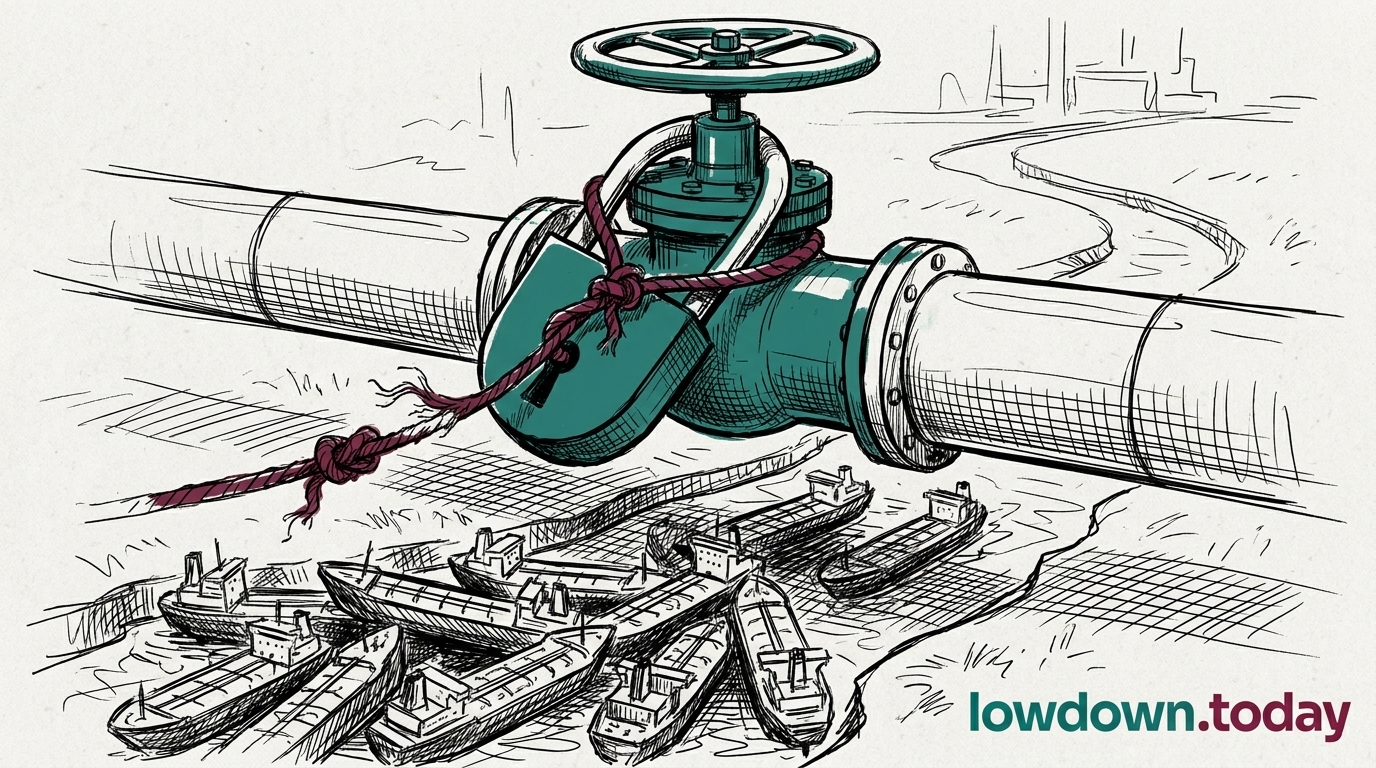
Kuwait said it would begin increasing production, and Gulf exporters drew on pipeline routes that skirt the strait of Hormuz entirely: Iraq's Kirkuk-Ceyhan line to Turkey's Mediterranean coast and Saudi Arabia's Yanbu East-West line to the Red Sea 1. Both run crude out to open water without touching the waterway the IRGC has formally declared closed.

The two pipelines carry roughly 9 million barrels a day between them, against the strait's normal 20 million 2. Producers can route under half their oil around Iran's leverage, which is why a closure threat still bites even as the workaround keeps prices calm: the alternatives soften the chokepoint without replacing it.

Three Saudi very large crude carriers reactivated their transponders off Oman on 19 June, the first confirmed commercial crossings since the closure declaration 3. Days earlier those same ships had only been positioned near Hormuz, not transiting ; by 22 June they were moving cargo across the closure line itself, turning a structural hedge for Riyadh and Baghdad into a live one.


Deep Analysis

In plain English

While Iran claims to have closed the Strait of Hormuz, Gulf oil producers have been routing crude through two alternative pipelines that avoid it entirely. One runs from Iraq's Kirkuk oilfields north to Turkey's Mediterranean coast; the other crosses Saudi Arabia from east to west, ending at the Red Sea port of Yanbu. Together these carry roughly 9 million barrels a day. The problem is that this is less than half of what normally goes through Hormuz (about 20 million barrels a day). So the world can get some oil out of the Gulf via these pipelines, but not nearly enough to replace what would normally flow through the strait. That is one reason energy prices remain elevated even as they fall from their peak.

What could happen next?
  • Consequence

    The 9 million barrels per day pipeline ceiling means Asian refiners dependent on Gulf crude face a persistent supply gap until the Oman corridor delivers full restoration; Kuwait's production increase partially offsets this but at reduced margin given sub-$80 Brent.

  • Precedent

    Saudi Aramco's resumption of VLCC transits through the Oman corridor, using AIS transparency rather than dark shipping, establishes a Gulf-producer norm for Hormuz reopening: producers will transit when the route is physically safe, regardless of IRGC declaration status.

First Reported In

Update #135 · Trump's threats peak, his paper stays blank

Wikipedia / Kpler· 22 Jun 2026
Read original
Different Perspectives
Indian refiners
Indian refiners
Indian refiners kept lifting discounted Urals as the India/Baltic price split widened past $9-10 a barrel, a gap that only grows as GL X1's Iranian wind-down cuts an alternative discounted grade off the market by 17 July. Cheaper Russian feedstock is being locked in while it lasts.
Chinese refiners
Chinese refiners
Chinese refiners gain leverage as the Urals-Brent discount widens, since Beijing's state buyers already source discounted Russian barrels near the fiscal floor unaffected by Western insurance costs. A wider discount, if it holds past 23 July, lets them lock in cheaper term contracts regardless of the cap's outcome.
US money managers (CFTC-tracked)
Managed money trimmed WTI net length into the rally, positioning that reflects doubt the Hormuz premium survives without freight or war-risk confirmation. The Brent-WTI spread widening almost entirely on the Brent leg supports that scepticism about a broad-based repricing.
OPEC+ (Saudi-led subgroup)
Saudi Arabia is defending market share through a fourth straight 188kbd August hike even as OPEC's own July MOMR cut 2026 demand growth for the fourth consecutive month. At a $108-111 fiscal breakeven, every added barrel costs Riyadh revenue it cannot recoup, so the hike reads as a positioning signal, not a demand bet.
Greek shipping registries
Greece, backed by Cyprus and Malta, is pushing a three-month cap-freeze compromise against the Commission's freeze to January 2027 ahead of the 23 July vote. Athens' and Valletta's combined tanker registrations mean a shorter review gives their insurers more frequent chances to reprice risk on Russian cargoes.
Russia (Deputy PM Alexander Novak)
Novak extended the diesel export restriction to producers on 8 July, the first producer-binding curb of the war, protecting the domestic pump price ahead of any refinery repair timeline. Urals still trades below Russia's $59 budget floor even as Brent gained, so the ban trades export revenue for fiscal stability at home.