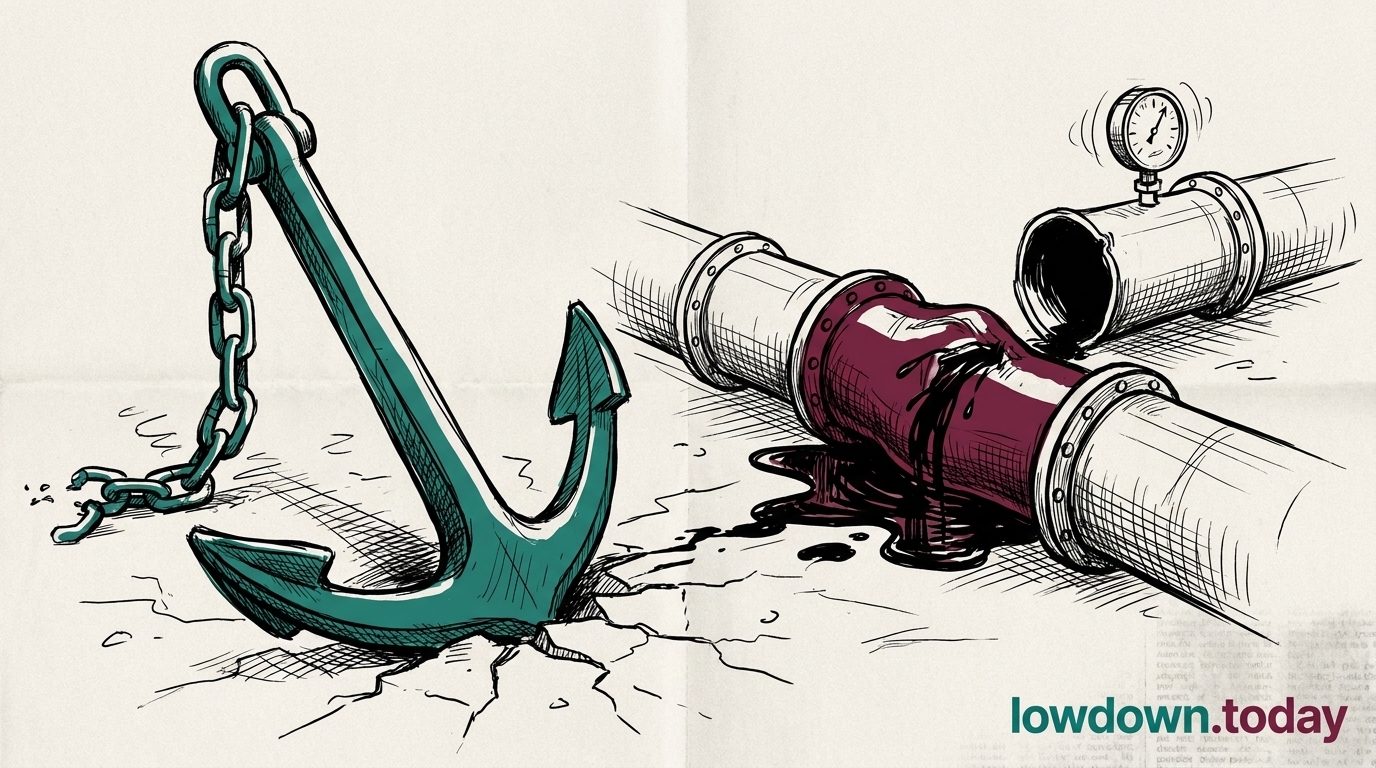
The Brent-Dubai EFS (glossed once: Exchange of Futures for Swaps, the standard spread instrument between the two crude benchmarks) sat above $6 per barrel through 4 to 8 May 2026, against a pre-Iran-conflict baseline below $2 per barrel1. The freight leg confirms it. TD3C (the 270,000-tonne VLCC route from the Middle East Gulf to China) was assessed at WS458.75 on 11 May 2026, a round-trip TCE of $462,102 per day, up roughly 50 WS points week-on-week from the previous Monday's WS408.13 and $407,437 per day2. The Baltic Dirty Tanker Index reached an all-time high above 1,900 points, +120 per cent year-on-year.
Hormuz transit remained physically disrupted weeks after the 17 April ceasefire. Mine clearance and port infrastructure repair were unfinished, and Iran ran the strait as a bilateral state-to-state passage system through mid-May, codified publicly by Foreign Minister Abbas Araghchi. The US Navy's Operation Project Freedom, announced on 4 May to escort merchant traffic out of The Gulf, drew Iranian warnings that the mission breached the ceasefire. A 5 May exchange of fire pushed Brent back to $114.44 per barrel intraday before the market settled. The war mechanics belong to a different topic; the spread and the freight spike sit here.
The EFS-TD3C relationship is the cleanest live measurement of the cost of disruption. EFS above $6 implies a $4 to $5 per barrel freight increment per tonne is being priced into Gulf crude bound for Asia; the WS458 print confirms the freight leg. Until both compress together, the conflict premium is in the system regardless of nominal ceasefire status. Med sour grades pick up the marginal Asia-bound demand, and Brent prices accordingly.
Underneath the spread sits a quieter demand-side leg. Vessels rerouting around the Cape of Good Hope are reportedly burning an extra 1,000 to 1,400 tonnes of bunker per trip, and roughly 50 VLCCs already rerouted since late February imply 50,000 to 70,000 tonnes of incremental marine distillate demand. Against an ARA gasoil base of 13.56 million barrels, that is 3 to 4 per cent of total stock, and largely absent from mainstream coverage that frames the draw as a refinery-supply problem.




