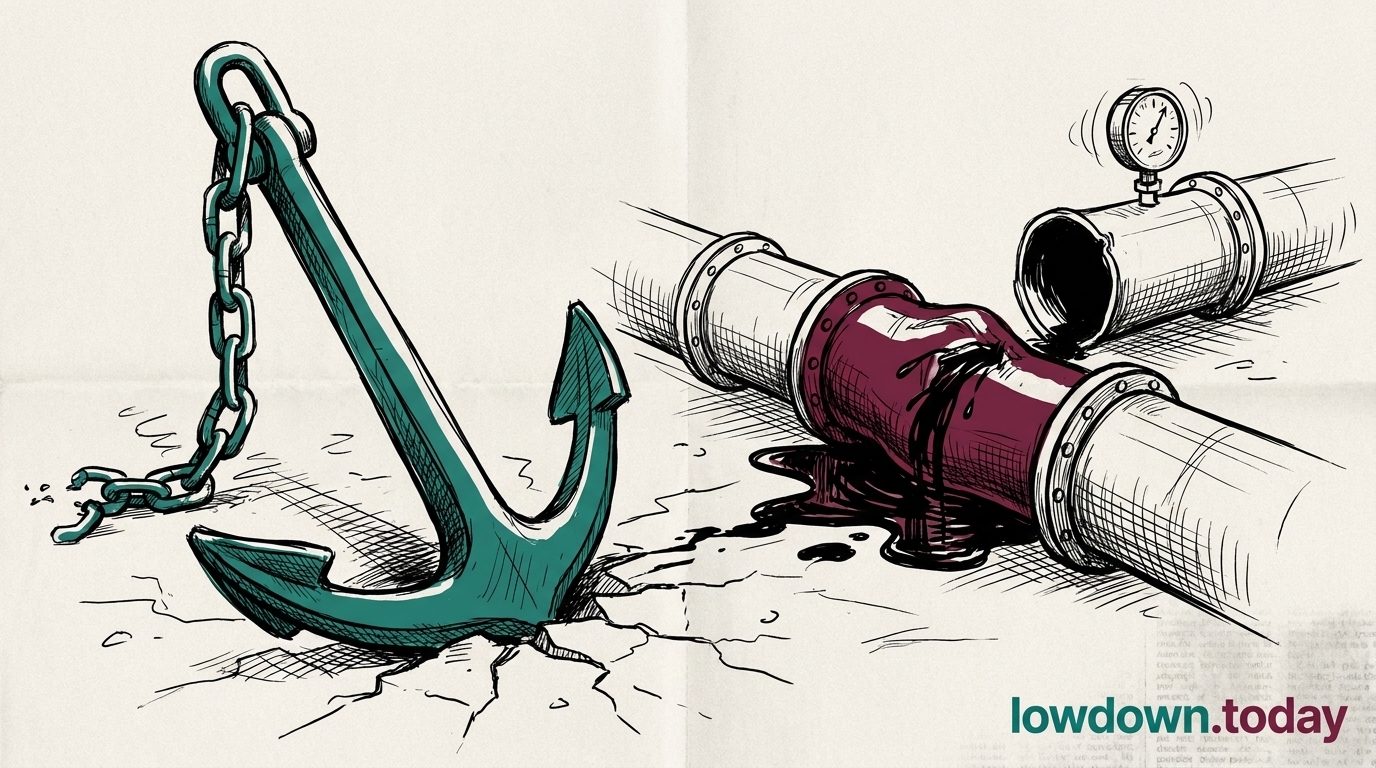
The Druzhba pipeline's southern leg restarted in late April 2026, restoring approximately 175,000 to 200,000 barrels per day of sanctions-exempt pipeline crude to MOL and Slovak refiners1. With Urals FOB at roughly $76 per barrel and Brent above $100 per barrel through early May, the pipeline-delivered feedstock cost advantage versus Northwest European seaborne peers reached roughly $40 per barrel, the widest divergence between landlocked Central European refiners and their NWE competitors on record in the sanctions era.
The legal architecture matters. Druzhba is an explicit carve-out from the EU's Russian crude embargo, granted in 2022 to Hungary and Slovakia on infrastructure grounds. Pipeline crude is exempt from the G7 price cap, exempt from the maritime services restrictions, and unaffected by the GL 134B lapse because no third-country completion or vessel-services chain is involved. The IEA flagged Russian pipeline export volumes up 36 per cent in the period as the parallel refinery-strike campaign cut domestic consumption. MOL now processes pipeline crude at a feedstock cost European peers cannot match and pockets the spread.
Druzhba southern flows resumed at full tilt the same week OFAC let GL 134B expire to tighten compliance pressure on seaborne Russian flows. The carve-out, designed in 2022 as a transition allowance for Hungary and Slovakia, has become a permanent competitive moat as the cap framework has degraded around it. Both governments have repeatedly used the carve-out as leverage in Brussels, and the May print gives them a fresh $40-per-barrel reason to keep doing so.
For the intra-European refining margin map, the consequence is that MOL sells refined product into a Continental market priced off ARA gasoil at multi-year-low stocks while running on a crude feedstock 40 per cent cheaper than its peers. The divergence between landlocked and seaborne refiners has stopped being a transition artefact and started behaving like a structural feature.




