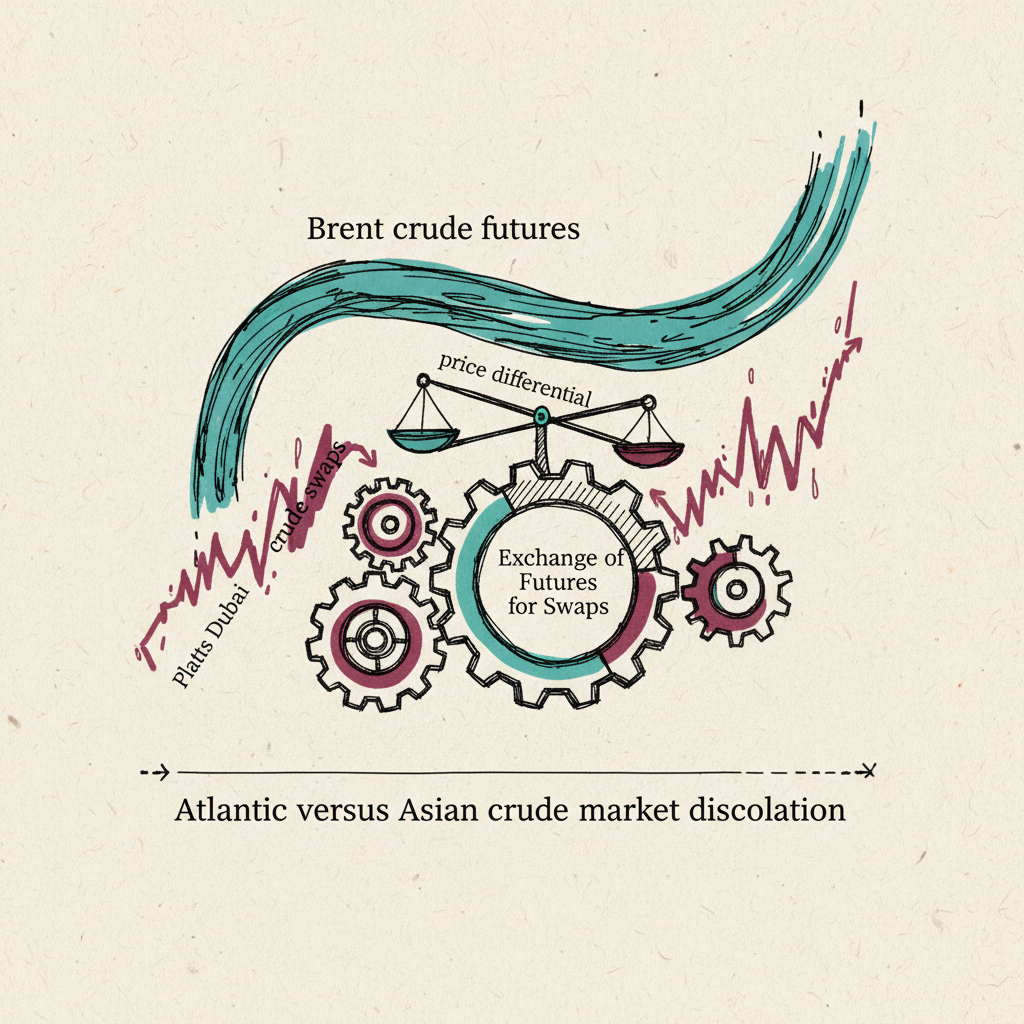
Brent-Dubai EFS
Brent-Dubai EFS: relative-demand gauge between Atlantic and Middle Eastern crude grades; compresses on Asian demand collapse, widens on Hormuz risk.
Last refreshed: 10 July 2026 · Appears in 1 active topic
Why did the EFS compress if Hormuz is still disrupted?
Timeline for Brent-Dubai EFS
Mentioned in: Brent-WTI gaps to $5.13 on Hormuz
European Oil MarketsStood at $4.24 on 8 July, still unconfirmed by dated freight for 10-13 July
European Oil Markets: Freight has not confirmed the spikeWidened 21% day-on-day to $4.24 a barrel
European Oil Markets: Hormuz risk lifts the Brent-Dubai EFSMentioned in: Brent-WTI blows out as price sits still
European Oil MarketsBrent whipsaws as spreads ignore deal
European Oil MarketsBackground
The Brent-Dubai Exchange of Futures for Swaps (EFS) measures the price difference between ICE Brent futures, the light-sweet Atlantic benchmark, and Platts Dubai assessments, the medium-sour Gulf benchmark underlying most Middle Eastern official selling prices. A positive EFS means Brent trades above Dubai. A wider positive EFS signals that Atlantic crude is relatively more expensive than Gulf crude, which incentivises Asian refiners to prioritise Gulf loading and pulls VLCC demand from the TD3C route, so the EFS and freight rates move together. The EFS, TD3C freight and the Baltic Dirty Tanker Index trade as a correlated system: the EFS is the upstream demand signal, TD3C is the freight expression, and BDTI is the aggregate dirty tanker read.
The EFS jumped roughly 21% day on day to $4.24 a barrel on 8 July as Strait of Hormuz risk reasserted itself, following IRGC vessel strikes on 6-7 July and a CENTCOM strike on 8 July. That reflation is still only about a fifth of April's $21 peak, so the spread is confirming renewed risk rather than repeating it.
The move follows a compression from the EFS's $6-plus peak of 4-8 May 2026 back towards the $2-3 band by late May, a level it held through the failed 18 June US-Iran MOU, when Brent whipsawed from $77.73 to $80.57 without the EFS re-widening. That confirmed the market had declined to price the full Hormuz premium on a single failed negotiation. The May compression tracked a collapse in Chinese seaborne crude imports to 6.78 million barrels a day, the lowest May print in almost a decade.
The July reflation now pulls against the OPEC+-driven Brent-WTI narrowing that dominated the first week of the month, and it lands while an AIS-dark corridor discovered in late June continues to move barrels outside tracked channels regardless of what the EFS is reading on demand. If Asian buying revives while Hormuz risk stays elevated, the spread can re-widen sharply on the same freight-and-arb mechanics that drove the May peak.
Is the Brent-Dubai EFS back at its April 2026 peak?
Why did the Brent-Dubai EFS jump in July 2026?
Did the Brent-Dubai EFS widen again after the Iran MOU?
How does the Brent-Dubai EFS affect tanker freight rates?
Why did the Brent-Dubai EFS compress in late May 2026?
Why did the Brent-Dubai EFS widen above $6 in 2026?
How does the Brent-Dubai EFS relate to the OPEC+ Brent-WTI trade?
What is the Brent-Dubai EFS and why does it matter?
Written with AI from Lowdown's published reporting. Not individually reviewed by an editor. Updated 10 July 2026. Editorial standards.