Skip to content
You can now search across every topic, entity and event.What's new
European Energy Markets
31JUL

Trump extends Lebanon ceasefire three weeks

3 min read
09:44UTC

Donald Trump extended the Israel-Lebanon ceasefire by three weeks to around 15-16 May following a second round of direct ambassador-level Washington talks. The extension is the only publicly signed Trump de-escalation instrument of the war.

EconomicDeveloping
Key takeaway

Lebanon is off the clock; Iran's WPR deadline now stands alone on 1 May.

Donald Trump on Thursday 23 April extended the Israel-Lebanon ceasefire by three weeks to approximately 15-16 May, following the second round of direct ambassador-level Washington talks 1. The extension is the only publicly signed Trump de-escalation instrument of the war; zero Iran-specific instruments remain signed across 55 days.

The extension takes Lebanon off the near-term calendar. It also isolates the War Powers Resolution clock, now dated 1 May on the 2 March congressional-notification reading, as the single paper-driven deadline Washington still has to meet on the Iran portfolio. The Lebanon track was the fallback explanation cited during the earlier buffer-zone dispute when Benjamin Netanyahu's "Yellow Line" demand threatened to bleed Israeli posture into the Iran front.

Process matters here because the Lebanon talks ran through a channel Washington has never formally opened on Iran. Ambassador-level direct discussion, mediated by the US and convened in Washington, produced a paper outcome that The White House signed. The same institutional infrastructure does not exist for Iran because the Pakistan channel carries a financial hinge through Saudi Arabia's $3 billion debt assistance and Vice President JD Vance's postponed Islamabad trip remains unscheduled.

The structural implication is that Trump's willingness to sign paper tracks the availability of a credible counterparty at his own table. For Lebanon, Hezbollah's operational weakness and Beirut's financial distress produced terms The White House could endorse. For Iran, the counterparty is distributed across Mojtaba Khamenei's handwritten courier chain, Ahmad Vahidi's IRGC and Abbas Araghchi's foreign ministry, and no single signature from Tehran would bind all three.


Deep Analysis

In plain English

The Israel-Lebanon ceasefire, which was due to expire around 26 April, has been extended by three more weeks to approximately 15 May. Trump agreed to the extension after a second round of direct, ambassador-level talks in Washington about the two countries' dispute over a 10km buffer zone along the border. The extension matters for the Iran war because Iran's Lebanese ally, Hezbollah, had been a potential wildcard: if Lebanon's ceasefire collapsed, it could have opened a second front on Israel's northern border at the same time as the Iran conflict. The extension takes that risk off the table for three weeks, but the underlying border dispute that caused the ceasefire tension is not resolved.

What could happen next?
  • Consequence

    Decoupling the Lebanon deadline from the Iran WPR 1 May clock removes Hezbollah as a potential Tehran pressure instrument for at least three weeks, narrowing Iran's available escalation options outside Hormuz.

First Reported In

Update #78 · Allies flagged, adversaries listed, nothing signed

US Congress Record· 24 Apr 2026
Read original
Different Perspectives
Spain's LNG terminal operators
Spain's 9,145 GWh terminal inventory is the largest single stock in the EU LNG network, an option value that can reroute cargoes wherever the winter strip pays best rather than a cavern gas obligation tied to a fixed date. That flexibility matters more as Germany's cavern shortfall pushes more of the winter security question onto import infrastructure.
European Commission
European Commission
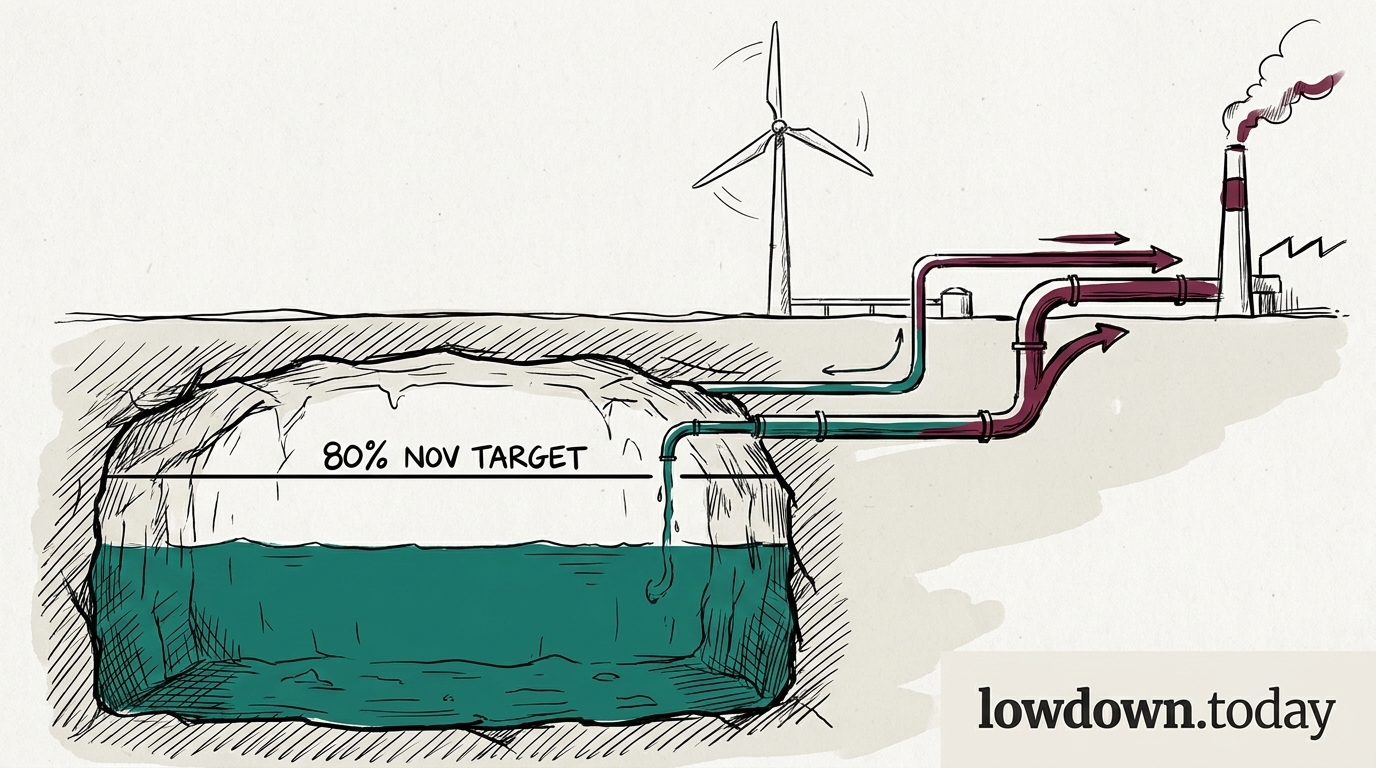
Brussels holds the bloc to 90% on a flexible window while Germany, holding roughly a quarter of EU storage capacity, tracks toward missing its own lower 80% figure by 21 points. A national shortfall this size in the anchor market matters more to bloc security than the flexible timetable alone can absorb.
French power exporters and CRE
French day-ahead rose in step with Germany but by less, reopening a EUR 7-17 premium that makes northward export flows commercially attractive again after the EUR 43.09 discount evaporated in days. CRE separately authorised RTE and Enedis to buy flexibility locally, betting the coming winter's binding constraint is grid congestion rather than a shortage of firm capacity.
TTF trading desk
TTF trading desk
A visible national shortfall like Germany's 21-point gap is a directional signal, not noise, for a desk holding the summer-winter spread. TTF's flat EUR 58-60 range through this week's German price swings says the market has not yet chosen to reprice refill risk into the front of the curve.
German cavern and CCGT operators
German caverns kept buying prompt gas at TTF near EUR 58-60 through the inversion; the wind collapse to 2.4 GW then flipped the spark spread to plus EUR 29 and put turbines back in the same queue. Every day turbines win that bid, injection at a third of the 877 GWh/day pace needed falls further behind.
Slovakia
Slovakia
Slovakia says it dropped its hold-out on the 21st sanctions package only after Ursula von der Leyen personally signed written gas-price and supply guarantees. The Council of the European Union's own 17,238-character release on the package names neither Slovakia nor any guarantee, leaving Bratislava's account unconfirmed by the institutional record.



