Skip to content
You can now search across every topic, entity and event.What's new
European Energy Markets
31JUL

Israeli strikes kill 14 north of Litani

3 min read
09:44UTC

Israeli airstrikes killed at least 14 people in southern Lebanon on Sunday 26 April, the most severe escalation since the 16 April truce. The IDF ordered seven Lebanese towns north of the Litani River to evacuate.

EconomicDeveloping
Key takeaway

Fourteen dead and seven evacuation orders north of the Litani put active combat under a technically intact ceasefire.

Israeli airstrikes killed at least 14 people in southern Lebanon on Sunday 26 April, the deadliest single day since the truce Donald Trump brokered on 16 April took effect 1. Lebanese health authorities counted civilians among the dead; Al Jazeera logged the strikes across multiple villages south of the Litani River. The Israel Defence Forces simultaneously issued forced-evacuation orders for seven Lebanese towns north of the Litani, beyond the 10-kilometre buffer zone that has structured the truce since 16 April. Trump extended that ceasefire on 23 April through to 15-16 May .

The Litani River runs roughly thirty kilometres inland and has functioned since the United Nations Interim Force in Lebanon (UNIFIL) deployed under Security Council Resolution 425 in 1978 as the historical northern edge of the southern-Lebanon security zone. Pushing displacement beyond the Litani is not a buffer-zone operation; it is a move toward the river the original UNIFIL mandate marked as Israel's withdrawal line. The 2024 IDF operational template that pushed civilian populations north before kinetic operations is the recent precedent. Evacuation orders north of the Litani prefigure the geography of any subsequent ground push.

Hezbollah said it would not stand down on Israeli forces inside Lebanon while Israel continues 'ceasefire violations'. The IDF has not withdrawn from the buffer. Both sides claim the other broke first, which is the form a ceasefire takes when neither party has signed a published text. Trump's extension on 23 April was a unilateral US announcement, not a bilateral instrument; the truce holds because the parties have not formally renounced it, not because either is performing under it. Fourteen confirmed dead and seven evacuation orders translate to active combat in everything but name. The Lebanese Armed Forces are not a party to the buffer's enforcement; UNIFIL has not been authorised to intervene against either side.

The wartime arithmetic has shifted. Trump's next extension cliff sits at 15-16 May, three weeks after the killings. Either the administration produces a written successor framework before then, or the de-facto ground operation north of the Litani becomes the documented one.


Deep Analysis

In plain English

Israel is bombing southern Lebanon and ordering civilians to leave towns even further north than the area covered by the recent ceasefire. At least 14 people were killed on Sunday. The ceasefire technically still exists but the fighting has resumed at a lower level. The river called the Litani has been the historical boundary , Israel telling civilians to leave towns north of that river suggests it may be preparing to send in ground troops.

Deep Analysis
Root Causes

The IDF has not withdrawn from the 10-kilometre buffer zone established in the April ceasefire, which means Hezbollah's refusal to stand down is legally grounded: neither side has complied with the truce's withdrawal architecture. The ceasefire text (a State Department publication) sets withdrawal timelines that Israel is not meeting, so Hezbollah retains the right under its own stated terms to resist Israeli forces inside Lebanon.

The structural driver is domestic Israeli politics: Netanyahu's governing coalition includes National Security Minister Ben Gvir and Finance Minister Smotrich, both of whom have made expanded Lebanese operations a public condition of remaining in government. Withdrawing to the buffer line would trigger a coalition crisis; staying north of the Litani escalates the civilian casualty count but preserves the coalition arithmetic.

What could happen next?
  • Risk

    If IDF ground operations cross the Litani River, Trump's 15-16 May Lebanon ceasefire extension becomes legally unsustainable, forcing either a renewed extension with conditions Israel cannot meet or a formal acknowledgement the ceasefire has ended.

    Short term · 0.72
  • Consequence

    Hezbollah's 'not standing down' posture while Israeli forces remain in Lebanon converts the ceasefire into a unilateral IDF posture; UNIFIL's rules of engagement give it no authority to intervene against Israeli operations north of the Litani.

    Immediate · 0.8
  • Risk

    Fourteen civilian deaths north of the buffer zone complicates any UN Security Council ceasefire extension resolution; Russia or China could use the casualty record as grounds to condition or veto a US-backed renewal.

    Short term · 0.6
First Reported In

Update #82 · Iran writes Phase 1; Washington still has no pen

Al Jazeera· 28 Apr 2026
Read original
Causes and effects
Different Perspectives
Spain's LNG terminal operators
Spain's 9,145 GWh terminal inventory is the largest single stock in the EU LNG network, an option value that can reroute cargoes wherever the winter strip pays best rather than a cavern gas obligation tied to a fixed date. That flexibility matters more as Germany's cavern shortfall pushes more of the winter security question onto import infrastructure.
European Commission
European Commission
Brussels holds the bloc to 90% on a flexible window while Germany, holding roughly a quarter of EU storage capacity, tracks toward missing its own lower 80% figure by 21 points. A national shortfall this size in the anchor market matters more to bloc security than the flexible timetable alone can absorb.
French power exporters and CRE
French day-ahead rose in step with Germany but by less, reopening a EUR 7-17 premium that makes northward export flows commercially attractive again after the EUR 43.09 discount evaporated in days. CRE separately authorised RTE and Enedis to buy flexibility locally, betting the coming winter's binding constraint is grid congestion rather than a shortage of firm capacity.
TTF trading desk
TTF trading desk
A visible national shortfall like Germany's 21-point gap is a directional signal, not noise, for a desk holding the summer-winter spread. TTF's flat EUR 58-60 range through this week's German price swings says the market has not yet chosen to reprice refill risk into the front of the curve.
German cavern and CCGT operators
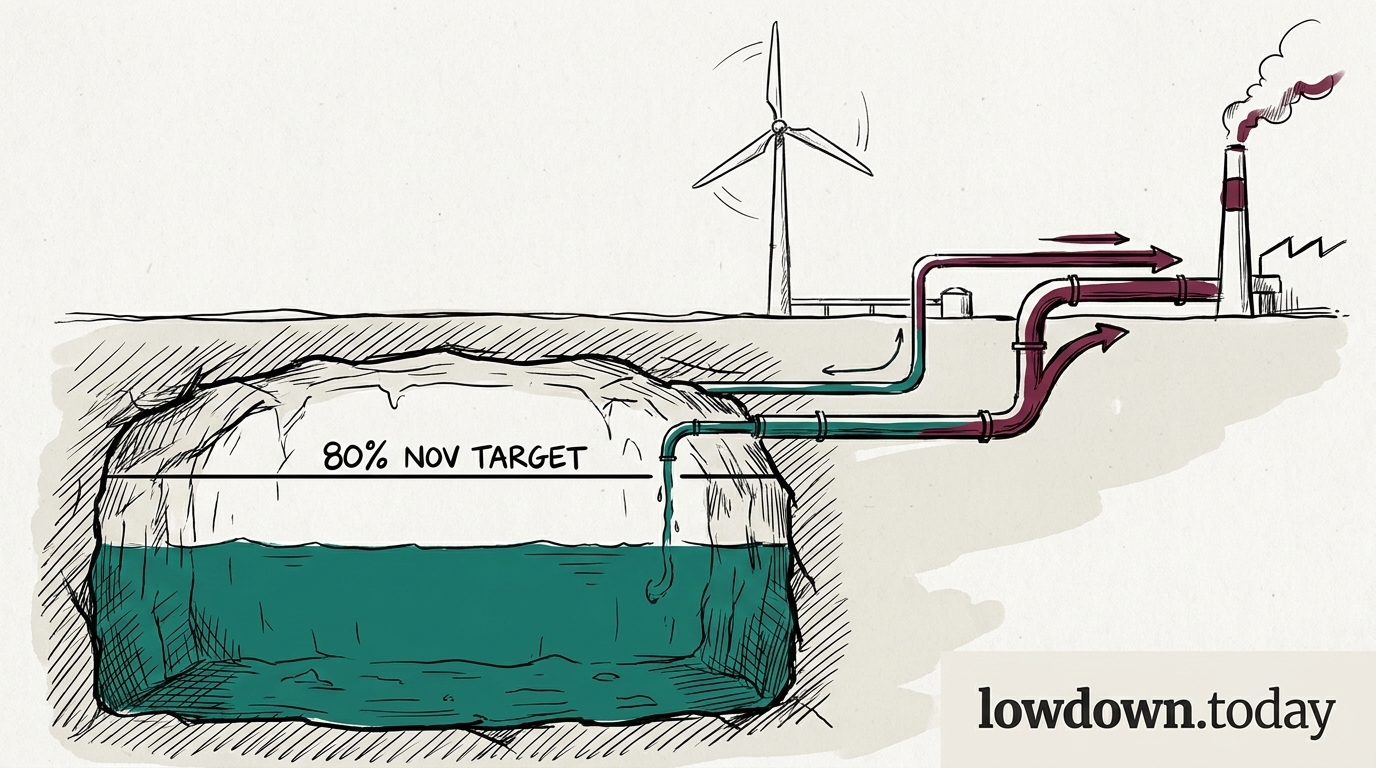
German caverns kept buying prompt gas at TTF near EUR 58-60 through the inversion; the wind collapse to 2.4 GW then flipped the spark spread to plus EUR 29 and put turbines back in the same queue. Every day turbines win that bid, injection at a third of the 877 GWh/day pace needed falls further behind.
Slovakia
Slovakia
Slovakia says it dropped its hold-out on the 21st sanctions package only after Ursula von der Leyen personally signed written gas-price and supply guarantees. The Council of the European Union's own 17,238-character release on the package names neither Slovakia nor any guarantee, leaving Bratislava's account unconfirmed by the institutional record.



